
Power press types differ by what drives the slide, and BEIGEMA builds all three under one category: the JB23 mechanical power press, introduced on its page as running “with high stroke frequency, runs fast and stably”; the APA pneumatic line, whose presses “use cylinders to power a slide”; and the Y32K four-column hydraulic press, built for “metal stamping, deep drawing, forming, and assembly”. This page compares the three by force, stroke, height and speed, model row by model row, and marks the hand-operated and hydro-pneumatic classes the catalog does not carry.
Every current model in all three lines is listed in the power press machine category.
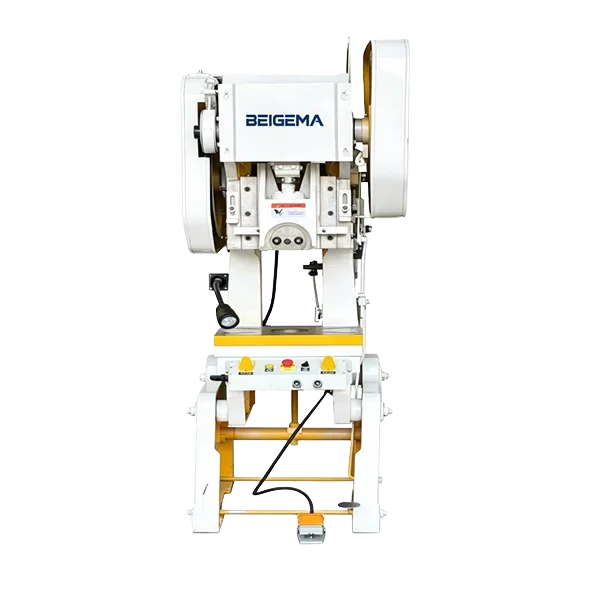
1. What Is a Power Press? Three Drive Types Compared
Power press machines exist for one job: pressing stock between a punch and a die — the APA page names “punching, shearing, piercing, and forming metal and plastic parts” as the work. What changes between the three BEIGEMA lines is how force reaches the slide, and each product page states it in its own words:
- Mechanical — the JB23 runs on mechanical drive at high stroke frequency, perfect, per its intro, for mass production of sheet metal parts.
- Pneumatic — the APA presses use cylinders powered by compressed air instead, with a clutch the page rates for fast response and high cycle rate on continuous stamping and automated feeding.
- Hydraulic — the Y32K drives its slide with oil, in a dual-speed design of fast travel and precise pressing, with single or multi-cylinder options.
Shops often call any of the three a punch press on the floor — the type that actually fits the job comes down to tonnage, stroke and cycle rate, not the name on the nameplate.
2. Mechanical Power Press: The JB23 Line for High-Speed Production
The JB23 Series mechanical power press is listed with semi-automation as its mode and max 250T as its capability. Table sizes run from the J23-10 at 100 kN and 130 strokes per minute up to the J23-250 at 2500 kN and 28 strokes per minute, with one differently-named row in between, the J21S-500 at 1000 kN and 43 strokes per minute.
Closed height — the space available for the die when the slide sits at the bottom of its stroke — runs 180 mm on the J23-10 up to 430 mm on the J23-250, and each size lists its own closed-height adjustment range on top of that (35 mm at the small end, 130 mm at the top) for shut-height fine-tuning. The spec table also carries a maximum tilt angle column: 35° on the J23-10 and J23-16, falling to 20° on the J23-63 and J23-80, and not listed from the J21S-500 upward.
Component-wise, the page credits the slide with built-in overload protection — a safety block that protects the machine from damage under overload — plus a precision guide for stamping accuracy, and the control cabinet supports single/continuous stamping mode switching and integrates with feeders and foot switches for semi-automatic and automatic production.
3. Pneumatic Power Press: APA for Light, High-Cycle Punching
The APA Series pneumatic punching machine comes in -V and -H versions at every size, and the spec table shows what each gives up for the other. On the 25-ton pair: the APA-25-V lists a 70 mm stroke with a 60–140 s.p.m. speed-changing range and no stable-speed figure; the APA-25-H lists a 30 mm stroke at 130–200 s.p.m. with a separate 110 s.p.m. stable speed.
Every row in the range also prints a rate tonnage point in millimetres, die height (195 mm on the APA-25-V up to 600 mm on the APA-400-H), slide adjustment, and a 6 kg/cm² air-pressure requirement across the whole line. Capacity runs 25 to 400 tons, and the pneumatic clutch section is the page’s own case for the type: modular design, fast response and high cycle rate, ideal for continuous stamping and automated feeding.
That combination of fast cycling and a defined tonnage point suits the punching, shearing, piercing and forming work the APA intro names — jobs that don’t need a mechanical press’s stroke rate or a hydraulic press’s forming depth.
4. Four-Column Hydraulic Press: Y32K for Forming and Deep Drawing
The Y32K Series four-column hydraulic press machine guides the slide on four columns between three beams, driven by a hydraulic master cylinder rather than a crank or air piston. Nominal force runs 630 kN on the Y32K-63 up to 8000 kN on the Y32K-800, with slide stroke growing from 500 mm to 1000 mm and maximum daylight — the open height available for loading and die changes — from 800 mm to 1800 mm across that same range.
Slide speed is listed in three stages — rapid approach, a slower working pass at 9–12 mm/s, and a faster return — plus an ejection force from 100 kN to 1250 kN for stripping formed parts off the die.
That constant, controllable force is what the Y32K page itself sells the frame on: precise pressure control for consistent part quality, for stamping, deep drawing, forming and assembly. For the frame-type map of the hydraulic class, see hydraulic press types.
5. Hand-Operated Presses vs the Three Powered Types
Hand-operated presses — arbor presses and fly presses — are not in the BEIGEMA catalog either, and none of the three power press families above is hand-operated. Entry tonnage starts at the smallest published steps of each line: the J23-10 at 100 kN, the APA-25 at 25 tons, and the Y32K-63 at 630 kN. If the job has outgrown a hand press, the metal punching machine types guide lays out the fuller field before committing to a powered machine.
6. Choosing by Tonnage, Stroke, Closed Height and Strokes per Minute
Picking between the three types starts with the part, not the catalog page. So what actually decides it? Four numbers: tonnage, the stroke length the die and part motion require, the closed or die height the tooling must fit inside, and the strokes-per-minute the production rate needs.
| Type / series | Drive | Force range | Slide stroke | Height reference | Speed |
|---|---|---|---|---|---|
| JB23 mechanical power press | Mechanical (J23 series) | 100–2500 kN (J23-10 to J23-250) | 50–200 mm | 180–430 mm closed height | 28–130 strokes/min |
| APA pneumatic power press | Air cylinder, V or H | 25–400 T (APA-25 to APA-400) | 30–250 mm | 195–600 mm die height | up to 200 s.p.m. speed-changing range |
| Y32K hydraulic press | Hydraulic cylinders, 4-column | 630–8000 kN (Y32K-63 to Y32K-800) | 500–1000 mm | 800–1800 mm max daylight | 9–12 mm/s working slide speed |
Evidence first: the JB23 and Y32K force ranges overlap from 630 kN to 2500 kN, so inside that band the choice comes down to stroke, cycle speed and forming depth, not force alone. Below 630 kN, the JB23 or the lighter APA sizes are the only options; above 2500 kN, only the Y32K reaches that force. Match stroke and closed height to the die next, then check strokes-per-minute against the production rate the job actually needs — the fastest number on the spec sheet isn’t always the one that matters.
The full method for turning a part drawing into a tonnage figure is in the power press selection guide; the frame map of the hydraulic class is in hydraulic press types, and every Y32K and JB23 tonnage row in the hydraulic press and power press tonnage chart.
Power Press Types FAQs
Mechanical JB23 or hydraulic Y32K: how do I choose for a punching job?
Compare tonnage first — the two lines overlap between 630 kN and 2500 kN. Inside that overlap, the JB23 page is the punching case: “with high stroke frequency, runs fast and stably. Perfect for mass production of sheet metal parts.” The Y32K wins when the job needs controlled force through a longer stroke, such as deep drawing or heavier forming. Send the part drawing, material and thickness and we’ll check both against the tonnage and stroke tables.
How do I confirm the strokes-per-minute rating on a pneumatic press quotation?
Check which figure is being quoted: the APA table lists a speed-changing range and, on H-version models, a separate stable-speed figure — the APA-60-H, for example, lists 80–120 s.p.m. changing against 65 s.p.m. stable, while the -V rows print a dash in the stable column. Confirm which one your job is being rated at, and check it against the material and thickness you’ll actually run.
Is a hydro-pneumatic press the same as an APA pneumatic press?
No — and hydro-pneumatic presses are not in the BEIGEMA catalog at all. The APA line runs on air cylinders (“Pneumatic punch presses use cylinders to power a slide”, per its own intro); the hydraulic side of the catalog is the Y32K four-column press. A job needing combined air-plus-oil drive sits outside what this site builds, and we’ll say so plainly if that’s your case.
Why would a mechanical power press slide fail to complete or return from a stroke?
One built-in cause is protection, not failure: the JB23 slide carries an overload protection safety block that “protects the machine from damage under overload” — a slide that stops rather than crashing can be that block doing its job. Send the model and when it happens and we’ll help narrow it down.
For deep drawing thin stainless panels, is a pneumatic or hydraulic press the better fit?
Deep drawing is named on the Y32K page as core work for the four-column frame — precise pressure control through the stroke, with the working pass listed at 9–12 mm/s. The APA pneumatic line is geared for punching, shearing, piercing and forming at high cycle rate, not sustained deep-draw force. Send the part depth, material and blank size and we’ll confirm which line fits.
Send the part drawing and tell us the material, thickness and tonnage you need through the BEIGEMA contact page, and we’ll point you at a JB23, APA or Y32K model — or say plainly if none of the three fits.


