
Plate Rolling Machine & Cone Rolling
BEIGEMA stands as a top manufacturer of plate rolling machines across China. We are renowned for solid brand strength, cutting-edge technical innovation and thoughtful customer support, with our products sold worldwide. Buyers know this machine as a plate rolling machine, a sheet metal roller or simply plate rolls — the same equipment, sized to your plate thickness and width.
As a plate rolling machine manufacturer and supplier, we customize and produce plate rolling and bending machines to meet diverse demands. From compact sheet metal rolling machines to heavy plate rollers, our equipment covers working widths from 200mm to 8000mm and processable material thickness from 0.5mm to 300mm. Our full product line includes 2-roll, 3-roll and 4-roll plate rolling machines (also called plate rolls or roll bending machines), section bending equipment, dished head straightening machines, as well as CNC control systems with tailor-made software solutions.
The range covers W11 3-roll machines (4-16 mm plate, 1500-3000 mm width), W11S upper-roller universal models (4-20 mm) and W12 4-roll machines rolling plate up to 50 mm thick with pre-bending to 40 mm, plus W24S and WYQ24 profile benders across 12 frame sizes from W24S-6 to W24S-500.
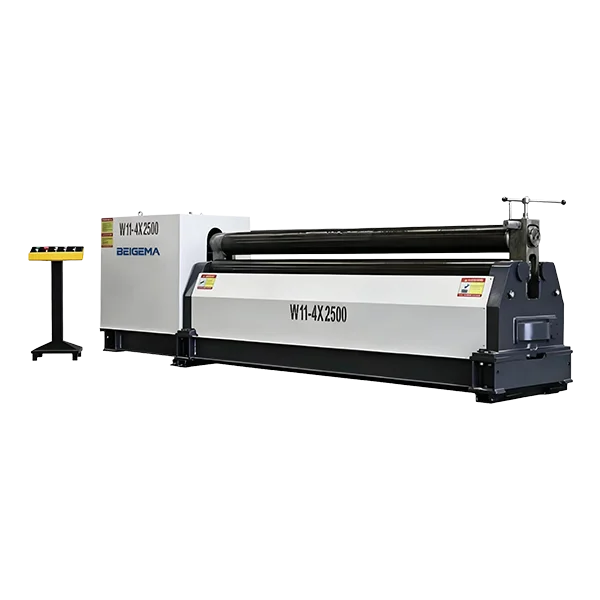
BEIGEMA Mechanical Three-Roll Plate Rolling Machine This cost-effective mechanical three-roll plate rolling machine is designed for rolling metal plates with thickness between 4mm and 40mm and working length from 1500mm to 4000mm. Featuring competitive pricing and practical performance, it is an ideal solution for businesses with low to medium production output.
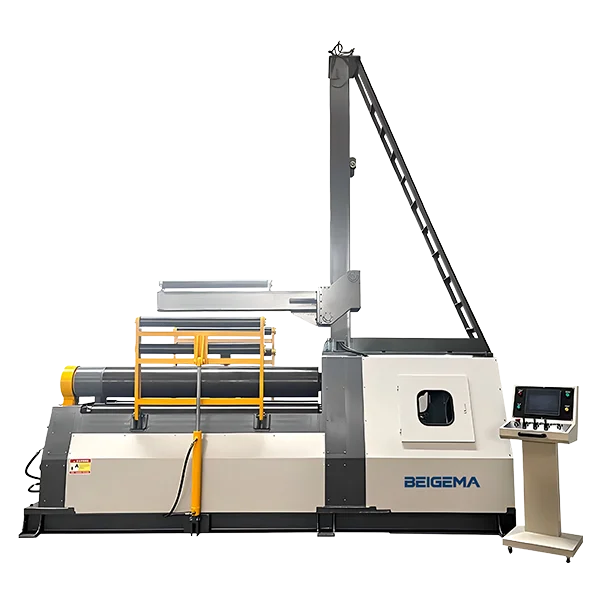
The W12 series four-roll hydraulic plate rolling machine completes pre-bending and circular rolling in one pass, with four rolls in a diamond arrangement for accurate and efficient plate rolling. Hardened 42CrMo alloy steel rolls, PLC control and Schneider electrics ensure stable long-term performance.
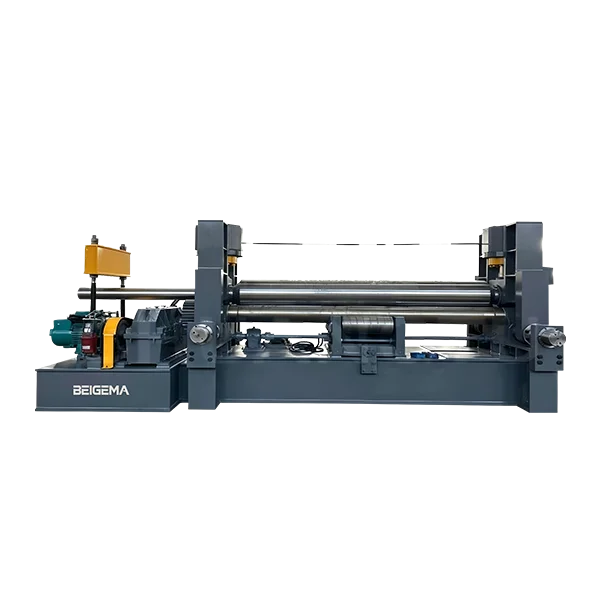
The W11S three-roll variable geometry plate roller brings notable strengths to your metal fabrication workflow. It features enhanced rolling capability, helping you cut down on procurement costs and daily running expenses. This model is an ideal investment for processing extra-thick plates over 80mm.
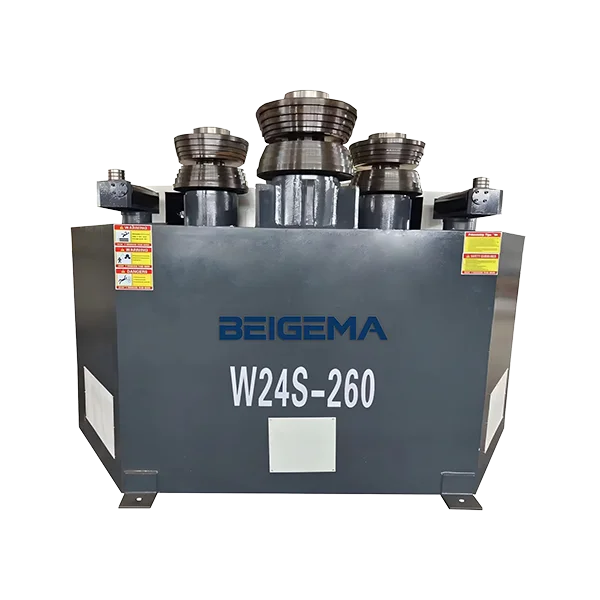
Profile bending machines are professional metal forming equipment designed for precision bending, rolling and arc forming of various section materials. Capable of processing angle steel, channel steel, I-beam, square tube, round tube and other profiles, these machines deliver uniform bending radian, high forming accuracy and stable finished quality.

Semi-hydraulic profile bending machines adopt a mature semi-hydraulic driving design, combining mechanical stability with hydraulic auxiliary power. This structure balances high forming precision and cost-effective performance, making it a popular choice for standard profile bending tasks.
It is widely applicable for bending various metal profiles such as angle steel, channel steel, square and round tubes. With stable output pressure, flexible angle adjustment and low failure rate, our semi-hydraulic profile benders deliver smooth arc forming and consistent workpiece quality. Featuring simple operation and low maintenance costs, they provide reliable and economical metal forming solutions for small and medium batch production in steel structure, construction and mechanical processing industries
Buying guide
About this range
Every machine is built to CE safety requirements and ships with a 24-month warranty, English interface and manuals, plus remote troubleshooting and commissioning guidance — the same package we have delivered to metal fabrication customers in more than 70 countries.
A W11S upper-roller plate rolling machine doubles as a cone rolling machine, and BEIGEMA also builds aluminum profile bending machines on the W24S and WYQ24 frames for angle, channel and tube work.
Which plate rolling machine fits your job?
A plate rolling machine is sized first by thickness × width at 245 MPa yield, then by pre-bend, then by plate versus section. Match thickness, width and roll diameter to a published range before you pick a frame.
A symmetrical 3-roll, an upper-roll universal, and a 4-roll plate bending machine do not leave the same flat on the same blank. Angle, channel and tube do not belong on a plate roll. Those jobs go to a section bending machine sized by section capacity, not by plate thickness.
Plate rolling range at a glance
Numbers below are BEIGEMA series ranges, not a single model. W11 and W12 rate thickness at 245 MPa. W11S does not list a yield figure in the same spec block.
| Series | Max thickness (mm) | Pre-bend thickness (mm) | Max width or section | Roll diameter (mm) | Power | Typical work |
|---|---|---|---|---|---|---|
| W11 3-roll | 4–40 | not published | 1500–3000 mm | Top 150–500; bottom 140–400 | 4–37 kW | Cylinders where leftover flats are acceptable; 4–5 m/min |
| W11S upper-roll | 4–50 | 3.5–40 | 2000–4000 mm | Top 200–630; bottom 125–340 | Drive 4–55 kW; hydraulic 2.2–22 kW; movement 1.1–11 kW | Pre-bent shells; wider plate |
| W12 4-roll | 4–60 | 3.5–48 | 2050–3100 mm working length | Top 160–670; lower 140–620; side 120–520 | 3–75 kW | Pre-bend in one clamping |
| W24S | — | — | Channel size 8–50; section size 38–160 | — | — | Angle, channel, tube; fully hydraulic |
| WYQ24 | — | — | Angle to 50×50×6 mm; round tube 60×1.5 mm; channel 50×25×5 mm | — | — | Light sections; half hydraulic |
Sizing by thickness, width and pre-bend
Rated thickness on W11 and W12 is at 245 MPa yield. Raise the yield and that rating does not hold: capacity falls, so step to a heavier model and apply material derating.
Where pre-bend is published, it sits below max rolling thickness: W11S 3.5–40 mm against 4–50 mm, W12 3.5–48 mm against 4–60 mm. The model that rolls 50 mm does not pre-bend 50 mm.
4 mm × 2 m, shortest remaining flat: 4 mm × 2000 mm fits the W11 3-roll symmetrical plate rolling machine (1500–3000 mm), W11S (from 2000 mm), and a W12 working length from 2050 mm. W11 publishes no pre-bend thickness; W11S and W12 both start pre-bend at 3.5 mm. Specify the four-roll W12 for the shortest flats and one clamping; skip W11.
16 mm × 2.5 m cylinder: 16 mm and 2500 mm sit inside all three plate windows. If leftover flats are acceptable, W11 can roll the shell at 4–5 m/min; if the shell must close, use W11S or W12 (pre-bend to 40 mm and 48 mm). It’s a geometry choice, and 3-roll vs 4-roll walks through it.
If the shell has to close with almost no remaining flat, why would you specify a machine that does not publish a pre-bend thickness?
40 mm × 2.5 m: 40 mm is the W11 thickness ceiling (W11-40×2500) and the W11S pre-bend ceiling (3.5–40 mm); W12 still has 60 mm rolling and 48 mm pre-bend, and 2500 mm width fits all three. For a closed 40 mm shell at 245 MPa, do not pick W11 if you need pre-bend; W12 is the series with headroom. If the plate is stronger than 245 MPa, leave W11 and size up inside W11S or W12 after derating.
Leftover flat ends come from the first bite. Minimum rolling diameter tracks top-roll diameter (W11 150–500 mm, W11S 200–630 mm, W12 160–670 mm). No spec block lists a minimum inside diameter (ID) per model.
Which machine, and which one to avoid
W11 3-roll symmetrical: Use it for cylinders at 245 MPa when a residual flat is acceptable (22 models, W11-4×1500 to W11-40×2500). It publishes no pre-bend thickness and is the only series here with a coiling speed (4–5 m/min). Do not pick W11 when you need short flats, when plate is thicker than 40 mm or wider than 3000 mm, or when the leftover flat would wreck the weld seam. Typical residual flat length is not on the spec sheet.
W11S upper-roll universal: Use the W11S series upper roller universal plate bending machine when you need pre-bend on wider plate (29 models, W11S-4×2500 to W11S-50×2500, top-roll pressure 25–540 tons). Do not pick W11S for structural profiles, for pre-bend above 40 mm, or for thickness above 50 mm. Do not pick it when you need a 1500 mm-wide model; published width starts at 2000 mm.
W12 4-roll: Use the W12 series 4-roller plate bending machine when pre-bend and one clamping matter (38 models, W12-4×2000 to W12-60×3000). Do not pick W12 when the plate is wider than 3100 mm (W11S goes to 4000 mm), when pre-bend exceeds 48 mm, when thickness exceeds 60 mm, or when the work is angle, channel or tube. Ovality, springback and surface marks still show up on an undersized frame.
W24S fully hydraulic: Use the W24S fully hydraulic profile bending machine for angle, channel and tube on a 12-model range (W24S-6 to W24S-500). Published windows are channel size 8–50 and section size 38–160; units for those fields are not stated on the spec block. Do not pick W24S to roll plate cylinders. Do not pick it when the section already fits the WYQ24 millimetre caps.
WYQ24 half hydraulic: Use the WYQ24 series half hydraulic profile bending machine when the section fits the published millimetre caps: flat bar 50×10 mm hard way / 80×15 mm easy way, square and round bar 30 mm, angle to 50×50×6 mm (also 40×40×5 and 35×35×5), round tube 60×1.5 mm, pipe 38×3 mm, square tube 40×40×3 mm, rectangular tube 50×30×3 mm, channel 50×25×5 mm. Size a profile bending machine by those sections, not by plate thickness. Do not pick WYQ24 for plate, for angle above 50×50×6 mm, for round tube above 60×1.5 mm, or for channel above 50×25×5 mm.
Roll diameters and drive power for both profile machines are not in the spec blocks.
The plate roll maintenance checklist sets out daily, weekly, monthly and yearly checks.
Before you request a quote
Send six facts. Missing one forces a guess on model.
- Material grade and yield in MPa. W11 and W12 thickness tables are at 245 MPa.
- Thickness in mm, body versus pre-bend pass.
- Plate width in mm, or section dimensions for profile work.
- Target finished inside diameter (ID). The spec does not publish a minimum ID per model.
- Pre-bend required or not, and cylinder versus cone. Cone rolling on a plate roll is a different setup; which of W11 / W11S / W12 ships cone tooling is not in the spec blocks.
- Pieces per shift or per month. Only W11 publishes a coiling speed (4–5 m/min).
FAQ
I have 4 mm × 2 m plate and I need the shortest flat ends. Which machine?
Specify W12 for 4 mm × 2000 mm when flats must be short. Skip W11; it has no published pre-bend.
I need a 40 mm × 2.5 m closed cylinder at 245 MPa. Which machine?
Use W12: 40 mm is the W11S pre-bend ceiling and W11 has no pre-bend. Derate and size up if yield is above 245 MPa.
Can the W11 replace a four-roll on production cylinders?
Only if leftover flats are acceptable. For closed shells, use W11S or W12.
My plate is stronger than 245 MPa. Do I still buy the 16 mm model?
No. W11 and W12 rate thickness at 245 MPa; step up after derating.
When do I leave the plate roll and buy a profile machine?
When the part is angle, channel, tube or bar, not a plate shell. WYQ24 holds the millimetre caps listed above; larger or fully hydraulic work goes to W24S (W24S-6 to W24S-500).
How do I choose between a 3-roll and a 4-roll plate rolling machine?
A plate rolling machine is sized by thickness times width at 245 MPa yield first, then by pre-bend, then by plate versus profile. BEIGEMA's range covers working widths from 200 mm to 8000 mm and thickness from 0.5 mm to 300 mm: W11 3-roll machines handle 4-16 mm plate at 1500-3000 mm width, W11S upper-roller universal models cover 4-20 mm, and W12 4-roll machines roll plate up to 50 mm thick with pre-bending to 40 mm.
Why does plate rolling leave a flat, unrolled spot near the ends of the part?
A flat end usually means the pre-bending step is undersized for the part, not that the roller is faulty. Pre-bending capacity runs below maximum rolling thickness on every BEIGEMA frame; a W12 that rolls plate up to 50 mm thick still pre-bends only up to 40 mm, so material near that ceiling needs a heavier model or a smaller pre-bend allowance built into the process before the final pass.
Does BEIGEMA supply profile bending machines for angle, channel and tube sections?
Yes. Alongside plate rolling machines covering 200-8000 mm width and 0.5-300 mm thickness at 245 MPa yield, BEIGEMA builds W24S and WYQ24 profile benders across 12 frame sizes from W24S-6 to W24S-500 for angle, channel and tube, sized by section capacity rather than plate thickness. Every machine ships with CE documentation and a 24-month warranty.
FAQ
1. What is the difference between a 3-roll and a 4-roll plate rolling machine?
A 3-roll plate rolling machine such as our W11 series uses a symmetrical mechanical design and is the most cost-effective option for general cylinder rolling. A 4-roll machine such as the W12 series clamps the plate between the top and bottom rolls and completes pre-bending and rolling in one pass, with four rolls in a diamond arrangement for higher accuracy and easier operation.
2. What plate thickness and width can BEIGEMA rolling machines handle?
W11 3-roll models roll plate from 4 mm to 16 mm thick at widths from 1500 mm to 3000 mm. W11S upper-roller universal models cover 4-20 mm. W12 4-roll models roll plate up to 50 mm thick with pre-bending up to 40 mm (plate yield limit 245 MPa). Send us your plate thickness, width and rolling diameter and we will size the right machine.
3. What is a profile bending machine used for?
A profile bending machine bends structural sections – angle steel, channel, flat bar and pipe – into arcs and rings. The fully hydraulic W24S series covers 12 frame sizes from W24S-6 to W24S-500 for different section capacities, while the semi-hydraulic WYQ24 series offers an economical option for lighter profiles.