
Hydraulic Press Brake & Sheet Metal Bending Machines
As a leading manufacturer specializing in sheet metal machinery, BEIGEMA holds a leading position in China’s press brake industry. The machine is known on the shop floor as a press brake, a sheet metal brake or simply a bending machine. We offer a comprehensive lineup of advanced bending machines, including NC, CNC, hydraulic, hybrid, and fully electric press brakes, each engineered with distinct performance strengths to suit diverse bending requirements. Beyond high-quality equipment, BEIGEMA focuses on delivering innovative, application-oriented solutions. We help customers boost production efficiency, optimize workflow processes, and achieve tailored manufacturing results. Our advanced CNC press brake technology empowers modern factories to streamline operations, improve consistency, and maximize overall production profitability.
Our press brake range runs from 40 tons x 2200 mm (WC67K) up to 500 tons x 6000 mm (MB8), with tandem configurations up to 2 x 500 tons for extra-long plates, and controller options from E21, TP10S and E310P to DELEM DA53T, DA-66S and DA-69S with up to 8+1 axes.
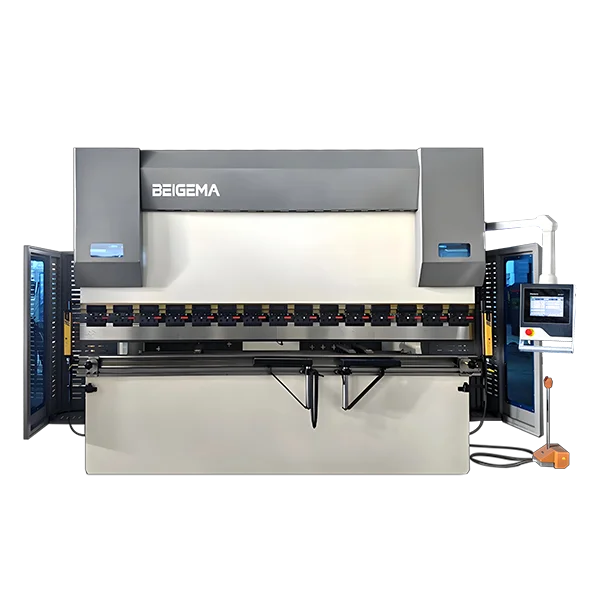
The MB8 series bending machine, equipped with the DA-53Tx control system and 3-6 axis back gauges, is specifically designed for precision sheet metal bending. The equipment features advanced technology, stable operation, and simple operation. It supports multiple die combinations, offers a high level of safety, and is economical in operating costs. The entire machine uses high-quality European clamping components, providing excellent bending performance and ease of use. The diverse die options adapt to different processing conditions, offering you professional and reliable bending solutions.
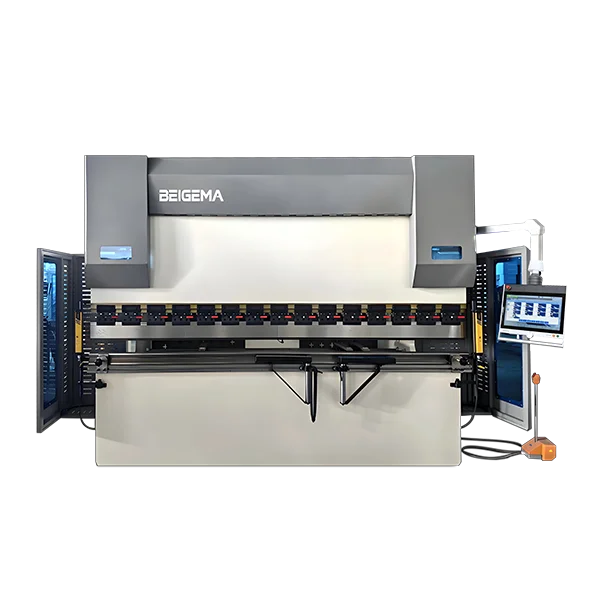
MB8 series high-spec CNC press brake is equipped with 6-8 axis back gauge and DA-66S controllers. Built with cutting-edge technology, it delivers outstanding efficiency for high-precision metal bending. The machine features intuitive control panels, solid machine frame and sophisticated overall design. It runs economically and boasts reliable performance among similar equipment. Fitted with premium European clamping mechanisms, it optimizes bending capacity while ensuring simple operation. A full selection of tooling is available to meet diverse production demands, and BEIGEMA is your dependable partner for sheet metal working.
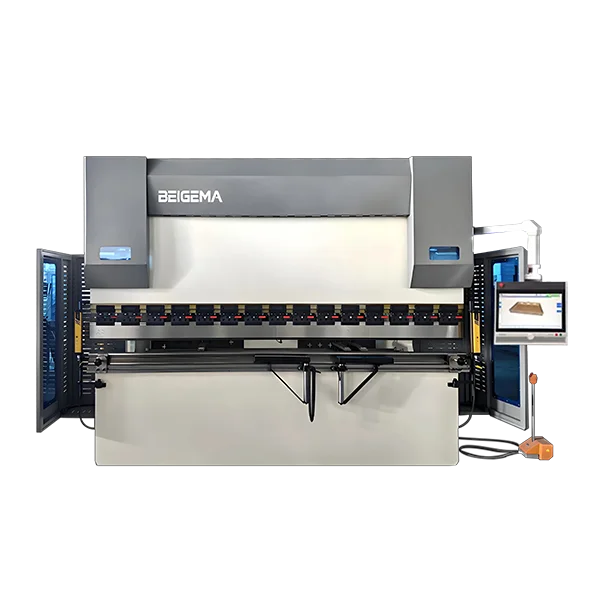
MB8 series high-spec CNC press brake is equipped with 6-8 axis back gauge and DA-69S controllers. Built with cutting-edge technology, it delivers outstanding efficiency for high-precision metal bending. The machine features intuitive control panels, solid machine frame and sophisticated overall design. It runs economically and boasts reliable performance among similar equipment. Fitted with premium European clamping mechanisms, it optimizes bending capacity while ensuring simple operation. A full selection of tooling is available to meet diverse production demands, and BEIGEMA is your dependable partner for sheet metal working.
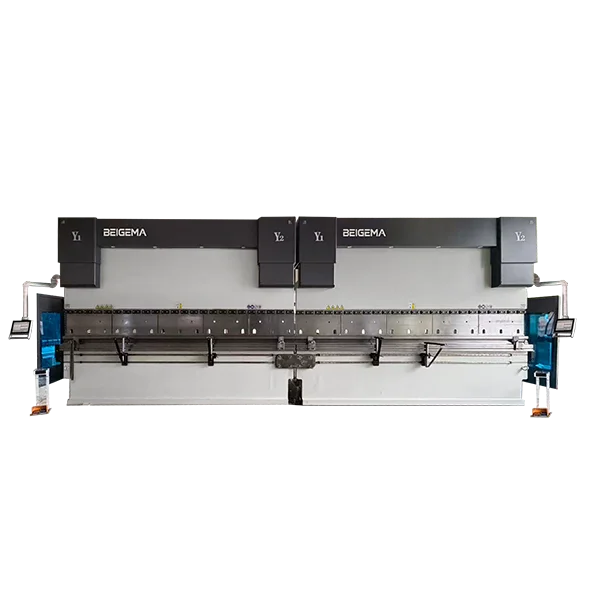
Tandem press brakes are the perfect solution for processing extra-long and wide sheet metal workpieces. This dual-machine system supports both synchronous linkage and independent operation. Compared with traditional single large bending equipment, it delivers higher working speed and superior forming quality. Choosing BEIGEMA tandem press brakes helps you cut down production time and significantly boost overall productivity, outperforming the use of separate small-sized press brakes.
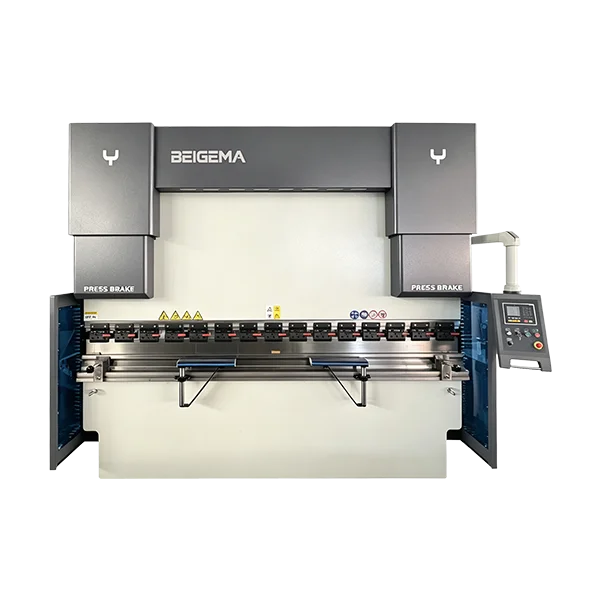
Our WC67K simple NC press brake fitted with E21 control system is ideal for general sheet metal bending tasks. It excels at precise bending work while keeping energy consumption low. Boasting intuitive operation, heavy-duty frame and well-optimized structure, the machine features high working efficiency and flexible tooling options. Compliant with strict CE safety regulations, it comes with cost-effective pricing and great overall value.
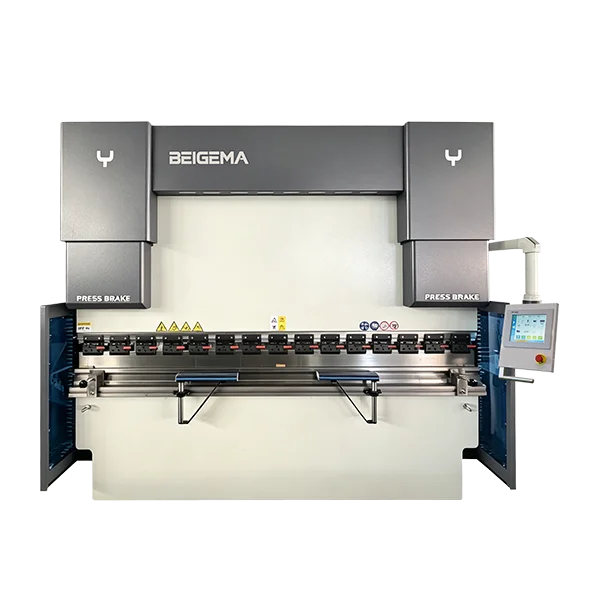
2-axis servo WC67K NC press brake fitted with TP10S controller enables accurate sheet metal bending with low energy consumption. It features rugged construction, user-friendly operation and versatile tool compatibility. Meeting strict CE safety requirements, this efficient bending machine offers superior cost performance.
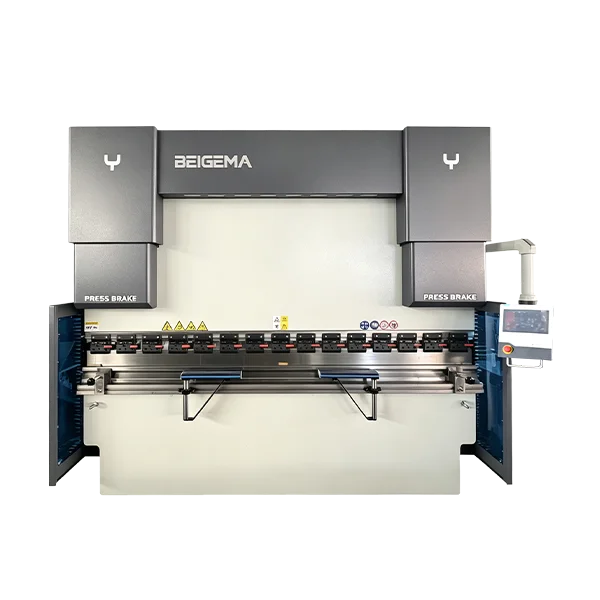
WC67K 2-axis servo NC press brake with E310P controller realizes accurate bending and low energy consumption. Built with solid frame and exquisite structure, it runs efficiently and is simple to operate. Compatible with various toolings and certified to CE safety regulations, it is a high-performance sheet metal bending equipment.

BEIGEMA has pioneered advanced hybrid drive technology for press brakes. Our ePp electric servo models cut energy use by 55% to 78% versus conventional bending equipment.
This eco-friendly hybrid design greatly lowers hydraulic oil consumption while retaining exceptional bending precision and stable working performance. It is an energy-saving and reliable solution for modern sheet metal processing.
Buying guide
About this range
For an initial capacity check, use the press brake tonnage calculator to estimate air-bending force from tensile strength, thickness, active bend length and V-die opening.
Every machine is built to CE safety requirements and ships with a 24-month warranty, English interface and manuals, plus remote troubleshooting and commissioning guidance — the same package we have delivered to metal fabrication customers in more than 70 countries.
Metal fabricators also search for these bending machines as a steel sheet bending machine or steel metal bending machine when comparing NC, CNC, hydraulic and electric press brake configurations.
Which press brake machine fits your job?
Which press brake machine fits a given job is a thickness × length problem first, then an axes and controller problem. The eight BEIGEMA units in this category are NC torsion-bar frames, CNC hydraulic frames, a pure-electric range, and a tandem pair range. Size the kN, then drop any series whose length, throat, opening, or axis count cannot take the part.
Worked loads use the air-bend formula on the press brake tonnage calculator: F(kN/m) ≈ 650 × t² / V, with 650 set for 450 MPa mild steel and V ≈ 8 × thickness. Thickness enters as t². Halve V and the force doubles. How to choose a press brake is the longer walkthrough; CNC vs NC press brake is the control split.
Press brake range at a glance
| Series | Pressure (kN) | Bending length (mm) | Throat (mm) | Opening or stroke | Axes or controller | Typical work from the listed range |
|---|---|---|---|---|---|---|
| WC67K + E21 | 400-6000 | 2200-7000 | 200-400 | Ram stroke 100-300 mm | E21 NC | Simple, repeatable NC bending at the lowest control cost; 30 models 40/2200 to 600/6000 |
| WC67K + TP10S | 400-6000 | 2200-7000 | 200-400 | Ram stroke 100-300 mm | TP10S NC, 2-axis servo | Same WC67K envelope with a 2-axis servo NC control |
| WC67K + E310P | 400-6000 | 2200-7000 | 200-400 | Ram stroke 100-300 mm | E310P NC, 2-axis servo | Same WC67K envelope; the third NC control option on this frame |
| MB8 DA-53Tx 4+1 | 630-12000 | 1300-10000 | 350-600 | Stroke 100-400 mm; opening 340-800 mm | DA-53Tx, 4+1 axis, touch operation | Entry CNC work with touch operation and up to four back-gauge axes |
| MB8 DA-66S 6-8 | 630-12000 | 1300-10000 | 350-600 | Stroke 100-400 mm; opening 340-800 mm | DA-66S, 6-8 axis | Same MB8 frame; 2D graphical programming, automatic sequencing and collision detection |
| MB8 DA-69S 6-8 | 630-12000 | 1300-10000 | 350-600 | Stroke 100-400 mm; opening 340-800 mm | DA-69S, 6-8 axis | Same MB8 frame; full 3D part programming and simulation |
| Pure electric | 350-1000 | 1350-3960 | 200-400 | Opening 430-525 mm; slider 180-250 mm | X 400-600 mm, R 200 mm | Servo-driven, 1.1-2.7 kW, 200 mm/s feed and return; six models 35T 1350 to 100T 3200 |
| Tandem | 2×2500-2×5000 (from 2×250T/4000 to 2×500T/6000) | 4000-6000 | 410-500 | Stroke 250-300 mm; opening 620-670 mm | Synchronized pair; controller not listed | Long plate on two frames; 14 models; machine mass 130-160 t |
Sizing by thickness and length
All three examples assume 450 MPa mild steel, air bending, and V = 8 × t. Stainless and high-strength grades need a material factor on top of 650. Put tensile and V into the press brake tonnage calculator rather than copying these kN values.
For 2 mm × 2 m at V = 16 mm, F = 650 × 2² / 16 = 650 × 4 / 16 = 162.5 kN/m, and 162.5 × 2 = 325 kN. The smallest pure electric press brake is rated 350 kN (range 350-1000 kN, length 1350-3960 mm), so the 35T class covers 325 kN. A WC67K with E21 starts at 400 kN and a 2200 mm table, which also covers a 2 m blank. Skip tandem: listed bending length starts at 4000 mm.
For 6 mm × 3 m at V = 48 mm, F = 650 × 6² / 48 = 650 × 36 / 48 = 487.5 kN/m, and 487.5 × 3 = 1462.5 kN. Pure electric tops out at 1000 kN, so you’ll need a WC67K or MB8 frame above 1462.5 kN. If the die V is 24 mm rather than 48 mm, force doubles to 2925 kN.
For 12 mm × 4 m at V = 96 mm, F = 650 × 12² / 96 = 650 × 144 / 96 = 975 kN/m, and 975 × 4 = 3900 kN. That is inside WC67K up to 6000 kN and MB8 up to 12000 kN, and outside pure electric. A tandem listing of 2×250T/4000 is 2500 kN per side, so 3900 kN is above one 250T ram .
Throat is the other hard stop after kN: WC67K and pure electric 200-400 mm, MB8 350-600 mm, tandem 410-500 mm, so a return flange deeper than 400 mm is already outside WC67K and electric. Column distance matters if a formed U must pass between the side frames: electric 900-2700 mm, MB8 1900-8000 mm, tandem 2700-5100 mm.
Which series, and which one to avoid
The three WC67K pages are the torsion-bar NC range (30 models, 40/2200 to 600/6000). Use that hydraulic press brake for stored single-angle work; do not buy it when throat must exceed 400 mm or the table must exceed 7000 mm. E21 is the lowest-cost control for simple, repeatable work; TP10S and E310P are the two 2-axis servo NC options on the same frame. Crowning is not in these spec rows, and 0.05 mm rear-gauge precision is published only on MB8.
The MB8 with DA-53Tx is the entry CNC press brake on 4+1 axes with touch operation, on the same 21-model frame as the other MB8 pages. Use 4+1 when up to four back-gauge axes cover the flanges. Do not pick it when the part needs more axes than that. Rear-gauge precision is listed at 0.05 mm.
DA-66S and DA-69S keep that MB8 envelope and 6-8 axes. DA-66S is 2D graphical programming with automatic sequencing and collision detection; DA-69S adds full 3D part programming and simulation (see the press brake controller comparison). Do you actually need full 3D part programming and simulation, or does 2D graphical programming with collision detection already run the cell? Skip both 6-8-axis pages if an NC X/Y controller already stores the bends, and skip DA-66S if simulation is a written requirement.
The pure electric press brake is six servo-driven models from 35T 1350 to 100T 3200 (350-1000 kN, 1350-3960 mm, 1.1-2.7 kW). It’s the low-kW bending machine for loads at or under 1000 kN. Do not use it for the 6 mm × 3 m example (1462.5 kN), or for beds longer than 3960 mm. The controller name is not on the spec row.
The tandem press brake is 14 synchronized-pair models from 2×250T/4000 to 2×500T/6000: listed length 4000-6000 mm, throat 410-500 mm, mass 130-160 t. Use it for long plate that needs two frames. Do not park a 2 m shop part on a 130 t line, and do not treat a 2×250T side (2500 kN) as enough for 3900 kN . The controller type is not listed.
Before you request a quote
Send six items with the RFQ. Material (grade and tensile, not just “steel”). Thickness range, minimum and maximum. Longest workpiece in mm, not the average blank.
Maximum workpiece weight, because sheet followers and back-gauge fingers are a separate choice on the press brake back gauge page. Bend angle and springback requirement; the 650 formula is air bend, not bottoming. How many back-gauge axes you will program, which also sets the tooling package.
If you need a published ram or angle repeatability, the MB8 row only lists rear-gauge precision at 0.05 mm. Name the press brake machine after those six inputs.
Can a 2 mm × 2 m mild-steel flange run on the smallest machine here?
Yes. 325 kN at V = 16 mm is below the pure-electric 350 kN floor and the WC67K 400 kN floor, so either series in its smallest listed model covers the load. A 2 m blank fits both beds; tandem listed length starts at 4000 mm, so skip it.
What if the job is 6 mm × 3 m, or a box with a deep side flange?
6 mm × 3 m at V = 48 mm is 1462.5 kN, above the pure-electric 1000 kN cap, so specify WC67K or MB8 above that kN. If the side flange is deeper than 400 mm, drop WC67K and electric (MB8 throat to 600 mm, tandem to 500 mm).
When is WC67K NC enough, and when is MB8 CNC the better frame?
WC67K is torsion-bar NC with E21, TP10S or E310P controls. MB8 is the CNC press brake family, 4+1 with DA-53Tx (touch operation) or 6-8 axes with DA-66S / DA-69S. If the work is simple, repeatable bending, WC67K matches; graphical programming, 0.05 mm rear gauge, throat to 600 mm, or length to 10000 mm put you on MB8.
Does DA-69S change the tonnage versus DA-53Tx?
No. DA-53Tx, DA-66S, and DA-69S share 630-12000 kN and 1300-10000 mm. The split is axes and programming: 4+1 with touch operation, 6-8 with 2D graphical programming and collision detection, 6-8 with full 3D programming and simulation. Pick the controller from the program you will run, not from the kN row.
When does tandem beat a long single MB8?
MB8 bending length is listed to 10000 mm on one frame; tandem is listed 4000-6000 mm as a synchronized pair at 2×250T to 2×500T. Use tandem when the RFQ is two frames for long plate; use a long MB8 when one bed to 10000 mm and 6-8-axis CNC is the requirement. Tandem opening is 620-670 mm and the listed mass is 130-160 t.
How do I choose the right press brake tonnage for my sheet thickness?
Tonnage is a thickness-and-length problem before it is a controller problem. BEIGEMA's press brake range runs from 40 tons/2200 mm (WC67K) up to 1200 tons (MB8), with tandem configurations to 2×500 tons for plates longer than one bed. Match the bending length, throat depth, open height and axis count to the part first, then confirm the tonnage sits inside the published band for that frame, not just the headline capacity.
Why does a press brake produce an uneven bend angle along the length of a part?
Uneven bend angle usually comes from ram deflection, back-gauge alignment or die wear rather than the controller. On long parts, crowning compensation is the key variable: BEIGEMA's CNC frames pair with DELEM DA-53T, DA-66S and DA-69S controllers offering up to 8+1 axes, which correct for deflection across the bend length. Check tooling squareness and V-die wear first, then confirm crowning is engaged for the material thickness and part length before adjusting the program.
Does BEIGEMA supply CNC press brakes with crowning for structural steel fabrication?
Yes. The CNC and NC press brake range covers 40 tons/2200 mm up to 500 tons/6000 mm, plus tandem pairs to 2×500 tons for plates beyond a single bed length. Controller options span E21, TP10S and E310P to DELEM DA-53T, DA-66S and DA-69S.
FAQ
1. what is press brake?
Press brakes shape cold metal into different geometries via dedicated dies. It delivers flexible operation and completes multi-angle bending efficiently. Equipped with advanced CNC systems and up to 12 axes, it auto-adjusts ram, back gauge, pressure and speed for high-precision processing.
2. what is cnc press brake?
The CNC press brake runs smoothly on return strokes without extra settings. For fast descent, dual one-way throttle valves work alongside parallel synchronization structure to compensate for deviations from machining errors and oil leakage, ensuring stable and synchronous downward motion.
3. what is nc press brake?
Featuring two-axis design and torsion bar synchronization, NC press brakes are controlled by numerical programs. Operators input coordinate and motion data through the control panel to complete various bending tasks. This type of equipment is more affordable than CNC press brakes and supports complex bending sequences with Delem 41, E21, Cyblec controllers. While it requires skilled operators, it is a practical, accurate and budget-friendly choice.
4. what is hydraulic press brake?
Hydraulic Press Brake Structure & Operation Guide
The hydraulic press brake mainly consists of frame, worktable and clamping plate. The worktable is mounted on the frame and assembled with base and pressure plate, which are connected by hinges. The base is structured with housing, electromagnetic coil and cover plate; the coil is installed inside the housing groove and sealed with the top cover.
After powering on the coil, electromagnetic attraction pulls the pressure plate tightly against the base to clamp thin metal sheets firmly. This electromagnetic clamping design supports customized pressure plates, enabling processing of workpieces with side walls.
Compared with mechanical bending equipment, hydraulic press brakes feature higher safety and better controllability. It supports multiple speed levels, delivers superior bending precision, and allows accurate inching movement for precise positioning before forming.
Operation Steps
- Basic Operation Control
Activate the foot pedal to start bending. The machine stops immediately once you release the pedal, and resumes downward travel when stepping down again. This flexible control differs greatly from plate shears. - Power Startup
Switch on the main power and the key switch on the control panel, then start the oil pump. You will hear the pump running, while the machine remains standby at this stage. - Stroke Setting
Stroke adjustment is critical for safe operation. Always conduct a trial run before formal bending. Keep a gap equal to the sheet thickness when the upper die reaches the lowest position, to prevent damage to dies and the machine. Stroke can be adjusted via electric rapid regulation or manual fine-tuning. - V Die Selection
As a standard rule, choose a V-groove width 8 times the sheet thickness. For example, a 4mm thick plate requires a 32mm wide groove. - Back Gauge Adjustment
The back gauge is equipped with electric quick adjustment and manual fine-tuning functions, operating in the same way as plate shearing machines.
5. how does a hydraulic press brake work?
Hydraulic press brakes rely on hydraulic power to push metal sheets against dies and complete bending forming. The final workpiece profile is fully determined by the die geometry. Its bending unit performs stamping forming: align the sheet metal with the die, then apply hydraulic pressure to bend the material into the desired shape.
As a core component, the die directly affects forming quality and workpiece strength. Equipped with standard and customized dies, the machine can fabricate diverse profiles. The vibration-resistant design also ensures outstanding bending accuracy.
6. What Are the Biggest Differences Between CNC Bending Machine and NC Bending Machine?
NC vs CNC Press Brake: Structure, Performance & Selection Guide
Structural Working Principles
NC and CNC press brakes adopt distinct designs for ram dual-side synchronization. NC models utilize a torsion bar to connect left and right rocker arms, adopting pure mechanical synchronous structure, with no automatic detection or correction for ram parallelism.
In contrast, CNC press brakes are fitted with magnetic or linear encoders on the ram and side frames. The CNC controller collects real-time data from encoders, then regulates proportional electro-hydraulic servo valves to keep precise synchronization. This closed-loop feedback system delivers superior synchronous performance.
Forming Accuracy
Ram parallelism directly decides the bending angle of finished workpieces. Traditional NC press brakes have no real-time error feedback and automatic compensation function. Its torsion bar structure also results in weak partial load resistance.
Equipped with proportional electro-hydraulic valves and encoders, CNC press brakes monitor running status continuously. The system automatically calibrates deviations to keep the ram balanced and stable during operation.
Running Speed & Operation Experience
The overall working speed covers ram movement, back gauge travel and bending cycles. NC press brakes feature a cylinder speed ratio of 6:1 or 8:1, running at a lower speed. They require skilled operators for repeated trial bending. Without V-axis compensation, material waste and higher labor costs are common.
CNC press brakes support a higher speed ratio up to 13:1 or 15:1. Equipped with dedicated numerical control system and V-axis compensation, it supports bending simulation. The operation is simplified, requiring less professional experience and no pre-marking.
Rigidity & Load Bearing Capacity
NC press brakes are not suitable for eccentric load processing, as uneven force will easily damage the torsion bar. CNC press brakes feature independent Y1 and Y2 axis control, enabling stable eccentric bending with no structural deformation risks.
Machine Selection Tips
When choosing a suitable press brake, please compare core parameters including tonnage, working length and ram stroke, as well as supporting tooling configurations. Machines with different tonnage and table sizes apply to different production scenarios.
You also need to take equipment status, application environment and budget into consideration. Feel free to inquire for detailed quotations and technical support to pick the most cost-effective model.