
Hydraulic Shearing Machine
As a top-tier producer of hydraulic shearing equipment in China, BEIGEMA has earned solid trust from global clients. Whether your workshop calls it a sheet metal shear, a metal shear or a hydraulic guillotine shearing machine, we build the full range. We supply a full lineup of high-efficiency guillotine shears across the world. More than just standard machinery, we focus on creating bespoke solutions to match your individual production demands. We deliver high-output guillotine shears, custom designs and user-friendly accessory packages tailored to real on-site working needs. Built with advanced configurations, our guillotine shears are optimized for higher productivity. They maintain steady and dependable performance for both precision cutting and large-batch processing, helping you get ideal working results consistently.
QC12K swing-beam and QC11Y guillotine models cut 6-12 mm plate at widths from 2000 mm to 6000 mm, with adjustable blade gap, adjustable shearing angle and E21S control.
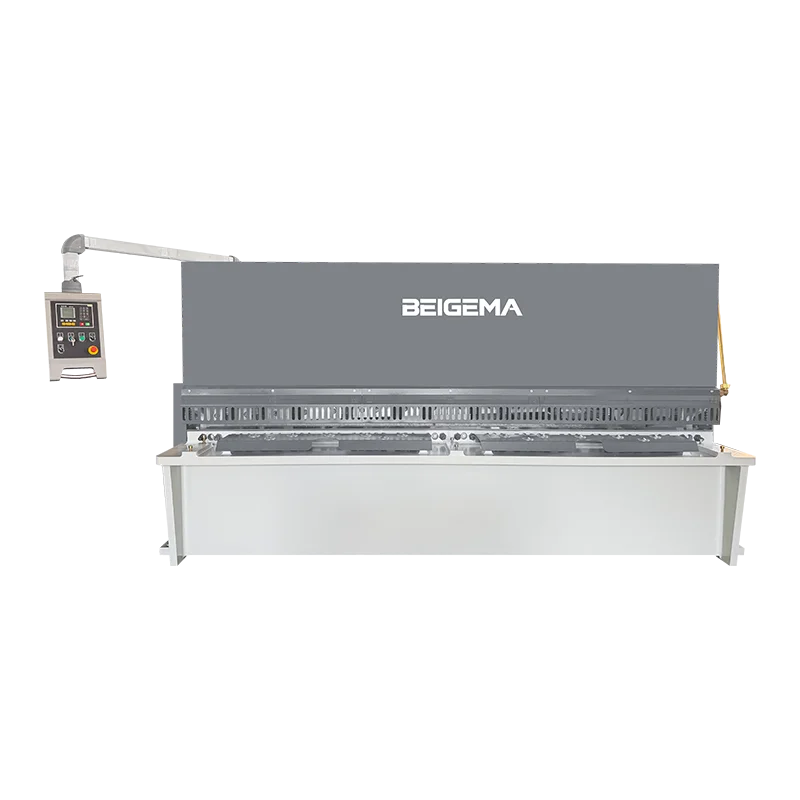
This is a high-performance metal cutting solution built for long-term stable production. Engineered with advanced industrial standards and humanized operation design, this shear delivers reliable safety performance and highly efficient cutting workflows to boost your workshop productivity and enterprise value.
Optimized cutting angle technology effectively eliminates plate twisting and ensures straight, precise shearing results with minimal tolerance deviation. It provides consistent, high-quality cutting for daily and long-term metal fabrication tasks.
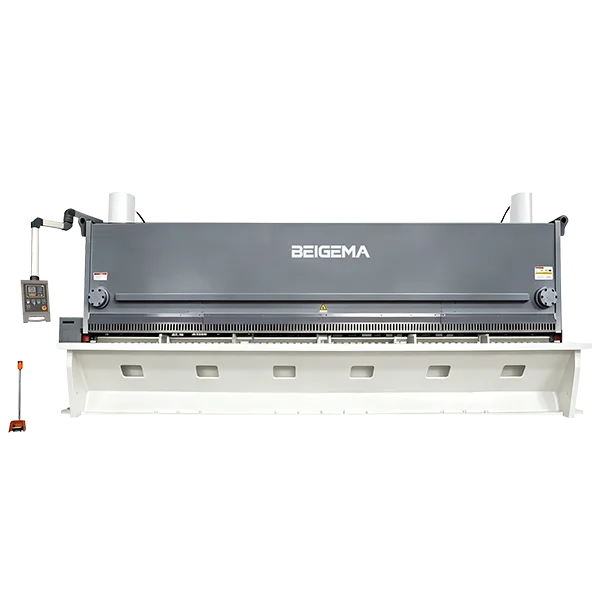
QC11Y series hydraulic guillotine shears are built to meet global industrial standards. As high-end technical equipment, they deliver targeted and reliable cutting solutions for sheet metal processing.
Developed with our rich industry expertise, all mechanical and electric drive parts are meticulously engineered. Every unit is strictly manufactured without compromising performance and quality. These shears stand out for dependable operation, high working efficiency and cost advantages.
Buying guide
About this range
Every machine is built to CE safety requirements and ships with a 24-month warranty, English interface and manuals, plus remote troubleshooting and commissioning guidance — the same package we have delivered to metal fabrication customers in more than 70 countries.
As a shearing machine manufacturer, BEIGEMA builds both QC12K swing-beam and QC11Y guillotine lines so fabricators can size a hydraulic shearing machine by thickness and width from the same factory.
Which shearing machine fits your job?
Use this page to size a shearing machine by thickness × cutting width first. Then pick swing beam or guillotine on speed, twist, and blade-gap method. Those checks come after capacity, not before.
The sheet metal shear buying guide covers capacity, rake angle and blade gap.
A swing beam shear pivots on an arc; a guillotine shear guides the upper blade on a largely linear path. Neither layout wins by name. The signed model still has to match material strength, width, tolerance and output.
Shearing machine range at a glance
Figures are series envelopes. Stroke rate is on the swing-beam line; throat height is on the guillotine line.
| Series | Max shearing thickness (mm) | Shearing width (mm) | Strokes or throat | Power (kW) | Models | Typical work |
|---|---|---|---|---|---|---|
| QC12K swing beam | 6–12 | 2000–6000 | 6–18 min⁻¹ | 7.5–18.5 | 14 | Repetitive straight cuts, mechanical blade gap |
| QC11Y guillotine | 6–40 | 2500–6000 | Throat 800–1200 mm | 7.5–55 | 32 | Mixed jobs, heavier plate, automatic blade gap |
QC12K is listed as QC12Y-6×2500 to QC12Y-12×3200; QC11Y as QC11Y-6×2500 to QC11Y-40×3200. Width still runs to 6000 mm, so those endpoints are not the full grid.
Sizing by thickness and width
Match maximum thickness and maximum width together. Then name the tensile-strength basis behind the mm rating. Stainless, high-strength steel and aluminum are not the same cut at the same nominal thickness.
Thin sheet, 3 mm × 2.5 m, high piece count. 3 mm sits under the 6 mm ceiling of the smallest model in both series. Width 2500 mm sits in both bands: QC12K from 2000 mm, QC11Y from 2500 mm.
Do not step to a 12 mm or 40 mm class for all-day 3 mm work until strokes at 3 mm are on the quote. QC12K publishes 6–18 min⁻¹; QC11Y does not publish stroke rate here. Mechanical gap points at QC12K. Automatic gap, or the higher-volume setup named on this category, points at QC11Y.
Stronger 3 mm sheet: keep the 6 mm class only after derating, not by reading a mild-steel millimeter as-is.
Mid plate, 10 mm × 3.2 m. 10 mm is inside the QC12K 6–12 mm band, but near the top, so the 6 mm frame is the wrong row. Shortlist a 12 mm QC12K if the rating basis matches. Width 3200 mm sits inside both bands.
10 mm also sits in QC11Y’s 6–40 mm band. One size up from a 12 mm swing beam is QC11Y, because the swing-beam series stops at 12 mm. Stronger stock at 10 mm: do not keep the 12 mm QC12K on stainless or high-strength plate without the maker’s derating basis.
Thick plate, 25 mm × 4 m. 25 mm is outside QC12K (max 12 mm). It is inside QC11Y’s 6–40 mm band, and 4000 mm is inside 2500–6000 mm. The named range ends at QC11Y-40×3200, so 25 × 4000 must be a real SKU.
One size up from 25 mm is toward the 40 mm class, only if throat (800–1200 mm) and motor (up to 55 kW) are checked on that row. Stronger plate: step toward a thicker QC11Y row after derating. This is a plate shear job, so QC12K is not in the running.
Which machine, and which one to avoid
The QC12K swing beam shear is the shortlist for general straight cutting when you want a straightforward, cost-conscious package. The live page lists E21S and mechanical blade-gap adjustment; this category also calls out fine blade-gap adjustment. Width starts at 2000 mm, which the guillotine line does not.
Do not choose it above 12 mm. Skip it when automatic blade gap is required, or when the work is variable plate that needs the guillotine’s adjustment range.
The QC11Y guillotine shear is the hydraulic shearing machine to shortlist when jobs change, plate is heavier, or automatic blade gap is part of the setup. E21S is the listed control.
Do not choose it when the sheet is 2000 mm wide and you need a 2000 mm machine. Do not park a 40 mm class on all-day 3 mm strip until stroke rate at 3 mm is written down.
Variable rake, where the selected model has it, can cut distortion on narrow strips or spread load on thicker material. It does not, by itself, lock a tolerance. A 40 mm frame on 3 mm strip every shift: who asked for that?
Before you request a quote
Send these six facts with the RFQ. Use the same six inputs when buying sheet-metal machinery from China.
- Material and tensile strength for every thickness you will cut, including coated or surface-sensitive stock. The millimeter on the name plate is not a grade.
- Thickness range, minimum and maximum, plus the narrowest strip. On thin work, clearance and rake decide the edge, not the 6 mm ceiling.
- Maximum sheet width. 2000 mm can still point at QC12K; 2500 mm and above can be either family; 4000–6000 mm must be a real SKU.
- Pieces per shift, batch size and material changes. QC11Y is described for higher-volume cutting; read QC12K’s 6–18 min⁻¹ at working thickness.
- Whether the cut must run low-twist, with bow, burr and straightness limits and a measurement method. Both designs can make a usable straight cut; hold-down, gap, rake, blade condition and sheet support still run the result.
- Backgauge travel, plus gap/rake control if you need it.
You’ll get a model number from BEIGEMA if those six lines are on the enquiry. It’s the signed table, not the series name, that you accept. Size from thickness and width first, then from the blade-path notes in guillotine vs swing beam, and compare quotes on the same strength basis, width, and written acceptance test.
FAQ
3 mm × 2500 mm, high piece count — which machine? Shortlist a 6 mm-class model in either family. Choose QC12K for mechanical gap; QC11Y for automatic gap or the higher-volume setup. Confirm strokes at 3 mm before stepping up.
10 mm × 3200 mm — QC12K or QC11Y? A 12 mm QC12K covers 10 × 3200 mm when the steel matches the rating basis. If the mix will include thicker plate, stainless, or frequent gauge changes, shortlist QC11Y. There is no universal 8 mm split.
Can QC12K take 25 mm plate? No. The series stops at 12 mm. 25 mm × 4000 mm is a QC11Y envelope job (6–40 mm, 2500–6000 mm), subject to the SKU that actually pairs that thickness with 4000 mm.
Does automatic blade gap mean a cleaner edge? No. QC11Y is described with automatic blade-gap adjustment; QC12K with mechanical adjustment. The right clearance still depends on material, tensile strength, thickness and blade condition.
Holes, contours or nesting: same shortlist? No. Both machines here do straight cuts. If the part needs contours, holes, internal features or nesting, compare a fiber laser as a different process, with its own power, gas and test conditions.
How do I choose between a swing-beam and a guillotine shearing machine?
Size a shearing machine by thickness times cutting width first, then pick the layout. QC12K swing-beam and QC11Y guillotine models cut 6-12 mm plate at widths from 2000 mm to 6000 mm, with adjustable blade gap, adjustable shearing angle and E21S control. A swing-beam shear pivots on an arc; a guillotine guides the upper blade on a largely linear path. Neither layout wins by name alone, so match thickness, width and output to the series envelope before ordering.
Why does a sheared edge show heavy burr on one side only?
One-sided burr on a hydraulic shearing machine usually points to uneven blade gap or a shearing angle set too wide for the plate thickness, not a worn motor. Both QC12K and QC11Y lines ship with adjustable blade gap and adjustable shearing angle plus E21S control, so re-check the gap setting against the 6-12 mm thickness band before assuming the blades need replacing; a gap set for thicker stock will tear thinner sheet.
Can BEIGEMA supply a hydraulic guillotine shear for wide-format plate?
Yes. The QC12K swing-beam and QC11Y guillotine ranges cut 6-12 mm plate at widths from 2000 mm to 6000 mm, both with adjustable blade gap, adjustable shearing angle and E21S control.
FAQ
1. What is the hydraulic guillotine shear?
This gate-type shearing machine features a heavy-duty all-steel welded frame structure, delivering outstanding structural rigidity and long-term operational stability. Equipped with eight-sided right-angle guide rails at four corners, the equipment maintains ultra-high cutting precision and adopts hydraulic pre-tightening technology to eliminate structural gaps. The entire hydraulic system is equipped with a two-way cartridge integrated valve group, ensuring sensitive response, stable pressure output and low failure rate. It supports optional configurations including digital stroke display, photoelectric safety protection devices and portable worktables for quick die replacement. Designed with dual-action functionality from both the upper sliding block and lower hydraulic cushion, the machine allows flexible adjustment of working pressure and stroke within the rated range to meet diverse processing requirements. Centralized button control simplifies operation procedures and improves overall working efficiency.
2. What is the hydraulic swing beam shear?
A hydraulic swing beam shear is a widely used sheet metal cutting machine driven by hydraulic power. Its blade beam swings in an arc during operation, which is the core feature distinguishing it from guillotine shears. Built with robust all-steel frame and precision guide rails, this equipment delivers stable cutting performance and excellent rigidity. The hydraulic system provides powerful and smooth shearing force, suitable for processing various metal plates of different thicknesses. It comes with practical configurations like stroke display, safety protection and flexible parameter adjustment. Thanks to simple operation, reliable quality and cost-effective performance, hydraulic swing beam shears are a mainstream choice for general metal fabrication workshops.
3.What Thickness And Length Can Your Shearing Machines Cut?
Our machines typically range from: Thickness:4 mm to 40 mm (mild steel) Cutting length: 2500 mm to 6000 mm Custom configurations are available for special requirements.
4.Differences Between Swing Beam and Guillotine Shearing Machines
Swing beam shearing machines feature a more straightforward build and come with a more budget-friendly price tag. In comparison, guillotine shears deliver superior cutting accuracy and work far better when processing thick metal sheets. They are the top pick for production tasks that demand high precision.