
Power Press Machine & Hydraulic Presses
Leverage BEIGEMA professional stamping press to optimize your production lines. We supply reliable sheet metal processing machinery, bespoke solutions and practical accessory packages to fit your practical demands. Depending on the market it is listed as a power press machine, a punch press or a mechanical power press.
Sticking to superior quality and innovative technology, we focus on delivering cutting-edge equipment. Our stamping presses greatly improve production efficiency, adapt to various customized processing needs, streamline daily operations and create greater value for your business.
APA pneumatic punching machines cover 25 to 160 tons with speeds up to 200 strokes per minute, alongside JB23 mechanical power presses and Y32K four-column hydraulic presses for stamping, deep drawing and forming.

The APA series pneumatic punching machine is driven by compressed air, offering fast response, a simple low-maintenance structure and smooth, safe operation for high-efficiency sheet metal punching and stamping.

This tilting punching press features a tiltable frame for easy discharge of workpieces and scraps. It supports single and continuous strokes via electric control, and can work in semi-automatic mode when fitted with auto feeder. Boasting compact build, sturdy structure and simple operation, it fits various cold stamping applications.
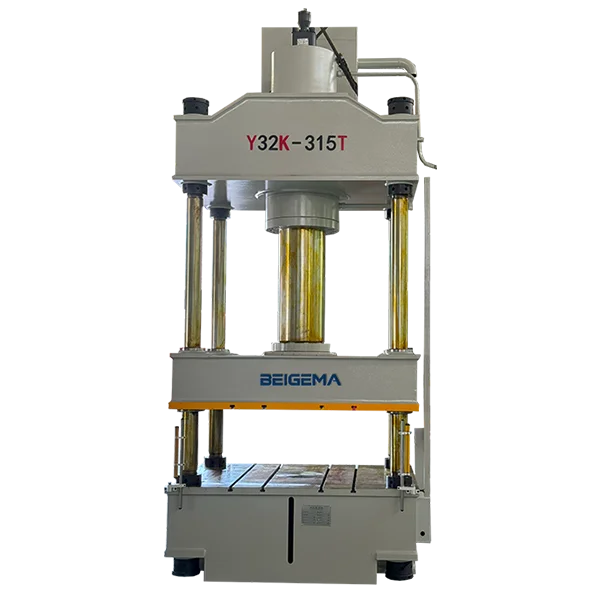
Four-column hydraulic forming press for deep drawing, stamping and molding. High rigidity structure, stable pressure output, suitable for kitchenware, hardware and auto parts manufacturing.
Buying guide
About this range
Every machine is built to CE safety requirements and ships with a 24-month warranty, English interface and manuals, plus remote troubleshooting and commissioning guidance — the same package we have delivered to metal fabrication customers in more than 70 countries.
Buyers comparing a hydraulic press for sale against mechanical options can also spec an aluminum punching machine here, since APA, JB23 and Y32K drives cover the same tonnage-and-stroke selection logic.
Which power press machine fits your job?
Use this page to match a power press machine to the job, not to a product card. Read nominal force and stroke first. Then check strokes per minute, shut height or daylight, table size, and whether the drive should be a hydraulic press, a mechanical press or a pneumatic press.
These figures are series ranges. A value inside a band still has to hold on the model you order, at the rated-tonnage position. Drive versus architecture is covered in the metal punching machine types guide. Next, use power press selection by tonnage, stroke and die height.
Power press range at a glance
| Series | Nominal force | Stroke (mm) | Strokes per minute | Shut height or opening | Table (mm) | Models | Typical work |
|---|---|---|---|---|---|---|---|
| APA pneumatic punch | 25–400 Ton | 30–250 | 30–110 s.p.m. | Die height 195–600 mm | Not published in spec | 22 (APA-25-V to APA-400-H) | Fast, repeatable punching |
| JB23 mechanical press | 100–2500 | 50–200 | 28–130 | Closed height 180–430 | 360–1500 × 240–900 | 12 (to J23-250) | General stamping and forming |
| Y32K four-column hydraulic | 630–8000 kN | 500–1000 | Not published as SPM (working 9–12 mm/s) | Maximum daylight 800–1800 mm | 520–2500 × 490–1800 | 9 (Y32K-63 to Y32K-1000) | Deep drawing and pressing |
APA lists rate tonnage point 1.6–8 mm and air 6 kg/cm². JB23 lists nominal-force stroke 2–14 and closed-height adjustment 35–130. Y32K lists approach 80–120 mm/s, return 50–100 mm/s, ejection 100–1250 kN / 160–355 mm.
Sizing by force, stroke and strokes per minute
For a round hole or a blank, screening force is required cutting force (kN) ≈ cut perimeter (mm) × thickness (mm) × shear strength (N/mm²) ÷ 1,000. Convert kN to metric ton-force by dividing by 9.80665. First-pass only.
2 mm sheet, blanking at 100 strokes per minute. The types guide’s 50 mm hole in 2 mm stock at 300 N/mm² uses perimeter ≈ 157.1 mm: 157.1 × 2 × 300 ÷ 1,000 = 94.2 kN ≈ 9.6 tf. APA’s 25 Ton floor sits above that nameplate. JB23’s floor is 100 with no unit on the spec.
100 s.p.m. sits inside APA 30–110 and JB23 28–130. It does not sit on Y32K: working 9–12 mm/s, approach 80–120 mm/s, stroke from 500 mm. That motion is outside a 100 s.p.m. blanking cycle.
Do not apply a universal 1.2–1.3 multiplier. Stronger stock raises τ and therefore F; move up the force band. Do not invent a coefficient.
8 mm structural punching. Same hole at 8 mm: 157.1 × 8 × 300 ÷ 1,000 = 377 kN ≈ 38.4 tf. Step up from the 25 Ton APA floor and from JB23’s floor of 100. Y32K’s 630 kN floor clears 377 kN on nameplate; still list every simultaneous perimeter before you buy a four-column frame for holes.
APA’s rate point is 1.6–8 mm; 8 mm is the top of that band. JB23’s nominal-force stroke is 2–14. Full mechanical tonnage may exist only near bottom dead centre.
If the punch works higher in the stroke, or the load is off-centre, nameplate is not the decision. Stronger plate: raise the force band, then confirm the capacity curve.
200 mm stroke for deep drawing or sizing.
Why run a 200 mm draw on a press whose maximum stroke is 200 mm?
JB23 slide stroke is 50–200 mm, so 200 mm is the ceiling, not a margin. Stroke must also open the tool for load, unload and strip. APA 30–250 mm leaves 50 mm at the long end. That is not a handling plan.
Y32K has 500–1000 mm stroke, 800–1800 mm daylight and 160–355 mm ejection stroke. That is the drawing and pressing series.
Hydraulic is the shortlist for dwell and speed stages. Do not use the hole formula for a draw. Stronger stock: process-specific calc, then 630–8000 kN.
Which machine, and which one to avoid
APA Series pneumatic punching machine. Use this punch press for fast, repeatable punching: 25–400 Ton, 30–110 s.p.m., stroke 30–250 mm, die height 195–600 mm, rate tonnage point 1.6–8 mm, air 6 kg/cm².
Do not buy it when the die must dwell, when full force is needed more than 8 mm above the rate point, or when daylight must reach 800–1800 mm. Do not buy it if shop air cannot hold 6 kg/cm².
JB23 Series mechanical power press. This is the general stamping press in the range: slide 50–200 mm, 28–130 strokes, closed height 180–430, table 360–1500 × 240–900. A mechanical press stores energy in a flywheel and crank; full tonnage may exist only near bottom dead centre.
Do not buy it when slide travel must exceed 200 mm, when closed height must exceed 430, or when the die needs hydraulic dwell. Do not buy it for a rate above 130 strokes a minute, or for a bed larger than 1500 × 900.
Y32K Series four-column hydraulic press. Use this hydraulic press for deep drawing and pressing: 630–8000 kN, slide 500–1000 mm, daylight 800–1800 mm, table 520–2500 × 490–1800, working speed 9–12 mm/s.
Do not buy it for 2 mm blanking at 100 s.p.m. It’s the wrong motion: 9–12 mm/s working speed and a 500 mm minimum stroke. Do not shortlist it for 25–400 Ton punching at 30–110 s.p.m.
Before you request a quote
You’ll need six items before a model-level reply is usable. Send the same pack with the selection worksheet and the punching-machine RFQ list.
- Process: blanking/punching, drawing, sizing/coining, or press-fit.
- Material grade and thickness, with a verified shear value for cut work.
- Closed die height and die size; match APA 195–600 mm, JB23 180–430, or Y32K daylight 800–1800 mm, and confirm the datum (bed or bolster).
- Parts per shift and feed method, not the catalogue speed band.
- Required stroke and opening, including stripper travel and part handling.
- Hold pressure: if the cycle must dwell, check the Y32K hydraulic curve. APA and JB23 are not published as dwell presses.
Add the largest simultaneous cutting perimeter and the load position on the bed. BEIGEMA still has to confirm rated position, energy and permitted die load.
We blank 2 mm coil at about 100 strokes per minute. Which series?
Shortlist APA (30–110 s.p.m.) or JB23 (28–130 strokes) after force, die height and table fit. Do not shortlist Y32K: working speed is 9–12 mm/s and stroke starts at 500 mm.
We need about 200 mm of working travel for a draw or a sizing pass with dwell. Which series?
Shortlist Y32K: 500–1000 mm stroke, 800–1800 mm daylight, hydraulic dwell. JB23’s 200 mm stroke is the ceiling. APA reaches 250 mm but remains a punch cycle with a 1.6–8 mm rate point.
Can press capacity be chosen from sheet thickness alone?
No. Cutting force is F = L × t × τ. Perimeter, simultaneous features and forming all change the load.
What is the difference between stroke and shut height?
Stroke is slide travel: APA 30–250 mm, JB23 50–200 mm, Y32K 500–1000 mm. Shut height is the closed space at a stated adjustment and datum. The die must sit inside that window.
When is a pneumatic press the wrong answer next to a mechanical or hydraulic frame?
Dwell, long forming, or force high above the 1.6–8 mm APA rate point: Y32K. Dedicated die at 28–130 strokes: JB23. Repeat punching at 30–110 s.p.m. and 6 kg/cm²: APA, checked on the model.
How do I choose between a mechanical, hydraulic and pneumatic power press?
Match a power press machine to the job by nominal force and stroke first, not to a product card. APA pneumatic punching machines cover 25-160 tons at speeds up to 200 strokes per minute with a rated-tonnage point of 1.6-8 mm and 6 kg/cm2 air supply; JB23 mechanical presses list a nominal-force stroke of 2-14 mm and closed-height adjustment of 35-130 mm; Y32K four-column hydraulic presses run 80-120 mm/s approach and 50-100 mm/s return.
What usually causes ram speed to slow down during deep drawing?
A slowing ram on a hydraulic power press typically points to a hydraulic-system issue rather than the tonnage rating itself. Y32K four-column presses are rated for 80-120 mm/s approach speed, 50-100 mm/s return and 100-1250 kN ejection force over a 160-355 mm stroke; if working speed drops well below the approach-speed band for your model, check pump output and valve response before assuming the frame is undersized for the draw depth.
Can BEIGEMA supply a four-column hydraulic press for stamping and forming?
Yes. The Y32K four-column hydraulic press range runs 80-120 mm/s approach, 50-100 mm/s return and 100-1250 kN ejection force across a 160-355 mm stroke, alongside APA pneumatic punching machines from 25-160 tons at up to 200 strokes per minute and JB23 mechanical presses.
FAQ
1. what is Pneumatic Punching Machine?
A pneumatic punching machine is an industrial press driven by compressed air. It features fast response, simple operation and safe running, widely used for metal stamping, blanking and cold forming.
2. what is four column hydraulic press?
A four-column hydraulic press is an industrial forming machine driven by hydraulic power. It uses four vertical columns to guide the moving platen, delivering stable and high-pressure force for stamping, deep drawing, and molding processes.
3. what is the application area of the pneumatic punching machine?
Pneumatic punch presses are widely used in various cold stamping processes due to their smooth operation, safe operation, and high cost-effectiveness.
Main service areas include: daily hardware, architectural hardware, electronic components, home appliance parts, automotive parts, kitchenware and sanitary ware, lighting accessories, metal crafts, and luggage hardware; they can perform processes such as punching, cutting, blanking, bending, forming, and shallow drawing, making them the mainstream stamping equipment in small and medium-sized processing workshops.