
This hydraulic press tonnage chart lists every tonnage step BEIGEMA publishes in one place: the Y32K four-column hydraulic press from Y32K-63 to Y32K-1000 and the JB23 mechanical power press from 10 to 125 tons, with nominal force, slide stroke, maximum daylight, table width and motor power copied from the two spec tables. Search for a 20 ton, 12 ton or 6 ton hydraulic press and none of them match a model here — the smallest four-column step is 63 tons — so this chart says plainly what each row does list instead.
Both series belong to the power press machine range, alongside the APA pneumatic punching machine covered in section 5.
1. How to Read the Y32K and JB23 Tonnage Tables
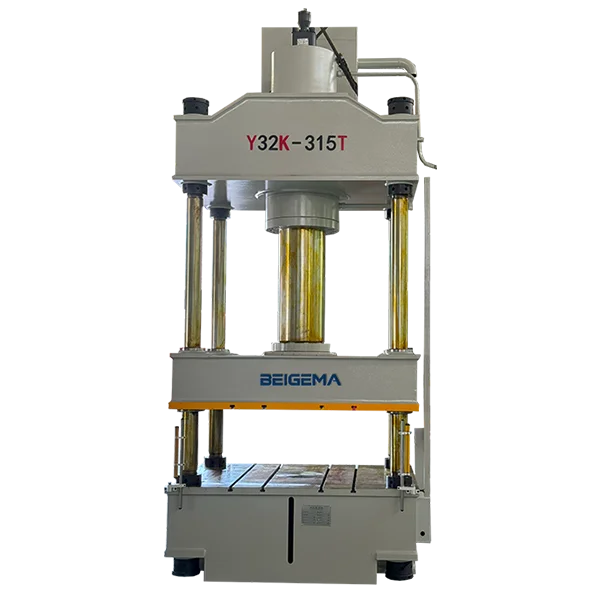
Each row below is a published model, not a calculated size. Y32K-63 through Y32K-1000 are four-column hydraulic presses; our own product page prints the mid-range step as “Y32K-315T” and states “With 315 tons of pressing force”, confirming the number after the dash is the nameplate rating. J23-10 through J23-125 are mechanical power presses from the JB23 series, plus one differently-named row in the middle, J21S-500, rated at 1000 kN between the 80-ton and 125-ton steps.
The numbers are only comparable inside the columns they’re printed in: the JB23 table carries a “Stroke of Nominal force” column (2 mm on the J23-10 up to 14 mm on the J23-250), the APA table a “Rate tonnage point” column in millimetres, and the Y32K table lists nominal force, ejection force and return force as separate kN columns. The power press selection guide covers the sizing method step by step; metal punching machine types explains what separates a hydraulic press from a mechanical or pneumatic one, and hydraulic press types maps the frame classes.
2. Is There a 20 Ton Hydraulic Press (or a 12-Ton, 6-Ton, 30-Ton One) at BEIGEMA?
No. BEIGEMA builds industrial four-column presses only in this class: the smallest published step is Y32K-63 at 630 kN. A 1 ton hydraulic press machine, a 1 ton hydraulic press, a 2 ton hydraulic press, a 5 ton hydraulic press or a 6 ton hydraulic press are all below that line, and so is a 12 ton hydraulic press.
A 20 ton hydraulic press is too, however the search is typed: hydraulic press 20 ton, a 20 t hydraulic press or a 20 ton hydraulic press machine all land on the same answer. A 30 ton hydraulic press (30 tonne hydraulic press in British spelling) is the next size up from what people search for, and it still isn’t a Y32K step; the nearest one is Y32K-63.
The JB23 mechanical power press line has the same floor on the low end: the smallest published model is J23-10 at 100 kN, so a 5 ton power press or a 5 ton power press machine isn’t on that table either. Section 4 lists every JB23 step from there up to 125 tons.
3. Y32K Four-Column Hydraulic Press Tonnage Chart: 63 to 1000 Tons
Nine steps are published, Y32K-63 to Y32K-1000, each one built, per the product page, for metal stamping, deep drawing, forming and assembly. A Y32K four-column hydraulic press runs on a hydraulic unit rated 21 to 31.5 MPa, with single or multi-cylinder options and a dual-speed design of fast travel and precise pressing.
The table below lists slide stroke, maximum daylight, table width and motor power for all nine steps, copied from the product spec table. For a 1000 ton hydraulic press, the closest name is Y32K-1000, the largest model in the lineup; its nominal-force cell is not listed here, so confirm the rated force before you size the job. A 150 ton hydraulic press sits between two published steps instead, Y32K-100 and Y32K-200, so the choice comes down to stroke and daylight rather than a name on the nameplate. Two nominal-force cells read “not listed”; the other columns of those rows are quoted as printed.
| Model | Nominal force (kN) | Slide stroke (mm) | Maximum daylight (mm) | Table width, left-to-right (mm) | Motor power (kW) |
|---|---|---|---|---|---|
| Y32K-63 | 630 | 500 | 800 | 520 | 7.5 |
| Y32K-100 | 1000 | 600 | 900 | 720 | 11 |
| Y32K-200 | 2000 | 700 | 1200 | 900 | 15 |
| Y32K-315 | 3150 | 800 | 1250 | 1120 | 22 |
| Y32K-400 | not listed | 800 | 1250 | 1120 | 22 |
| Y32K-500 | 5000 | 900 | 1500 | 1400 | 44 |
| Y32K-630 | 6300 | 900 | 1500 | 1600 | 60 |
| Y32K-800 | 8000 | 1000 | 1800 | 2200 | 90 |
| Y32K-1000 | not listed | 1000 | 1800 | 2500 | 90 |
Slide stroke runs from 500 mm at the smallest step to 1000 mm at the two largest, and maximum daylight from 800 mm to 1800 mm across the same range, so a taller die or a longer draw needs one of the upper steps regardless of tonnage. Confirm shut-height and load position against the die before ordering; the power press selection guide covers that check in detail.
4. JB23 Mechanical Power Press Tonnage Chart: 10 to 125 Tons
Eight steps fall in this range, J23-10 to J23-125, all part of the same JB23 mechanical power press line built for mass production of sheet metal parts. Three steps beyond 125 tons exist too, J23-160, J23-200 and J23-250, but they sit outside the range this chart covers.
Nominal force ranges from 100 kN at J23-10 to 1250 kN at J23-125, and the cycle rate falls as force rises: 130 strokes per minute at the smallest step down to 35 at the largest. J21S-500 breaks the naming pattern; it’s rated 1000 kN, between the 80-ton and 125-ton steps, running 43 strokes per minute.
| Model | Nominal force (kN) | Slide stroke (mm) | Strokes per minute | Worktable width, left-to-right (mm) | Power (kW) |
|---|---|---|---|---|---|
| J23-10 | 100 | 50 | 130 | 360 | 1.1 |
| J23-16 | 160 | 60 | 110 | 440 | 1.5 |
| J23-25 | 250 | 70 | 60 | 500 | 2.2 |
| J23-40 | 400 | 100 | 55 | 680 | 4 |
| J23-63 | 630 | 100 | 50 | 720 | 5.5 |
| J23-80 | 800 | 120 | 45 | 750 | 7.5 |
| J21S-500 | 1000 | 130 | 43 | 900 | 11 |
| J23-125 | 1250 | 130 | 35 | 930 | 11 |
Closed height and its adjustment both grow with tonnage: 180 mm closed height with 35 mm of adjustment at J23-10, up to 400 mm closed height with 110 mm of adjustment at J23-125. That is the figure a die-height check comes down to before ordering tooling.
5. Choosing Between Y32K Hydraulic, JB23 Mechanical and APA Pneumatic
Drive type is the first fork before tonnage. A Y32K hydraulic press suits the work its own page names — stamping, deep drawing, forming and assembly with precise pressure control; a JB23 mechanical press suits repeat blanking and punching at high stroke frequency; the APA pneumatic punching machine suits continuous stamping and automated feeding on air cylinders, rated to Max 400T.
None of the three is selected on tonnage alone. Why not, if the rated force is right there on the nameplate? Because that number means little if the die doesn’t fit the shut-height window or the frame can’t carry the load at that position — check the stroke-of-nominal-force and rate-tonnage-point columns the tables actually print. For the three-type comparison in one table, see power press types.
Hydraulic Press and Power Press Tonnage Chart FAQs
Is there a 1 ton, 5 ton, 12 ton or 20 ton hydraulic press at BEIGEMA?
No. Every four-column press on this site is a Y32K model, and the smallest published step is Y32K-63 at 630 kN. Section 2 above lists which small-tonnage searches have no match on this site; send your part thickness and length and we’ll confirm whether the 63-ton step fits or a larger one is needed.
What does the tonnage in a Y32K or J23 model name mean?
It’s the nameplate rating. Y32K-315T is confirmed at 315 tons of pressing force on the product page, and the rest of the Y32K and J23 lineup follows the same pattern, with nominal force in kN on the spec table row above the model’s tonnage figure.
Should I choose a JB23 mechanical press or a Y32K hydraulic press for punching steel plate?
That depends on dwell time and cycle rate, not material alone. A JB23 model runs a fixed, fast stroke — J23-63 cycles at 50 strokes per minute — which suits repeat blanking and punching. A Y32K hydraulic press holds force through a longer dwell in its 9–12 mm/s working pass, which suits forming and deep drawing. Send the part drawing and production rate and we’ll recommend checking one series against the other.
How do I choose between an APA pneumatic press and a Y32K hydraulic press for deep drawing?
Check the site’s own framing first: the Y32K page names metal stamping, deep drawing, forming and assembly as the four-column frame’s work, while the APA page is built around high-speed punching — its clutch section reads “fast response and high cycle rate, ideal for continuous stamping and automated feeding”. Deep-drawn parts start with the Y32K family; confirm material grade, thickness and die dimensions before selecting a model.
How fast does a 63-ton JB23 press cycle?
J23-63 is rated at 630 kN with a 100 mm slide stroke and 50 strokes per minute on the spec table. That’s faster than the two JB23 steps above it: J23-80 runs 45 strokes per minute and J21S-500 runs 43.
To match a part to a step, send the drawing with material, thickness and length, and tell us whether the job is forming, deep drawing or punching.

