
Hydraulic press types group by frame: H-frame, C-frame and four-column. Of the three, the BEIGEMA catalog carries the four-column type only — the Y32K series, nine published models from Y32K-63 to Y32K-1000, with the highest nominal force printed in the table at 8000 kN on the Y32K-800 — built, per its own page, on a three-beam four-column structure for metal stamping, deep drawing, forming and assembly. H-frame and C-frame presses are not BEIGEMA product lines; sections 1 and 2 below state that boundary and nothing more, and every comparison row on this page stays inside the Y32K table.
The Y32K sits in the power press machine category as BEIGEMA’s hydraulic line, alongside the mechanical JB23 and pneumatic APA series.
1. H-Frame Hydraulic Press: Two Uprights, Open Front and Back
H-frame hydraulic presses are not a BEIGEMA product line, and this page gives no selection steps, parameters or capacity figures for them. Buyers shopping that class should look elsewhere; what follows covers the frame the catalog does build.
2. C-Frame Hydraulic Press: Single Column, Open on Three Sides
C-frame hydraulic presses — open-gap and gap-frame presses included — are not a BEIGEMA product line either. The same boundary applies: no comparison rows below cover them, because the catalog lists none.
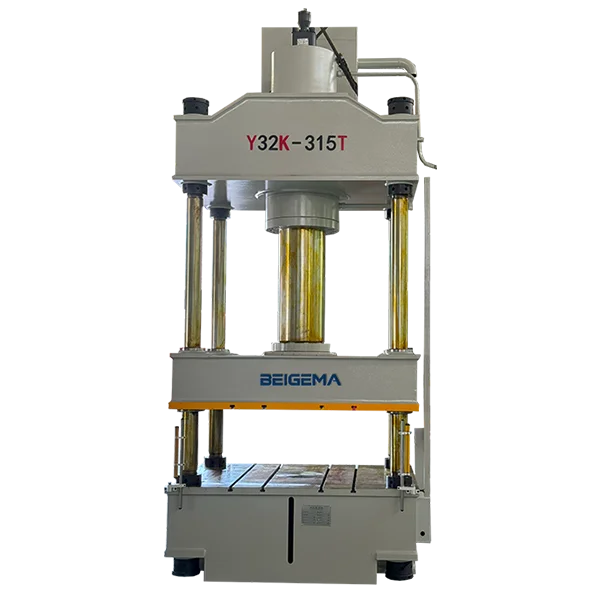
3. Four-Column Hydraulic Press (Y32K Series): The Frame BEIGEMA Builds
The Y32K product page introduces the frame with its own mid-range step: “The Y32K-315T four-column hydraulic press features a robust three-beam, four-column structure for exceptional rigidity and stability. With 315 tons of pressing force, it is ideal for metal stamping, deep drawing, forming, and assembly operations.” The configuration list adds a 3-beam 4-column rigid frame, a main forged hydraulic cylinder, PLC control with pressure and stroke adjustment, overload protection with emergency stop, and a T-slot worktable for easy tool mounting.
The hydraulic master cylinder is installed on the upper beam to drive the slide, in single or multi-cylinder options with a dual-speed design the page sums up as “fast travel and precise pressing”. The hydraulic unit supplies high-pressure oil ranging from 21 to 31.5 MPa through axial piston pumps, and the integrated valve group combines pressure relief, flow control and solenoid directional valves for multi-step adjustment. The structure section also lists real-time monitoring with touch control and remote troubleshooting.
- Model range: Y32K-63 through Y32K-1000 — the full span of the hydraulic line.
- Slide speed in three listed stages: rapid approach 80 to 120 mm/s, working 9 to 12 mm/s, return 50 to 100 mm/s.
- Ejection force 100 kN to 1250 kN and return force 125 kN to 1250 kN across the table.
Full specifications are on the Y32K series four column hydraulic press machine page; the model-by-model tonnage rows are laid out in our hydraulic press tonnage chart.
4. Y32K Capacity Range: Nominal Force, Ejection Force, Return Force and Stroke
Tooling load matters as much as nominal force when sizing a die for a hydraulic press: check ejection force against the die’s knockout requirement and return force against the upper die’s dead weight. The table lists all four figures by model, plus slide stroke. A “not listed” cell means this page does not quote that figure.
| Model | Nominal force (kN) | Ejection force (kN) | Return force (kN) | Slide stroke (mm) |
|---|---|---|---|---|
| Y32K-63 | 630 | 100 | 125 | 500 |
| Y32K-100 | 1000 | 250 | 320 | 600 |
| Y32K-200 | 2000 | 400 | 450 | 700 |
| Y32K-315 | 3150 | 630 | 600 | 800 |
| Y32K-400 | not listed | 630 | 600 | 800 |
| Y32K-500 | 5000 | 1000 | 1000 | 900 |
| Y32K-630 | 6300 | 1000 | 1000 | 900 |
| Y32K-800 | 8000 | 1000 | 1200 | 1000 |
| Y32K-1000 | not listed | 1250 | 1250 | 1000 |
Evidence first: ejection and return force sit well under nominal force at every size — on the Y32K-315, 630 kN ejection and 600 kN return against 3150 kN nominal. Conclusion: check the model’s own ejection and return columns, not the nameplate nominal force, when sizing knockout or dead-weight return.
5. Which Type Should You Buy: Hydraulic, Mechanical or Pneumatic?
So which type actually fits the job? A four-column hydraulic press isn’t always the right choice — match the process first, then the tonnage. The Y32K’s dual-speed slide is tuned for a controlled press stroke, while the two companion series in the same category trade that control for cycle speed:
- Production stamping, deep drawing or forming at real tonnage: the Y32K four-column, Y32K-63 through Y32K-1000.
- High stroke-frequency mass production of sheet metal parts: the JB23 mechanical power press, semi-automation rated to max 250T.
- High-speed punching on air cylinders, built for continuous stamping and automated feeding: the APA series pneumatic punching machine, rated to Max 400T.
For the full three-drive comparison with every model row, see power press types; for turning a part drawing into a tonnage figure step by step, see the power press selection guide, and for a punching-specific walkthrough, metal punching machine types and how to choose the right one.
Hydraulic Press Types FAQs
What jobs does the Y32K page itself name for the four-column frame?
Metal stamping, deep drawing, forming and assembly — with precise pressure control for consistent part quality, which the page frames as “a reliable choice for high-volume production”. That is the process set the four-column Y32K line is sold against.
Should I choose the JB23 mechanical press or the Y32K hydraulic press for punching structural steel?
If the job is repetitive punching or blanking at a fast stroke rate, the JB23 page is built for that: “with high stroke frequency, runs fast and stably. Perfect for mass production of sheet metal parts.” If the part needs a controlled press stroke instead — forming, deep drawing, assembly pressing — the Y32K’s dual-speed design of fast travel and precise pressing fits better. Send the part drawing and we’ll confirm which process it needs.
APA pneumatic press or Y32K hydraulic press for deep drawing thin stainless parts?
Deep drawing needs controlled slide speed and pressure through the stroke — what the Y32K’s dual-speed slide and integrated valve group are built for. The APA’s pneumatic clutch is described on its own page as “fast response and high cycle rate, ideal for continuous stamping and automated feeding”: punching and piercing, not a controlled draw. For deep drawing, the hydraulic Y32K is the right family.
How do I check a supplier’s press tonnage claim before ordering?
Ask for the model’s own spec table, not a nameplate number. On this site the Y32K table lists nominal force, ejection force, return force, slide stroke and daylight per model; the JB23 table adds a “Stroke of Nominal force” column in millimetres (2 mm on the J23-10 up to 14 mm on the J23-250); the APA table carries a “Rate tonnage point” column in millimetres on every row. A tonnage figure quoted without the column it belongs to isn’t verifiable.
What should I check first if tonnage readings look wrong on a four-column hydraulic press?
Start with the integrated valve group: the pressure relief setting, the flow control valve position, and whether the hydraulic unit’s oil pressure sits within its rated 21 to 31.5 MPa range. Confirm those before assuming a load-cell, sensor or mechanical fault. And if ram speed seems to sag mid-stroke, remember the dual-speed slide is designed to switch from fast travel (80 to 120 mm/s) to a working pass of 9 to 12 mm/s — that transition is the machine doing its job, not a fault.
Tell us the part, the process — punching, forming or deep drawing — and the tonnage you’re estimating, or send the drawing through the BEIGEMA contact page, and we’ll match it to a Y32K model or the right press type.


