
A portable laser welder is defined by four rows of its spec table: source power (1000w, 1500w or 2000w on the BM handheld), welding range (0.5~6 mm carbon steel, 0.5~6 mm stainless steel, 0.5~4 mm aluminum), welding speed (≤120 mm/s) and cooling mode (water). Choose the power from the thickest joint you weld every day in the most reflective metal on your list, not from the largest number in the catalog. Wire feed, shielding gas and a chiller matched to the source decide whether the seam is clean; the power figure alone doesn’t.
The BM handheld fiber laser welding machine is the one welder in the BEIGEMA fiber laser cutting machine category, beside the BM 3015 single-table and the enclosed exchange-table cutters.
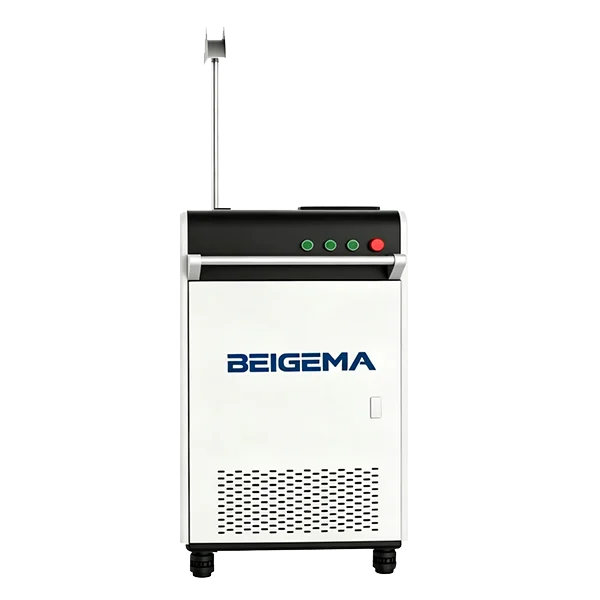
1. Reading the spec table of a portable laser welder
The BM handheld fiber laser welding machine page publishes one parameter table for the family. It is copied below unchanged.
| Parameter | Published value |
|---|---|
| Laser power (kw) | 1000w / 1500w / 2000w |
| Welding speed (mm/s) | ≤ 120mm/s |
| Welding range (mm) | 0.5~6mm carbon steel; 0.5~6 stainless steel; 0.5~4 aluminum |
| Fiber length (m) | Standard 10 |
| Cooling mode | Water cooling |
| Electromechanical | 380V / 50HZ; 220V support customization |
Two things the table doesn’t say. It lists no wire feeder, so whether one ships is a quotation item. And the power row stops at 2000w while the summary box on the same page lists 3kw, so treat a 3 kW source as an option written into the technical quotation, not a catalog row.
2. Choosing 1000w, 1500w or 2000w by material and thickness
Power is energy into the seam per second. A thicker joint needs more energy per millimeter: at fixed speed it needs more watts, and at fixed watts you slow down, which on thin sheet brings back the distortion the laser was bought to remove. Buy the power step that keeps you moving on your thickest daily joint.
Material changes the arithmetic. The table gives aluminum 0.5~4 mm against 0.5~6 mm for the two steels; aluminum also reflects more of the beam and conducts heat away from the pool faster than steel. Stainless holds its heat: good for penetration, bad for heat tint if gas coverage slips. Carbon steel is the most forgiving of the three.
| Material | Published range (mm) | What pushes you to the next power step | Where filler wire enters |
|---|---|---|---|
| Carbon steel | 0.5~6 | Top of the range at production speed; fillets on thicker sheet | Fit-up gaps, outside corners, built-up fillets |
| Stainless steel | 0.5~6 | Same logic; heat tint is a speed and gas problem, not a power one | Same joints, filler matched to the grade |
| Aluminum | 0.5~4 | More watts at the same thickness; a 1000w laser welder is a thin-sheet choice | Most butt joints; oxide skin cleaned first |
| Galvanized steel | No separate row in the table | The zinc coating sets the problem, not the thickness | Wire bridges the gap left for zinc vapor to vent |
Which power, then? The table doesn’t split the welding range by power, so start from the thickest material you weld on most shifts, in its most reflective grade. Treat the range as a screening reference, the way the fiber laser cutting machine power guide treats cutting charts, and weld a sample of your own joint before ordering.
3. Wire feed, shielding gas, cooling and power supply
Wire feed. A fiber laser spot is small, so a weld with no filler only works when the two edges touch along the whole seam. Where fit-up leaves a gap, a wire feeder pushes filler into the pool and the laser melts it with the base metal; wire also builds a fillet and allows a second pass at the top of the range. Say in the enquiry whether a feeder is required.
Shielding gas. The gas leaves the nozzle on the gun and covers the pool so it doesn’t react with air. Coverage matters more than flow: too little and stainless turns dark while aluminum takes porosity; too much and the jet pulls air into the pool. Argon is the usual choice on a hand fiber laser welding gun. Porosity on galvanized sheet is a zinc problem first, so grind the coating back at the joint or leave a venting gap bridged with wire before changing power.
Cooling and supply. The table lists water cooling; the product page names an S&A water chiller with dual temperature regulation among the components. Give it airflow and clean water and protect the loop from freezing; a cooling fault stops the source before the seam shows a defect. Electromechanical is 380V / 50HZ with 220V as customization, so send the voltage and frequency at the wall of the bay. The standard 10 m fiber is the leash: the cabinet stays parked, so lay out the bench with the longest seam inside that radius.
4. Hand laser welder vs TIG and MIG: what changes, what doesn’t
The product page’s claim is that this laser welder runs 2-10 times quicker than traditional TIG and MIG welding modes, with weld joints free of pores and burrs and grinding mostly unnecessary. Where does that come from? A focused beam puts its energy into a spot, so the part takes less total heat than an arc for the same seam: less distortion on thin sheet and a narrower bead. The operator moves the gun while the machine drives the swing pattern, which is easier to teach than coordinating a TIG torch, arc length and rod by hand. MIG keeps its place where gaps are wide or the section sits outside the 0.5~6 mm range.
What doesn’t change is joint preparation. Laser welding sheet metal is less tolerant of gaps, rust, oil and mill scale than MIG, so the cleaning a MIG welder can skip becomes the process. The same family covers it: laser cleaning uses high-frequency, high-energy laser pulses to remove rust, oil, oxide layers and paint, and the handheld welder page lists replaceable nozzles for welding, cleaning and cutting. Eye protection and fume extraction at the seam aren’t options.
5. Pairing the welder with a 3015 fiber laser cutter
A cut-and-weld package is the usual dealer enquiry: a BM 3015 single plate form fiber laser cutting machine or the BM full covered fiber laser cutting machine with exchange table for the blanks, and the handheld welder for assembly. Pick the cutter’s power from the power guide, which screens 1 to 12 kW by material, and the gas from the sheet metal laser cutting assist gas guide: an oxygen-cut carbon steel edge carries an oxide layer that may need removal before welding, while a nitrogen-cut edge is oxide-free. For plate above the cutter’s chart, read laser cutting vs plasma cutting first.
- The BM handheld table in the fiber laser range starts at 1000w; there is no 500w row.
Portable Laser Welder FAQs
How thick can a portable laser welder weld?
The BM handheld table lists 0.5~6 mm carbon steel, 0.5~6 mm stainless steel and 0.5~4 mm aluminum at a welding speed of ≤120 mm/s. That is the outer limit across the 1000w, 1500w and 2000w sources; what you hold at speed depends on power, joint type and wire.
Should I choose a 1000w, 1500w or 2000w laser welder?
Choose from the thickest material you weld on most shifts, in its most reflective grade. The table doesn’t split the welding range by power, so weld a sample of that joint on the power you’re considering before ordering. The summary box also lists 3kw; have it written into the quotation.
Why does a handheld laser welder leave porosity on galvanized sheet?
Zinc vaporizes inside the pool before the steel melts and the trapped vapor becomes pores. Grind the coating back at the joint or leave a venting gap bridged with filler wire, check that the shielding gas covers the pool without pulling air in, and only then adjust power and speed.
Is a handheld laser welder faster than TIG or MIG?
The product page states that this laser welder runs 2-10 times quicker than traditional TIG and MIG welding modes, with grinding mostly unnecessary. The gain is largest on thin sheet with tight fit-up; on gapped joints or section outside the 0.5~6 mm range, arc welding keeps its place.
Does the machine need 380 V supply and a chiller?
The table lists 380V / 50HZ, with 220V supported as customization, and water cooling as the cooling mode. A chiller is part of the system, so plan a bay with airflow, clean water, shielding gas and fume extraction, and send the wall voltage and frequency.
To get a power and configuration proposal, send the drawing and tell us material and thickness per grade, joint types, whether any sheet is galvanized, and wall voltage and frequency.
