
A steel plate guillotine and a swing beam shear don’t treat every sheet the same way once you move to stainless steel or aluminum. Stronger or softer sheets change the shearing force, the blade clearance and, on some jobs, the maximum thickness a given machine can handle. This guide reads BEIGEMA’s own capacity tables by material and sets out where clearance and capacity need adjusting.
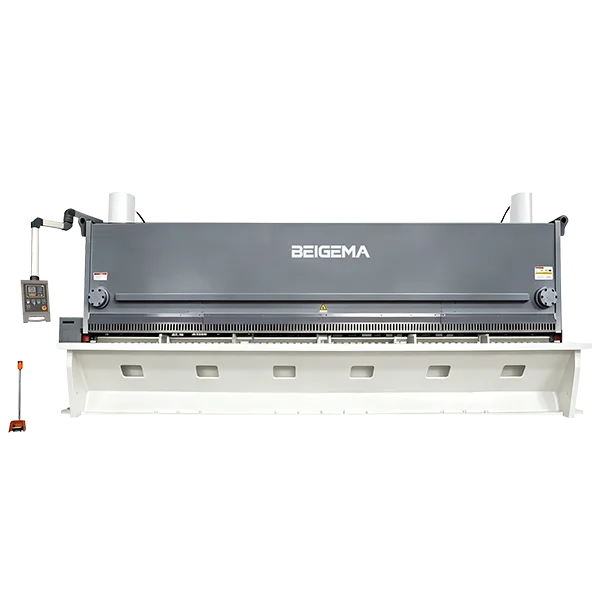
BEIGEMA’s current lineup of hydraulic shearing machines covers both families used for this kind of work: the guillotine and the swing beam.
1. Why Tensile Strength Sets the Real Capacity Limit
Every thickness rating on a hydraulic shear assumes a material strength. The BEIGEMA swing beam spec table states that basis directly: a Tensile Strength column printed at ≤ 450, with each thickness figure rated against that ceiling. The table prints no unit beside the number, so confirm the basis against the mill certificate of the sheet you actually buy.
When the sheet in front of the operator is stronger than the rated basis, the machine needs less thickness to reach the same cutting force. That’s capacity derating. The same model that shears a given thickness at the rated basis won’t necessarily take that same thickness in a stronger stainless grade at the same setting. Confirm the derated thickness for your exact grade before you commit to a model, not after the first trial cut.
2. Steel Plate Guillotine and Swing Beam Capacity by Thickness
The QC12K swing beam shearing machine (its spec rows are printed QC12Y-…) and the QC11Y hydraulic guillotine shearing machine scale differently with thickness; only the swing beam table prints the tensile-strength basis, so ask for the rated basis of a guillotine row when you compare the two. At a fixed 3200 mm width, the swing beam series runs from 6 mm to 12 mm:
| Model | Thickness (mm) | Width (mm) | Tensile Strength | Shearing Angle (°) | Strokes (min⁻¹) | Backgauge Range | Main Power (kW) |
|---|---|---|---|---|---|---|---|
| QC12Y-6×3200 | 6 | 3200 | ≤ 450 | 1° 30′ | 16 | 20~600 | 7.5 |
| QC12Y-8×3200 | 8 | 3200 | ≤ 450 | 1° 30′ | 10 | 20~600 | 11 |
| QC12Y-10×3200 | 10 | 3200 | ≤ 450 | 1° 30′ | 10 | 20~600 | 15 |
| QC12Y-12×3200 | 12 | 3200 | ≤ 450 | 2° | 9 | 20~600 | 18.5 |
The guillotine series extends further at the same 3200 mm width, from 6 mm up to 40 mm, with motor power and stroke count climbing to match:
| Model | Thickness (mm) | Width (mm) | Strokes (min⁻¹) | Backgauge Range | Shearing Angle (°) | Throat Height (mm) | Motor Power (kW) |
|---|---|---|---|---|---|---|---|
| QC11Y-6×3200 | 6 | 3200 | 14-35 | 20-600 | 0.5°-1.5° | 800 | 7.5 |
| QC11Y-8×3200 | 8 | 3200 | 12-30 | 20-600 | 0.5°-2° | 850 | 11 |
| QC11Y-12×3200 | 12 | 3200 | 12-25 | 20-800 | 0.5°-2° | 900 | 18.5 |
| QC11Y-16×3200 | 16 | 3200 | 12-20 | 20-800 | 0.5°-2.5° | 900 | 22 |
| QC11Y-20×3200 | 20 | 3200 | 10-20 | 20-800 | 0.5°-3° | 950 | 30 |
| QC11Y-25×3200 | 25 | 3200 | 8-15 | 20-800 | 0.5°-3.5° | 950 | 37 |
| QC11Y-30×3200 | 30 | 3200 | 8-12 | 20-1000 | 0.5°-4.0° | 1100 | 45 |
| QC11Y-40×3200 | 40 | 3200 | 4-10 | 20-1000 | 0.5°-4.0° | 1200 | 55 |
Read these thickness figures against the rated tensile strength, not on their own. A stainless sheet above that rating needs a lower row on the table, even when the millimeter number matches a job you’ve run before.
3. Blade Clearance Changes With Material, Not Just Thickness
Blade gap is the side clearance between the moving and the fixed cutting edges where they pass closest. It is not the same thing as the clearance around a punch and die, and no one percentage suits every shear, blade set or material, so no universal clearance number belongs in this guide.
Whatever the sheet is made of, the sequence holds: identify the grade, thickness and tensile strength, cut a trial piece under control, then judge the edge, the burr and the part shape before releasing the batch. A gap left at one setting when the material changes tends to show up as a rougher cut or heavier machine load rather than as a clean edge. The shear blade sharpening and maintenance guide covers how to set and hold that gap.
4. Guillotine or Swing Beam for Stainless and Aluminum Work
Is a guillotine automatically the right call once stainless enters the job mix? The guillotine vs swing beam shearing machine comparison says no, and material is one reason why. The QC12K swing beam shearing machine “exhibits minimal twisting and deformation, making it suitable for cutting long plates, thin plates, and stainless steel,” according to its own product listing.
A guillotine still earns its place on thicker stock and jobs that change specification often; its wider adjustment range and rake angle control give an operator more to work with. For thin stainless sheet or long aluminum panels that distort easily, the swing beam’s lower-twist cut can be the safer default.
5. Protecting Aluminum Sheet and Setting Up the Job
Aluminum marks more easily than steel, so the practical fixes sit outside the blade itself: keep the bed, back-gauge and hold-downs free of scale and swarf, leave protective film on the sheet for as long as the workflow allows, and don’t drag panels across the table or stack them face to face. None of that changes the cutting principle. It only changes how the sheet looks afterward.
Shearing Stainless Steel and Aluminum FAQs
Why can’t a shear’s 10 mm thickness rating cover 10 mm stainless at the same setting?
Because the rated thickness assumes a tensile strength, and the swing beam table prints that basis as ≤ 450 with no unit beside it. A stainless grade above that basis resists more per millimeter, so the same sheet thickness needs a lower row on the capacity table, not the row the rating was based on.
Does blade clearance need to change between steel, stainless and aluminum?
Yes, in principle, though no universal percentage fits every shear and blade grade. Identify the grade, thickness and tensile strength, cut a trial piece, then judge the edge, the burr and the part shape before the batch runs; the blade sharpening and maintenance guide walks through the same sequence.
Should I choose the QC11Y guillotine or the QC12K swing beam for stainless work?
It depends on thickness and sheet length more than on stainless alone. The swing beam is built to minimize twisting and deformation on long, thin sheet and stainless, while the guillotine’s wider adjustment range suits thicker stock and jobs that change often. The guillotine vs swing beam comparison walks through the full decision.
How do I stop aluminum sheet from scratching during shearing?
Keep the bed, hold-downs and back-gauge clean of scale and swarf, leave protective film on the sheet as long as the workflow allows, and avoid dragging or stacking panels face to face. These are handling steps around the shear, not changes to the cutting setup itself.
What information should I send with a quotation request for stainless or aluminum shearing?
The grade, the thickness and the full cutting length, plus the narrowest strip you must cut and the expected batch size. Controller, axes, working range, tolerances and included components are then confirmed in the signed technical quotation for the exact machine.
Send the material grade, thickness and cutting length for your stainless or aluminum job through BEIGEMA’s contact page, and check it against the QC11Y and QC12K tables before you order.


