
Shearing Stainless: Strength, Gap and Machine Choice
Shearing stainless changes what the machine must resist, how the blade gap is set, and how the cut edge is protected. The material certificate and tensile strength drive the real capacity check, not the nominal thickness alone. Buyers should decide in this order: confirm the exact grade and thickness, match that to a catalog row with a stated tensile limit, agree blade clearance logic for the material, choose between straight-travel and pivoting-arc blade carriers, then define the trial cut and inspection record before shipment.
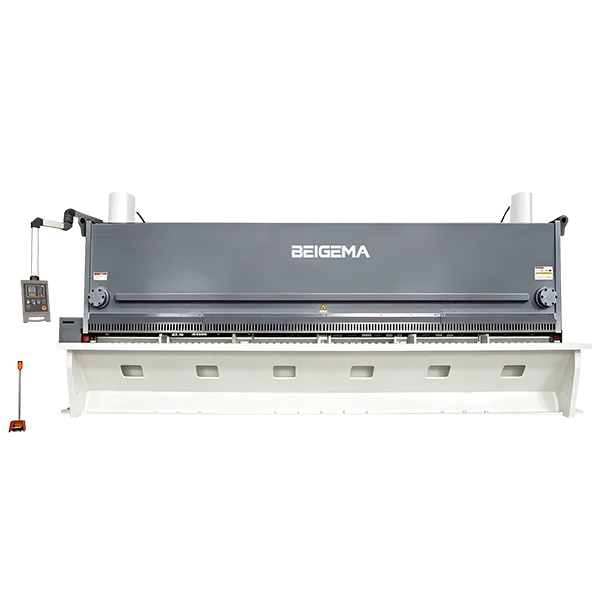
The catalog tables below describe standard models. They are not universal application promises. Controller, axes, working range, tolerances and included components must be confirmed in the signed technical quotation for the selected machine.
Why Tensile Strength Sets the Real Capacity Limit
Shearing stainless is not the same as shearing mild steel of equal thickness. Stainless grades often carry higher tensile strength, and the shear force rises with that strength. A machine rated for a given thickness at a stated tensile ceiling may not be suitable for the same thickness in a stronger grade. The QC12K swing-beam product table, whose model rows use QC12Y notation, states a tensile-strength condition. The QC11Y guillotine table reproduced here does not state that condition; obtain the applicable material strength from the seller before using its thickness rating.
Do not infer a safe load from machine force alone. The published force or motor power does not tell you what a specific stainless grade will do to the blade, the hold-down, or the frame. Ask the seller to confirm the maximum thickness for your exact grade and width against the catalog row. If the grade is unknown, the capacity is unconfirmed, not zero and not equal to the mild-steel row.
Blade clearance is the second half of the strength question. A gap that suits mild steel can overload the edge or leave a heavy burr in stainless. The correct clearance depends on material type and thickness together. The machine may offer manual or automatic gap adjustment, but the setting for your job must be confirmed against the material certificate and the seller’s recommendation for that model.
Steel Plate Guillotine and Swing Beam Capacity by Thickness
The two common hydraulic shear families differ in blade motion. The guillotine type moves the blade carrier in a straight line, while the swing beam type pivots the carrier in an arc. Both can be ordered in several thickness and width combinations. The tables below are catalog descriptions for the listed models, not a promise that every row suits every stainless grade.
QC12Y swing beam shearing machine, 3200 mm width, by thickness
| Model | Thickness (mm) | Width (mm) | Tensile Strength | Shearing Angle (°) | Strokes (min⁻¹) | Backgauge Range | Main Power (kW) |
|---|---|---|---|---|---|---|---|
| QC12Y-6×3200 | 6 | 3200 | ≤ 450 | 1° 30′ | 16 | 20~600 | 7.5 |
| QC12Y-8×3200 | 8 | 3200 | ≤ 450 | 1° 30′ | 10 | 20~600 | 11 |
| QC12Y-10×3200 | 10 | 3200 | ≤ 450 | 1° 30′ | 10 | 20~600 | 15 |
| QC12Y-12×3200 | 12 | 3200 | ≤ 450 | 2° | 9 | 20~600 | 18.5 |
See the QC12K swing beam shearing machine page for the pivoting-arc family and its configuration notes, and browse all hydraulic shearing machines for other widths.
QC11Y hydraulic guillotine shearing machine, 3200 mm width, by thickness
| Model | Thickness (mm) | Width (mm) | Strokes (min⁻¹) | Backgauge Range | Shearing Angle (°) | Throat Height (mm) | Motor Power (kW) |
|---|---|---|---|---|---|---|---|
| QC11Y-6×3200 | 6 | 3200 | 14-35 | 20-600 | 0.5°-1.5° | 800 | 7.5 |
| QC11Y-8×3200 | 8 | 3200 | 12-30 | 20-600 | 0.5°-2° | 850 | 11 |
| QC11Y-12×3200 | 12 | 3200 | 12-25 | 20-800 | 0.5°-2° | 900 | 18.5 |
| QC11Y-16×3200 | 16 | 3200 | 12-20 | 20-800 | 0.5°-2.5° | 900 | 22 |
| QC11Y-20×3200 | 20 | 3200 | 10-20 | 20-800 | 0.5°-3° | 950 | 30 |
| QC11Y-25×3200 | 25 | 3200 | 8-15 | 20-800 | 0.5°-3.5° | 950 | 37 |
| QC11Y-30×3200 | 30 | 3200 | 8-12 | 20-1000 | 0.5°-4.0° | 1100 | 45 |
| QC11Y-40×3200 | 40 | 3200 | 4-10 | 20-1000 | 0.5°-4.0° | 1200 | 55 |
The QC11Y hydraulic guillotine shearing machine page lists the straight-travel family and its standard and optional items. Compare the two motions in the guillotine vs swing beam shearing machine comparison before choosing a frame.
Blade Clearance Changes With Material, Not Just Thickness
Blade clearance is a material decision as much as a thickness decision. Stainless work-hardens and resists shearing differently from aluminum, so the same thickness can need a different gap. The QC12K page describes a purely mechanical gap adjustment with a graduated handwheel, while the QC11Y page describes automatic blade gap adjustment that sets clearance from thickness and material. Those are different setup paths, and neither removes the need to confirm the correct value for your grade.
Do not add arbitrary derating factors to the catalog numbers. If the material certificate shows a tensile strength above the catalog column, the row does not apply. If the certificate is missing, the value is unknown and must be confirmed with the seller. A gap set too wide can leave a rolled edge or heavy burr; a gap set too narrow can raise cutting force and blade wear. The acceptance cut is where the chosen gap is proven on the actual sheet.
Blade condition matters too. The shear blade sharpening and maintenance guide explains edge care. A dull edge can mimic a gap problem, so inspect the blade before blaming the setting.
Guillotine or Swing Beam for Stainless and Aluminum Work
The blade carrier motion changes how the sheet is stressed during the cut. The table below labels the two motions as described in the product text. It is a guide to the mechanism, not a claim that one type is always better for a given material.
| Family | Blade carrier motion | Catalog description to verify |
|---|---|---|
| QC11Y | Straight travel | Guillotine frame with straight-line blade carrier; automatic gap adjustment described on the product page |
| QC12K | Pivoting arc | Swing beam frame with beveled-arc blade entry; mechanical gap adjustment described on the product page |
The QC12K page states that its blade cuts in with a beveled arc and is suitable for long plates, thin plates and stainless steel. That is a catalog description, not a universal guarantee for every stainless grade or thickness. The QC11Y page describes a robust structure and smooth, burr-free cuts, again as catalog language. Buyers should treat both as starting points for a trial cut on their own material.
For aluminum, the same motion question applies, but surface protection becomes more prominent. Aluminum is softer and can mark or scratch during handling and hold-down. The machine type does not remove that risk. Confirm with the seller which hold-down, support and surface-protection options are included or optional for the selected model.
Protecting Aluminum Sheet and Setting Up the Job
Aluminum sheet needs clean handling before the blade touches it. Grit on the table, a rough hold-down foot, or a burr on the back gauge can mark the surface. Ask what the seller confirms for the working surfaces and hold-down contact points on your selected model. Some machines list pneumatic supporters or front and back light protection as optional items; those are configurable equipment, not standard inclusions unless the quotation says so.
Set the job around the material certificate, not around a guess. The buyer should supply the grade, temper, thickness, width and length, plus the tensile strength from the certificate if available. The seller should confirm the matching catalog row, the blade gap logic for that grade, the blade carrier motion, and which options are included. The acceptance part then demonstrates the result: burr height, flatness, twist and surface condition on the actual sheet.
For a repeatable record, use the blank table below. An em dash means the value is unconfirmed, not zero. Fill each row from the certificate, the quotation, or the trial cut.
| Record step | Part or material | Value or result | Confirmed by |
|---|---|---|---|
| Material certificate | — | Grade —, temper —, tensile — | — |
| Parameter confirmation | — | Catalog row —, gap setting —, blade motion — | — |
| Trial cut | — | Thickness —, width —, length —, quantity — | — |
| Burr and deformation record | — | Burr —, flatness —, twist —, surface — | — |
Keep the record with the machine file. If a later production run uses a different grade, the old record does not carry over. The tensile strength and gap logic must be confirmed again for the new certificate.
Shearing Stainless Steel and Aluminum FAQs
Can I use the carbon steel rating directly for stainless? No. Where the catalog states a tensile-strength limit, compare the material certificate with it. Where that condition is absent, ask the seller to state it and confirm the maximum thickness for your grade and width. If the certificate is missing, the capacity is unconfirmed.
How do I protect the aluminum surface? Confirm the hold-down contact points, table condition and any optional support or protection items in the quotation. Handle sheets cleanly and inspect the back gauge and blade for burrs. The machine type alone does not protect the surface.
Is a burr a clearance problem or a blade problem? It can be either. Inspect the blade first, then confirm the gap setting for the material and thickness. A dull edge and a wrong gap can produce similar symptoms, so record both before changing anything.
What material information should I send for a quotation? Send the grade, temper, thickness, width and length, plus the tensile strength from the material certificate. Use the BEIGEMA contact page to send your material grade and sheet dimensions so the seller can match the catalog row and confirm the gap logic.
For related equipment, the Handheld and Portable Laser Welder: Joint Verification covers a different process and requires a controlled laser work area with a competent laser-safety assessment; eyewear alone is insufficient. The BEIGEMA sheet metal shears range is the starting point for the shear families discussed here.
Related selection reference: Handheld and Portable Laser Welder: Joint Verification. The QC12K swing beam shearing machine provides the supplier specification behind the shortlist.
Compare BEIGEMA sheet metal shears against this job brief, then send your shearing stainless requirements for a configuration review.
For factory specification sheets and controller configurations across this machinery series, compare our BM Series Handheld Fiber Laser Welding Machine 1KW to 2KW.
Related pages
Related guides
- Guillotine vs Swing Beam Shearing Machine: Which Should You Choose?
- Shear Blade Sharpening and Maintenance: Gap, Wear and Blade Life
- Sheet Metal Shear Buying Guide: Capacity, Rake Angle and Blade Gap
- Sheet Metal Shearing Defects: Why Parts Twist, Bow and Camber
- Metal Shear Types: Blade Paths and Acceptance Checks
- Shearing Machine Capacity Chart: Verify the Cutting Job