
Metal shear types split into four working groups: hydraulic guillotine shears, hydraulic swing beam shears, the shear stations on a hydraulic ironworker, and manual hand shears. BEIGEMA builds the first two for batch sheet cutting — the QC11Y guillotine is catalogued from 6 mm to 40 mm and the QC12K swing beam (listed as QC12Y-… model rows on its spec sheet) from 6 mm to 12 mm — while bars and angles belong to the ironworker line and hand shears sit outside the product range.
Every hydraulic model on this page is listed in the hydraulic shearing and sheet metal cutting machine category.
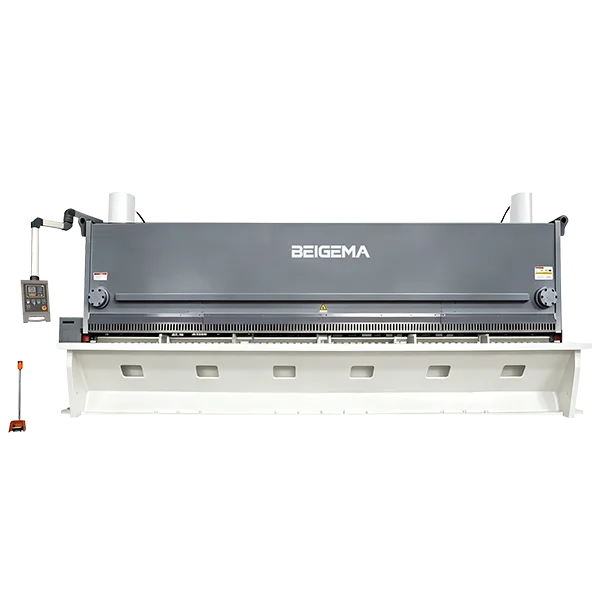
1. Hydraulic Guillotine Shear (QC11Y): Upper Blade on a Straight Guide
On this design the upper blade travels on a guided path over a fixed lower blade, and hydraulic power moves the blade carrier through the cut. The QC11Y is the BEIGEMA guillotine; with the E21S system it stores backgauge positions as multi-step programs, and its automatic blade gap adjustment sets the clearance from the entered thickness and material.
What the QC11Y table lists:
- Shearing thickness of 6, 8, 12, 16, 20, 25, 30 and 40 mm.
- Shearing width 2500 mm to 6000 mm: 6 mm to 20 mm models up to 6000 mm, 25 mm up to 4000 mm, 30 mm and 40 mm up to 3200 mm.
- Adjustable shearing angle: 0.5°–1.5° on the 6 mm models, 0.5°–4.0° on the 30 mm and 40 mm models.
- Backgauge 20–600 mm, 20–800 mm or 20–1000 mm by model; throat height 800 mm to 1200 mm; motor power 7.5 kW to 55 kW.
- Automatic blade gap adjustment from the entered thickness and material, so the operator doesn’t tune the gap by hand.
Who should buy one: shops whose thickness changes job to job, anyone above 12 mm who needs heavy duty metal shears, and buyers who want angle and gap under controller command; the full table is on the QC11Y hydraulic guillotine shearing machine page.
2. Hydraulic Swing Beam Shear (QC12K Series): Blade Carrier on an Arc
Here the upper blade carrier swings on pivots, and the QC12K page describes the cut as entering with a beveled arc that needs less force and keeps the sheet from warping. Its models are tabulated as QC12Y-6×2500 to QC12Y-12×3200. Blade gap is adjusted mechanically through a graduated handwheel, which the page credits with a simple structure and low maintenance cost, so this hydraulic sheet metal shear is often shortlisted for straightforward repeat cutting.
- Thickness of 6, 8, 10 and 12 mm, each row rated against a Tensile Strength column printed at ≤ 450 with no unit beside it.
- Width 2000 mm to 6000 mm; the 12 mm models are listed at 2000 mm and 3200 mm only.
- Fixed shearing angle: 1° 30′ on the 6 mm to 10 mm models, 2° on the 12 mm models.
- Strokes per minute from 18 (QC12Y-6×2500) to 6 (QC12Y-8×6000, QC12Y-10×6000); main power 7.5 kW to 18.5 kW.
- Backgauge range 20~600 mm or 20~800 mm with CNC automatic positioning; blades made of Cr12MoV.
Who should buy one: enclosure and general sheet-metal shops cutting up to 12 mm in repeat batches where a fixed shearing angle isn’t a limitation. See the QC12K hydraulic swing beam shearing machine.
3. Plate Shears and Angle Shears on Ironworkers
“Plate shear” in a supplier catalog usually means the shear stations on a hydraulic ironworker, a combined punching and shearing machine. The BEIGEMA Q35Y range integrates punching, shearing of channel and angle steel, shearing of thick plates, cutting of round and square bar, and corner cutting; its own product page points plate cutting across a full sheet to the hydraulic shearing machines. Station capacities vary by model, and the tradeoffs between one ironworker and dedicated machines are compared in the ironworker vs separate machines guide.
Hand shears (snips), bench-mounted lever shears and air powered sheet metal cutters are manual trimming tools that are not part of the BEIGEMA product line; batch cutting of sheet starts at the 6 mm rows of the two hydraulic tables above.
4. Capacity Comparison: QC11Y Guillotine vs QC12K Swing Beam
Sizes listed in both series come first, then guillotine-only sizes; a dash means not listed. The QC11Y stroke column is a range because that table covers its adjustable settings.
| Thickness × width (mm) | QC11Y strokes (min⁻¹) | QC11Y motor (kW) | QC12K strokes (min⁻¹) | QC12K motor (kW) |
|---|---|---|---|---|
| 6 × 2500 | 16–35 | 7.5 | 18 | 7.5 |
| 6 × 3200 | 14–35 | 7.5 | 16 | 7.5 |
| 6 × 4000 | 10–30 | 7.5 | 12 | 7.5 |
| 6 × 6000 | 8–25 | 11 | 7 | 11 |
| 8 × 3200 | 12–30 | 11 | 10 | 11 |
| 8 × 6000 | 8–20 | 15 | 6 | 15 |
| 12 × 3200 | 12–25 | 18.5 | 9 | 18.5 |
| 16 × 3200 | 12–20 | 22 | — | — |
| 20 × 3200 | 10–20 | 30 | — | — |
| 25 × 3200 | 8–15 | 37 | — | — |
| 30 × 3200 | 8–12 | 45 | — | — |
| 40 × 3200 | 4–10 | 55 | — | — |
Evidence first: at 6 × 3200 both series list 7.5 kW and the guillotine’s 14–35 stroke range brackets the swing beam’s 16, so motor power doesn’t separate hydraulic metal shears below 12 mm. Above 12 mm only the QC11Y column has entries, 22 kW at 16 mm to 55 kW at 40 mm. Conclusion: below 12 mm choose by adjustment range and duty; above 12 mm the type question answers itself. The tier-by-tier numbers behind this table, including every intermediate bed length, are in the shearing machine capacity chart.
5. Which Metal Shear Type Should You Buy?
So which type fits your parts? Match the thickest material you cut in batches to the tables, then the longest cut, then how often the job changes.
- Enclosure and panel work at 6 mm, cuts to 2500 mm or 3200 mm: QC12Y-6×2500 or QC12Y-6×3200 first; the QC11Y-6 sizes when the shearing angle has to change between jobs.
- Structural plate at 12 mm over 4000 mm: QC11Y-12×4000 (8–20 strokes/min, 18.5 kW).
- Sheet steel guillotine work from 16 mm to 40 mm: QC11Y only, widths to 6000 mm up to 20 mm and 3200 mm at 30 mm and 40 mm.
- Long sheets to 6000 mm: QC12K at 6, 8 and 10 mm, QC11Y at 6 mm through 20 mm.
- Bars, angles and notched corners: an ironworker plate shear. Trimming and curves on thin sheet: a hand or air powered shear.
How the two blade paths behave in service, and what to verify on each, are compared in the guillotine vs swing beam shearing machine comparison; the purchase checks for capacity, rake and gap are collected in the sheet metal shear buying guide. Whatever the type, gap and blade condition decide the edge — the shear blade sharpening and maintenance guide covers wear, sharpening and setting.
Metal Shear Types FAQs
Which shear type suits thin steel enclosure panels?
Both series start at 6 mm. For enclosure panels we’d shortlist the QC12Y-6×2500 (18 strokes/min, 7.5 kW) or QC12Y-6×3200 (16 strokes/min, 7.5 kW); the QC11Y-6×2500 adds an adjustable 0.5°–1.5° shearing angle and automatic blade gap adjustment.
New QC12K swing beam shear or a used machine: how do I decide?
Check the used machine’s blade gap adjustment, hold-downs, backgauge travel and squareness with a trial cut before weighing it against a new QC12Y-6×3200 (16 strokes/min, 20~600 mm backgauge, 7.5 kW). Worn guides on a guillotine don’t beat a new swing beam with the adjustment you need.
What should a 12 mm × 4000 mm hydraulic guillotine include for structural steel?
QC11Y-12×4000 lists 8–20 strokes/min, a 20–800 mm backgauge, a 0.5°–2° shearing angle, 940 mm throat height and 18.5 kW. Prioritize the adjustable shearing angle, automatic blade gap adjustment and backgauge range, then set the gap for your actual grade and confirm with a trial cut.
Does my bar and angle work belong on a hydraulic shear or an ironworker?
On the ironworker. The Q35Y stations cover punching, channel and angle shearing, thick-plate shearing, round and square bar cutting and corner cutting in one machine, while the QC11Y and QC12K tables are written for sheet and plate across a cutting width. State your section sizes so the ironworker model, not just the family, can be checked.
Is there a QC12K model for 6 mm × 3200 mm electrical enclosure steel?
Yes: QC12Y-6×3200, rated 6 mm over 3200 mm against the table’s Tensile Strength column (≤ 450, no unit printed), with a fixed 1° 30′ shearing angle, 16 strokes/min, 20~600 mm backgauge and 7.5 kW. Send the steel grade with the inquiry so the rating can be checked.
Tell us the material grade, thickness and cutting length, or send the part drawing through the BEIGEMA contact page, and we’ll match it to a model row.
Related pages
Related guides
- Shearing Machine Capacity Chart: QC11Y 6-40 mm and QC12K 6-12 mm Rows
- Shearing Stainless Steel and Aluminum Sheet: Blade Clearance and Capacity Derating
- Guillotine vs Swing Beam Shearing Machine: Which Should You Choose?
- Shear Blade Sharpening and Maintenance: Gap, Wear and Blade Life
- Sheet Metal Shear Buying Guide: Capacity, Rake Angle and Blade Gap
- Sheet Metal Shearing Defects: Why Parts Twist, Bow and Camber


