
WC67K Series NC Hydraulic Press Brake Machine With E310P Controller System

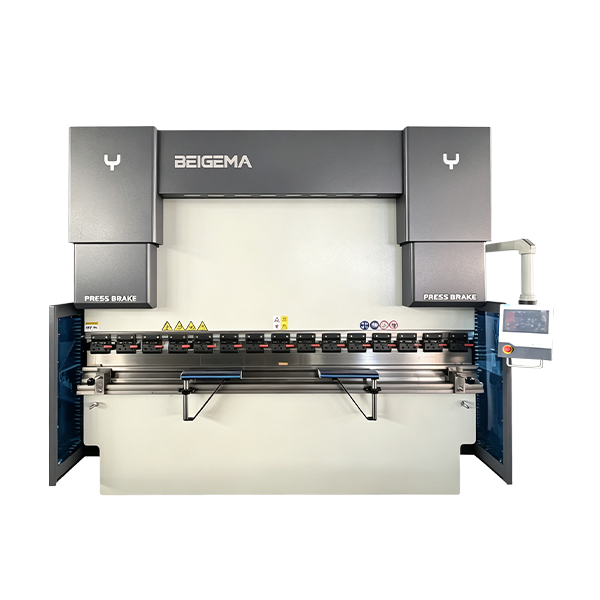
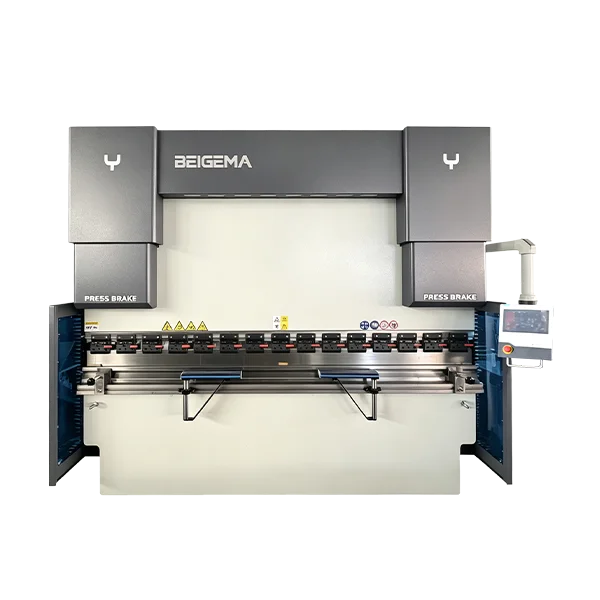
This WC67K page presents the E310P controller configuration for buyers who need a color touch interface and a broader programmed setup. The functions published on the page cover X, Y, R and V, angle programming, programmable material and tooling information, and reference-point teaching. These controller functions help structure the bend setup, while the quotation defines which corresponding hardware is actually supplied on the machine.
Browse all hydraulic press brake machines, or step up to the MB8 CNC press brake with DA-69S.
Configuration note: Controller, axes, working range, tolerances and included components must be confirmed in the signed technical quotation for the selected machine.
When the E310P version fits: The published E310P configuration on this page supports X, Y, R and V-axis functions, angle programming, material and tooling data, and a color touch interface. That makes it the WC67K page to review when the project needs more programmed functions than the basic E21 configuration. The final axis hardware, crowning system and included options must still be confirmed in the technical quotation. Compare the E21 configuration, the TP10S configuration, and our CNC vs NC press brake guide.
Buyer resources: compare press brake machines, learn how to choose a press brake, or compare CNC and NC press brakes.
For an E310P quotation, list which adjustments must be programmed and which may remain manual. Match each requested X, Y, R or V function to the hardware included in the offer, and review the setup using the material and tooling planned for production.
- Model: WC67K
- Controller: E310P
- Capabilities: 30T ~ 400T
- NC Controller: E310P
- Back gauge: X+Y
- Hydraulic valve: Rexroth from Germany
- Gear Pumu: Sunny from USA
- Foot Switch: Kacon from Korea
- Main Motor: Siemens from Germany
- Electric Components: Schneider from France
- Oil Sealing: Japan
- Ball Screw + Linear Guide: HIWIN
- Front Support: BEIGEMA
- Tube Connector: EMB from Germany
- Fast Clamp: BEIGEMA
- Punch and Die: Beigema
- Compensation: Mechanical Crowning
Standard Configurations
Introduction To Components

NC Hydraulic Press Brake Control System E310P
4 axes are supported: X-axis, Y-axis, R-axis, and V-axis. Angle programing Automatically adjust the clamping point position. Materials and die information are programmable. Full colorful touch screen control. Teaching or searching the reference point.
For a setup specified around programmed axes, the E310P description names X-axis, Y-axis, R-axis and V-axis and states support for 4 axes. The E21 description instead identifies X/Y positioning of the back gauge and stop. R and V are therefore explicit controller functions to review in the E310P list when comparing the descriptions.
For work that needs the bend angle entered together with material and die information, E310P combines angle programming with programmable material and die data. Its interface is described as a full-color touch screen, and its functions include automatic clamping-point adjustment. The same controller description also provides a choice of teaching or searching for the reference point.

Front Support Arm
The front support arms of this NC press brake hold large, long and thin sheet metal during feeding, assisting workers while ensuring maximum positioning and bending accuracy. Optional sheet follower systems are available for larger panels.

Upper Punch and Lower Die
The throat size can be customized according to customer requirements. Each press brake comes standard with a set of upper and lower press brake tooling made of 42CrMo high-strength alloy steel, capable of withstanding large bending loads and having a long service life.

Schneider Electrical Components
- Schneider electrical components give the sheet metal machine excellent operational stability and strong anti-interference capability, with superior dustproof, high-temperature and vibration resistance.
- It features comprehensive leakage and misoperation prevention capabilities, ensuring safe and standardized workshop production and meeting global export certification requirements.
- Precise control and improved processing efficiency. It achieves synchronized and coordinated operation of the back gauge, deflection compensation, and front gauge support systems, ensuring consistency in bending dimensions and angles for batches of workpieces.
- Durable and low maintenance costs.

Rexroth Valve
The Rexroth hydraulic valve gives the press brake machine highly precise pressure control, strong dual-cylinder synchronization, and zero deviation in bending angles and dimensions for batch operations.
Stable pressure and fast response, smooth and shock-free operation, excellent bending and forming effect for both thick and thin plates.
Integrated oil circuit with low failure rate, fewer interfaces to reduce oil leakage, vibration reduction and noise reduction, and greater overall machine durability.

Siemens Motor
The Siemens main motor of this hydraulic press brake operates with stable power, providing ample power for the slider’s descent, pressurization, and return. Oil delivery remains stable, ensuring bending accuracy, while also saving energy and extending the overall machine lifespan.
More Details of Hydraulic Press

Back View

Stop Finger

Linear Guide

Back gauge

Fast Clapm

Chain

Limit Switch

Oil Cylinder
NC Hydraulic Press Brake Machine Specification
| Specification | Nominal Pressure (KN) | working table Length | Throat depth (mm) | Ram stroke (mm) | Number of stroke (min 1) | Main Power (Kw) |
|---|---|---|---|---|---|---|
| 40/2200 | 400 | 2200 | 200 | 100 | 11 | 4 |
| 40/2500 | 400 | 2500 | 200 | 100 | 11 | 4 |
| 50/2500 | 500 | 2500 | 200 | 100 | 11 | 5.5 |
| 63/2500 | 630 | 2500 | 250 | 100 | 10 | 5.5 |
| 63/3200 | 630 | 3200 | 250 | 100 | 10 | 5.5 |
| 80/2500 | 800 | 2500 | 320 | 150 | 8 | 7.5 |
| 80/3200 | 800 | 3200 | 320 | 150 | 8 | 7.5 |
| 100/2500 | 1000 | 2500 | 320 | 150 | 8 | 7.5 |
| 100/3200 | 1000 | 3200 | 320 | 150 | 8 | 7.5 |
| 100/4000 | 1000 | 4000 | 400 | 150 | 8 | 7.5 |
| 125/2500 | 1250 | 2500 | 320 | 150 | 8 | 7.5 |
| 125/3200 | 1250 | 3200 | 320 | 150 | 8 | 7.5 |
| 125/4000 | 1250 | 4000 | 400 | 150 | 8 | 7.5 |
| 160/3200 | 1600 | 3200 | 400 | 150 | 8 | 11 |
| 160/4000 | 1600 | 4000 | 400 | 180 | 8 | 11 |
| 160/5000 | 1600 | 5000 | 400 | 180 | 7 | 11 |
| 160/6000 | 1600 | 6000 | 400 | 200 | 7 | 15 |
| 200/3200 | 2000 | 3200 | 400 | 200 | 7 | 15 |
| 200/4000 | 2000 | 4000 | 400 | 200 | 7 | 15 |
| 200/6000 | 2000 | 6000 | 400 | 200 | 7 | 15 |
| 250/3200 | 2500 | 3200 | 400 | 200 | 7 | 18.5 |
| 250/4000 | 2500 | 4000 | 400 | 200 | 7 | 18.5 |
| 250/6000 | 2500 | 6000 | 400 | 250 | 7 | 18.5 |
| 300/3200 | 3000 | 3200 | 400 | 250 | 7 | 22 |
| 300/4000 | 3000 | 4000 | 400 | 250 | 7 | 22 |
| 300/6000 | 3000 | 6000 | 400 | 250 | 7 | 30 |
| 300/7000 | 3000 | 7000 | 400 | 250 | 7 | 30 |
| 400/6000 | 4000 | 6000 | 400 | 250 | 7 | 30 |
| 500/6000 | 5000 | 6000 | 400 | 300 | 7 | 37 |
| 600/6000 | 6000 | 6000 | 400 | 300 | 7 | 37 |
Optional Parts

TP10S

E21

Light Curtain
FAQ
When is the E310P WC67K configuration appropriate?
The E310P page is the WC67K option to review when the bending process needs more programmed functions than the basic E21 workflow. The published controller information supports X, Y, R and V functions, angle programming, programmable material and tooling information, reference-point teaching and a full-color touch interface. Those functions help a buyer organize a more detailed setup, but they do not automatically mean that every quoted machine contains four powered axes.
The machine quotation must identify the actual back-gauge hardware, the R-axis arrangement, the compensation system associated with the V function, and the tooling and safety package. This distinction prevents controller capability from being mistaken for a standard mechanical configuration.
What should be confirmed for an E310P press brake?
- Material, thickness, bend length, target tonnage and the part families to be programmed.
- Which of X, Y, R and V are physically supplied and how each function is driven.
- Tool and material data requirements, back-gauge travel, crowning and guarding.
- Required tolerances, repeat volume, commissioning scope and operator training needs.
For a simpler positioning workflow, compare the E21 WC67K configuration. For X/Y control with angle, tool and multi-program functions, review the TP10S page. Buyers considering a move beyond WC67K can also compare the MB8 with DA-53Tx. Estimate air-bending load with the bending force calculator.
E310P setup workflow on the WC67K platform
The E310P workflow brings material, tool and angle information into the programmed setup through a full-color touch interface. Its published X, Y, R and V functions give the operator a framework for controlling or calculating the required movements and compensation. Reference-point teaching supports setup, but the controller capability must be matched to the machine hardware named in the final configuration.
For that reason, an E310P quotation should distinguish every function from the supplied mechanism. It should state how the ram and back gauge are controlled, whether an R-axis movement is physically included, and what system provides the V-related compensation. Working length, tonnage, tooling, back-gauge range and safety equipment remain separate specification lines.
Projects that benefit from the E310P option
- Part families where stored material and tooling information can reduce repeated setup work.
- Jobs that need angle programming and a touch interface for clearer operator input.
- Specifications that explicitly require X, Y, R or V functions and identify the matching hardware.
Send part drawings, material and thickness, bend length, tolerances, repeat volume and the desired axis functions. Then confirm the physical back-gauge, R-axis arrangement, compensation method, tooling and guarding line by line. Buyers who mainly need X/Y program storage and retract functions should compare the TP10S configuration; a simpler routine-positioning requirement may be better served by the E21 version.