
A small bending brake, in the BEIGEMA catalog, is a powered press brake rated from 35 to 63 tons with a bed from 1300 to 3200 mm. The floor of the range is the pure electric 35T 1350 at 350 kN and the WC67K 40/2200 NC hydraulic at 400 kN; the MB8 CNC hydraulic line starts at 63T/1300. Thin, short and varied parts usually land on one of these eleven rows; long, thick plate pushes the sizing math one step up.
Every row below is a catalog row from our press brake machine range, with the electric line included because it holds the smallest model we build.
1. What a small bending brake is, and what it isn’t
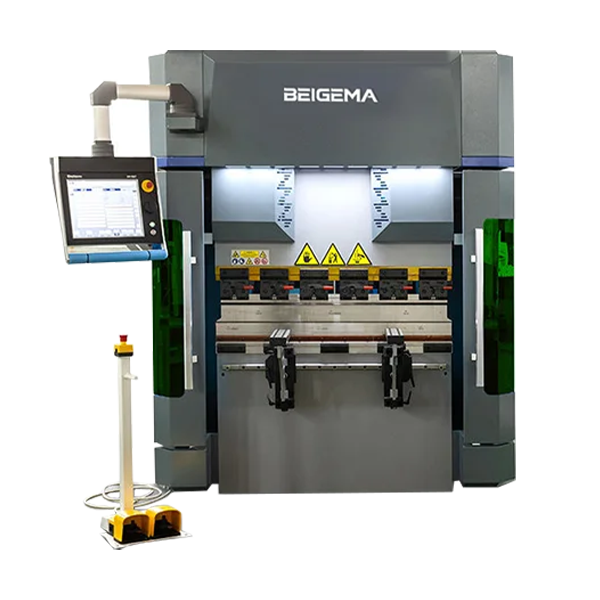
A small sheet metal brake or small sheet metal bender can mean two different tools. A manual box-and-pan brake folds thin sheet with a hand lever and a clamping bar: no ram, no cylinder, no programmable back gauge. A small press brake is a powered machine: the ram drives a punch into a V-die, a back gauge positions the sheet, and a controller stores the sequence.
BEIGEMA builds the second kind only. The compact press brake rows sit at 35, 40, 50 and 63 tons across three drives: pure electric (35T 1350 to 63T 2500), WC67K NC hydraulic with the E21 controller (40/2200 to 63/3200), and MB8 CNC hydraulic with the Delem DA-66S (63T/1300 and 63T/2500).
Why does the electric line start lower than the hydraulic one? The product page describes the 35T 1350 as an all-electric CNC press brake with zero oil leaks; its sheet prints a 2280×1220×2200 mm envelope and 4000 kg, the lightest row we publish.
2. Small press brake models from 35 to 63 tons: one table for three series
Rows are copied from the three product spec tables. “Not listed” means the page doesn’t print that field, not that the machine lacks it.
| Model | Pressure (kN) | Bed length (mm) | Throat depth (mm) | Stroke (mm) | Drive and control | Main motor (kW) | Weight |
|---|---|---|---|---|---|---|---|
| Pure electric 35T 1350 | 350 | 1350 | 200 | 180 | All-electric, CNC | 2*8.6 | 4000 kg |
| Pure electric 50T 1650 | 500 | 1650 | 300 | 200 | All-electric, CNC | 2*16 | 4800 kg |
| Pure electric 63T 2050 | 630 | 2050 | 300 | 200 | All-electric, CNC | 2*21 | 6300 kg |
| Pure electric 63T 2500 | 630 | 2500 | 300 | 200 | All-electric, CNC | 2*21 | 6800 kg |
| WC67K 40/2200 | 400 | 2200 | 200 | 100 | Hydraulic, E21 NC | 4 | not listed |
| WC67K 40/2500 | 400 | 2500 | 200 | 100 | Hydraulic, E21 NC | 4 | not listed |
| WC67K 50/2500 | 500 | 2500 | 200 | 100 | Hydraulic, E21 NC | 5.5 | not listed |
| WC67K 63/2500 | 630 | 2500 | 250 | 100 | Hydraulic, E21 NC | 5.5 | not listed |
| WC67K 63/3200 | 630 | 3200 | 250 | 100 | Hydraulic, E21 NC | 5.5 | not listed |
| MB8 63T/1300 | 630 | 1300 | 350 | 100 | Hydraulic, Delem DA-66S CNC | 5.5 | 5.8 T |
| MB8 63T/2500 | 630 | 2500 | 350 | 170 | Hydraulic, Delem DA-66S CNC | 5.5 | 5.8 T |
- Bed length is the real spread: 1300 and 1350 mm at the short end, 3200 mm at the long end, and 2500 mm the only length all three series share at 63 tons.
3. Small electric press brake or small hydraulic press brake?
The 63 ton, 2500 mm combination exists in all three series, so it makes the cleanest comparison. Evidence first, then the call.
| Published field | WC67K 63/2500 (E21 NC) | MB8 63T/2500 (DA-66S CNC) | Pure electric 63T 2500 |
|---|---|---|---|
| Pressure (kN) | 630 | 630 | 630 |
| Bed / bending length (mm) | 2500 | 2500 | 2500 |
| Column distance (mm) | not listed | 1900 | 2000 |
| Throat depth (mm) | 250 | 350 | 300 |
| Ram / slider stroke (mm) | 100 | 170 | 200 |
| Max opening height (mm) | not listed | 380 | 470 |
| X-axis travel (mm) | not listed | 500 | 600 |
| R-axis travel (mm) | not listed | not listed | 200 |
| Back stoppers (pcs) | not listed | 2 | not listed |
| Strokes per minute | 10 | not listed | not listed |
| Bending / return speed (mm/s) | not listed | not listed | 0-30 / 200 |
| Main motor (kW) | 5.5 | 5.5 | 2*21 |
| Average power (kW) | not listed | not listed | 2.7 |
| Length × width × height (mm) | not listed | 3100×1450×2050 | 3260×1380×2505 |
| Weight | not listed | 5.8 T | 6800 kg |
The WC67K NC press brake with E21 controller is the plain hydraulic choice: X/Y positioning, multi-step program storage, a Rexroth valve and 42CrMo upper and lower tooling as standard. It suits straight flanges in short runs; the press brake controller comparison shows where the E21 sits among our six controller options.
The MB8 CNC press brake with DA-66S is the small cnc press brake in this tier: 2D graphical touch programming on a 24-inch display, a 350 mm throat and 500 mm X-axis travel on both 63 ton rows. Its 63T/1300 is the shortest CNC bed we publish.
The pure electric press brake is the only series in the tier that publishes speed figures: 0-30 mm/s bending, 200 mm/s return, 200 mm/s feed, plus a 200 mm R-axis on every row. Its two power figures, 2*21 kW main motor and 2.7 kW average, aren’t interchangeable; ask what duty cycle sits behind the average.
4. Floor space and weight of a compact press brake
A small shop usually asks about the footprint before the tonnage. Two series print overall dimensions; the WC67K page doesn’t, so ask us for its layout drawing.
| Model | Length × width × height (mm) | Weight | Column distance (mm) | Opening (mm) | X-axis travel (mm) |
|---|---|---|---|---|---|
| Pure electric 35T 1350 | 2280×1220×2200 | 4000 kg | 900 | 430 | 400 |
| Pure electric 50T 1650 | 2280×1320×2230 | 4800 kg | 900 | 470 | 400 |
| Pure electric 63T 2050 | 2960×1380×2485 | 6300 kg | 1700 | 470 | 600 |
| Pure electric 63T 2500 | 3260×1380×2505 | 6800 kg | 2000 | 470 | 600 |
| MB8 63T/1300 | 3100×1450×2050 | 5.8 T | 1950 | 340 | 500 |
| MB8 63T/2500 | 3100×1450×2050 | 5.8 T | 1900 | 380 | 500 |
The 35T 1350 and 50T 1650 share the same 2280 mm length and 900 mm column distance, so the step from 35 to 50 tons adds no floor length. The MB8 63T/1300 prints the same 3100×1450×2050 mm envelope as the 63T/2500, so the shorter bed doesn’t shrink the machine. Throat depth, 200 to 350 mm across the tier, sets how far a flange can pass behind the die line.
5. Which thickness and length a small bending brake handles
Capacity comes from the material and the bend, not from the word “small”. Our tonnage calculator page sets the rules: force rises with thickness squared, so 12 mm plate needs far more than twice the tonnage of 6 mm; the estimate assumes a V-die at roughly 8× thickness; and halving the V opening doubles the force and can crack the outer fiber on stainless and high-strength grades.
The 650 constant is calibrated for mild steel at 450 MPa, and the page asks you to verify tensile strength against the mill certificate: Q235 / A36 at roughly 400–450 MPa, stainless 304 at 520–620 MPa, aluminum 5052 at 195–260 MPa. A part that fits 350 kN in aluminum isn’t a 350 kN part in 304.
The full list of published steps, from the 35T 1350 floor to the 1200T/7000 top row, is in the press brake tonnage chart.
Length matters twice: the bed must cover the longest flange in one stroke, and 630 kN over a 2500 mm bend is a different load per meter than over a short bracket. Run the press brake tonnage calculator with your material, thickness, bend length and V opening, take the first catalog step above the result, then read how to choose a press brake for the frame, drive and controller checks. Plates longer than any single bed belong to the tandem press brake for long plate bending, the opposite end of the catalog.
6. Options to confirm on a small metal bending brake
Before ordering any row here, confirm the working length, tonnage, back-gauge travel, and whether any R-axis or crowning function is manual or controlled. Four more items for this size class:
- Crowning. Under load the slider and worktable deform elastically, giving a larger bend angle mid-sheet than at the ends, the “opening error” described on the electric press brake page. Ask whether your row includes mechanical crowning and whether it’s manual or controlled.
- Tooling. Each WC67K comes standard with upper and lower tooling in 42CrMo alloy steel; the electric line uses a quick-clamping fixture with a locking lever. Ask which V openings are in the set, because V size drives the tonnage estimate.
- Back gauge. The electric rows list 400 mm X-axis travel at 35 and 50 tons, 600 mm at 63 tons, and a 200 mm R-axis on every row; the MB8 rows list 500 mm. Match these to your deepest flange.
- Sheet support and safety. The WC67K front support arms hold long, thin sheet during feeding; the electric line lists dual-pedal operation and an elevated red mushroom-style E-stop.
Small Bending Brake FAQs
What is the smallest press brake BEIGEMA builds?
The pure electric 35T 1350: 350 kN, 1350 mm bed, 200 mm throat, 180 mm slider stroke, 2280×1220×2200 mm overall and 4000 kg. The smallest hydraulic row is the WC67K 40/2200 at 400 kN, and the smallest CNC hydraulic row is the MB8 63T/1300 at 630 kN.
Should a small shop choose an electric or a hydraulic small press brake for thin sheet?
Start from the part mix, not the drive. Thin, repeated work fits the electric rows: 350 to 630 kN, 1350 to 2500 mm beds, 0-30 mm/s bending speed and a 200 mm R-axis. A shop that also runs longer plate now and then gets more bed in the same tonnage class from the WC67K 63/3200. Run the calculator on the thickest part first.
How much floor space does a compact press brake take?
The electric 35T 1350 and 50T 1650 both print 2280 mm length, at 1220 and 1320 mm width; the 63T 2050 prints 2960×1380×2485 mm and the 63T 2500 prints 3260×1380×2505 mm. Both MB8 63 ton rows print 3100×1450×2050 mm at 5.8 T. The WC67K page doesn’t print dimensions.
Can a small cnc press brake bend 6 mm plate?
Only the calculation can say. Required force depends on tensile strength, thickness squared, bend length and V opening; the 650 constant on our calculator assumes mild steel at 450 MPa and a V-die near 8× thickness. If the result sits above 630 kN, the 63-ton rows are too small; the next hydraulic steps are the WC67K 80/2500 and 80/3200, and the next CNC row is the MB8 100T/3200.
How do I verify crowning and controller claims on a small press brake quote?
Have the controller model, the number of controlled axes, and whether crowning and the R-axis are manual or controlled written into the signed technical quotation; a claim that isn’t in it isn’t part of the order.
To match a part to a row, send the drawing with the thickness, material and longest bend, and tell us whether the machine has to fit a fixed floor space.
Related pages
Related guides
- Press Brake Tonnage Chart: 35T–1200T Models by Bed Length (WC67K, MB8, Electric, Tandem)
- How to Choose a Press Brake: A 7-Step Buyer’s Guide
- CNC vs NC Press Brake: Which One Do You Actually Need?
- Press Brake Controllers Compared: E21 vs DA53T vs DA66S vs DA69S
- Press Brake Tonnage Calculator
- Hydraulic vs Electric Press Brake: Which Is Better?
- Press Brake Maintenance Checklist: Daily, Monthly and Annual Tasks
- What Industries Use Press Brakes? 9 Real Applications
Machines this guide applies to
- MB8 Series CNC Hydraulic Press Brake Machine with DA-53Tx 4+1 Axis
- MB8 SERIES CNC HYDRAULIC PRESS BRAKE MACHINE WITH DA66S 6-8 AXIS
- MB8 SERIES CNC HYDRAULIC PRESS BRAKE MACHINE WITH DA69S 6-8 AXIS
- Pure Electric Press Brake Bending Machine
- Tandem Press Brake Machine for Long Plate Bending
- WC67K Series NC Hydraulic Press Brake Machine With E21 Controller System
- WC67K Series NC Hydraulic Press Brake Machine With E310P Controller System
- WC67K Series NC Hydraulic Press Brake Machine With TP10S Controller System
