
MB8 SERIES CNC HYDRAULIC PRESS BRAKE MACHINE WITH DA66S 6-8 AXIS

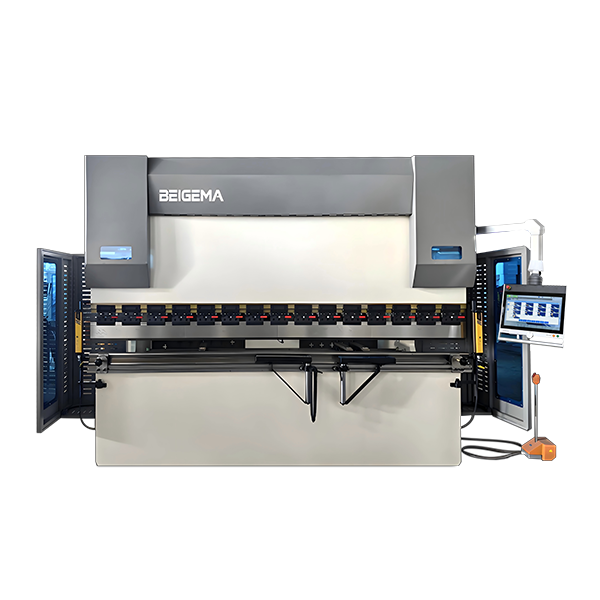
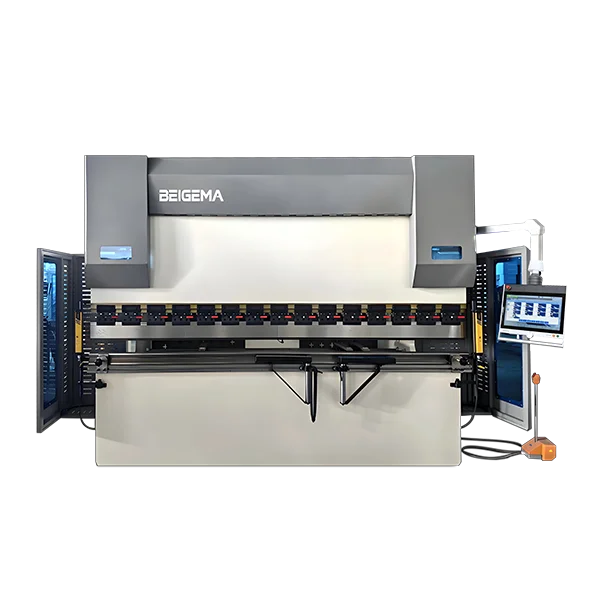
This MB8 configuration pairs the hydraulic press brake platform with the Delem DA-66S workflow. The controller information published on this page emphasizes 2D graphical touch programming, a 24-inch display, 3D machine representation during simulation and production, and Profile-S2D offline software. It is intended for teams that want visual programming and sequence review while preparing most parts in 2D.
Browse all CNC and NC hydraulic press brake machines, or see the economical WC67K NC press brake.
Configuration note: Controller, axes, working range, tolerances and included components must be confirmed in the signed technical quotation for the selected machine.
Why choose the DA-66S configuration: Delem describes the DA-66S as a 2D graphical control with a 24-inch touch display, 3D machine representation, Modusys compatibility and Profile-S2D offline software. This page therefore covers the 2D-focused DA-60S configuration; the final number of controlled axes and machine options still depends on the signed technical quotation. See the official Delem DA-66S overview, compare the DA-69S MB8 model, or review CNC vs NC press brakes.
Buyer resources: compare press brake machines, learn how to choose a press brake, or compare CNC and NC press brakes.
For DA-66S evaluation, use a real multi-bend part to review the 2D programming workflow and the machine representation together. Identify bends that require repositioning, different tools or clearance checks before deciding which machine axes and options belong in the quotation.
- Model: MB8
- Controller: DA-66S
- Capabilities: 30T ~ 1000T
- NC Controller: DA-66S
- Back gauge: Y1+Y2+X+R
- Hydraulic valve: Rexroth from Germany
- Gear Pumu: Sunny from USA
- Foot Switch: Kacon from Korea
- Main Motor: Siemens from Germany
- Electric Components: Schneider from France
- Oil Sealing: Japan
- Ball Screw + Linear Guide: HIWIN
- Front Support: BEIGEMA
- Grating ruler: FAGOR
- Fast Clamp: BEIGEMA
- Punch and Die: Beigema
- Sealing ring: PARKER-UAS
- Compensation: Mechanical Crowning
Standard Configurations
Introduction To Components

DA-66S controller system
- 2D graphical touch screen programming mode
- 3D machine representation, in simulation and production
- 24″ high resolution color TFT
- Delem Modusys compatibility (module scalability and adaptivity)
- USB, peripheral interfacing
- User specific application support within the control’s multitasking environment
- Sensor bending & correction interface
- Profile-S2D offline software

Standard Two V Die
The CNC double V-die features a dual-groove integrated design, allowing for quick switching without tool setting. It boasts high precision, wear resistance, and durability, ensuring smooth bending and positioning. Compatible with various CNC press brake machines, it produces high-efficiency, well-formed finished products — see the full range of press brake toolings.

Front Support Arm
Stable front support for large and long workpieces on the CNC press brake: the support plate is made of high-strength aluminum alloy profile, which has good load-bearing capacity and effectively prevents sagging and deformation when the plate is bent, ensuring the dimensional and angular accuracy of the workpiece and avoiding warping errors.

8+1 AXIS BACK GAUGE
The 8+1 axis press brake back gauge bends long and short plates, thick plates, and stainless steel with zero angular deviation from start to finish, eliminating the need for manual fine-tuning. It is suitable for complex multi-bending, and with 8-axis back gauge multi-directional positioning + W-axis compensation, it can form irregularly shaped, long, and large parts in one go, making it suitable for mass production of cabinets, new energy, chassis, and precision sheet metal.

Proportional Valve
Bosch Rexroth servo proportional valves offer closed-loop control, fast response, high accuracy (±0.01mm), high pressure resistance, durability, linearly adjustable flow rate, and compatibility with CNC press brake machines, providing stable operation, precise bending, and minimal maintenance.
Featuring high-frequency response, high closed-loop accuracy, shock resistance, long lifespan and steplessly adjustable flow rate, they work with the DA-66S/DA-69S system to ensure accurate bending angles, stable speeds, and low scrap rates.

Siemens Motor
The CNC press brake machine is equipped with an original Siemens CNC system and servo host, which features high precision, fast response, stable multi-axis synchronization, no drift over long periods, intelligent compensation, simple programming, and low failure rate, making it suitable for high-precision batch bending.

Servo Motor
- Rapid response, sensitive start/stop, smooth bending and speed change, fast processing rhythm
- Precise positioning, high accuracy in position and angle control, small finished product error
- Energy-saving and power-saving, low consumption under no-load, more fuel-efficient and power-saving than hydraulic systems
- Quiet operation, low vibration and noise, better workshop environment
- Durable and worry-free, sufficient torque and stable power, low failure rate and long service life
CNC Hydraulic Press Brake Machine DA-66S Specification
| Model | Bending Pressure (kN) | Bending Length (mm) | Column Distance (mm) | Throat Depth (mm) | Slider Stroke (mm) | Max Opening Height (mm) | X-axis Max Distance (mm) | Workpiece Linearity (mm/m) | Rear Gauge Precision (mm) | Back stopper (PCS) | Main Motor (kw) | Length*Width*Height (mm) | Weight (T) |
|---|---|---|---|---|---|---|---|---|---|---|---|---|---|
| 63T/1300 | 630 | 1300 | 1950 | 350 | 100 | 340 | 500 | ≥ 0.3 | 0.05 | 2 | 5.5 | 3100×1450×2050 | 5.8 |
| 63T/2500 | 630 | 2500 | 1900 | 350 | 170 | 380 | 500 | ≥ 0.3 | 0.05 | 2 | 5.5 | 3100×1450×2050 | 5.8 |
| 100T/3200 | 1000 | 3200 | 2700 | 400 | 200 | 420 | 500 | ≥ 0.3 | 0.05 | 3 | 7.5 | 3500×1580×2400 | 8.5 |
| 110T/3200 | 1100 | 3200 | 2700 | 400 | 200 | 420 | 500 | ≥ 0.3 | 0.05 | 3 | 7.5 | 3500×1580×2400 | 8.8 |
| 125T/3200 | 1250 | 3200 | 2700 | 400 | 200 | 420 | 500 | ≥ 0.3 | 0.05 | 3 | 11 | 3500×1580×2400 | 9.5 |
| 135T/3200 | 1350 | 3200 | 2700 | 400 | 200 | 420 | 500 | ≥ 0.3 | 0.05 | 3 | 11 | 3500×1580×2400 | 9.9 |
| 160T/3200 | 1600 | 3200 | 2700 | 400 | 200 | 420 | 500 | ≥ 0.3 | 0.05 | 3 | 11 | 3500×1650×2500 | 11 |
| 175T/3200 | 1750 | 3200 | 2700 | 400 | 200 | 420 | 500 | ≥ 0.3 | 0.05 | 3 | 11 | 3500×1650×2500 | 11 |
| 200T/3200 | 2000 | 3200 | 2700 | 400 | 200 | 420 | 500 | ≥ 0.3 | 0.05 | 3 | 15 | 3500×1680×2550 | 14 |
| 250T/3200 | 2500 | 3200 | 2700 | 400 | 200 | 420 | 500 | ≥ 0.3 | 0.05 | 3 | 15 | 3500×1700×2600 | 15.5 |
| 300T/3200 | 3000 | 3200 | 2700 | 400 | 200 | 420 | 500 | ≥ 0.3 | 0.05 | 3 | 22 | 3500×1800×2730 | 16.8 |
| 400T/4000 | 4000 | 4000 | 3500 | 400 | 320 | 420 | 500 | ≥ 0.3 | 0.05 | 4 | 30 | 4500×2450×3500 | 31 |
| 500T/6000 | 5000 | 6000 | 4900 | 500 | 320 | 600 | 800 | ≥ 0.3 | 0.05 | 6 | 37 | 6500×2810×4500 | 53 |
| 600T/6000 | 6000 | 6000 | 4900 | 500 | 320 | 600 | 800 | ≥ 0.3 | 0.05 | 6 | 45 | 6500×2910×5100 | 68 |
| 800T/6000 | 8000 | 6000 | 4900 | 600 | 400 | 600 | 800 | ≥ 0.3 | 0.05 | 6 | 55 | 6500×2950×5300 | 90 |
| 800T/8000 | 8000 | 8000 | 5900 | 600 | 400 | 600 | 800 | ≥ 0.3 | 0.05 | 8 | 55 | 8500×2950×5900 | 120 |
| 1000T/6000 | 10000 | 6000 | 4900 | 600 | 400 | 600 | 800 | ≥ 0.3 | 0.05 | 6 | 2×37 | 6500×3000×5600 | 100 |
| 1000T/8000 | 10000 | 8000 | 6900 | 600 | 400 | 600 | 800 | ≥ 0.3 | 0.05 | 8 | 2×37 | 8500×3000×6100 | 130 |
| 1000T/10000 | 10000 | 10000 | 8000 | 600 | 400 | 600 | 800 | ≥ 0.3 | 0.05 | 10 | 2×37 | 10500×3000×5850 | 150 |
| 1200T/6000 | 12000 | 6000 | 4900 | 600 | 400 | 800 | 1000 | ≥ 0.3 | 0.05 | 6 | 2×37 | 6500×3100×5850 | 130 |
| 1200T/7000 | 12000 | 7000 | 5900 | 600 | 400 | 800 | 1000 | ≥ 0.3 | 0.05 | 7 | 2×37 | 8500×3100×7150 | 160 |
FAQ
When is the DA-66S configuration the better fit?
The DA-66S version is aimed at bending teams that want graphical programming without making full 3D part programming the center of every job. Its published control package combines 2D graphical touch programming, a 24-inch display, 3D machine representation during simulation and production, and Profile-S2D offline software. This makes it a practical step above entry controller workflows when operators need a clearer visual setup for repeat and mixed-part production.
Choose this page when the job mix is mainly programmed in 2D and the purchasing team still needs an MB8 platform with configurable back-gauge axes and machine options. The controller name does not lock the complete machine specification: working length, tonnage, controlled axes, tooling, deflection compensation and safety equipment remain quotation items.
What should be confirmed in a DA-66S quotation?
- Material grade, maximum thickness, bend length and the parts used to calculate the required tonnage.
- The required back-gauge layout, controlled axes and any front support or sheet-handling option.
- Tooling profiles, crowning arrangement, safety system and included offline-programming package.
- Target angle and dimensional tolerances, production volume and acceptance method.
For jobs that depend on full 3D part programming and visualization, compare the DA-69S MB8 configuration. For a controller-by-controller view, use the press brake controller comparison, then send the part details for configuration review.
DA-66S programming workflow on this MB8 configuration
A typical DA-66S evaluation begins with the part profile rather than the controller name alone. The operator can build the bend in the 2D graphical interface, review the proposed sequence against the 3D machine representation, and then prepare the job for production. Profile-S2D provides an offline route for preparing or reviewing programs away from the press brake. This workflow is useful when a shop handles repeat parts and mixed batches but does not need full 3D part creation for every job.
The controller display and software describe how the job is prepared; they do not define every mechanical item on the machine. The quoted MB8 must separately state working length, tonnage, back-gauge layout, controlled axes, crowning, tooling and safety equipment. Buyers should match those items to actual drawings so the visual programming capability is supported by the correct machine configuration.
Jobs that favor the DA-66S page
- Repeat and mixed-part work where most profiles can be programmed clearly in 2D.
- Teams that want graphical bend-sequence review and machine representation during setup.
- Production that benefits from Profile-S2D preparation without making full 3D programming the primary requirement.
For quotation review, attach representative drawings and identify the material, thickness, bend length, tolerances and expected batch size. Also list the required axes, part-support method, punch and die profiles, crowning arrangement and guarding. This keeps the controller choice tied to the supplied hardware and gives BEIGEMA enough information to compare the requested configuration with the DA-69S version.