
BEIGEMA sizing tool
Press Brake Tonnage Calculator
Estimate the force for a conventional air bend before comparing press brake models. Enter the same material, thickness, active bend length and V-die opening you will use on the shop floor.
The 650 constant is calibrated for mild steel at 450 MPa tensile strength, air bending over a V-die at roughly 8× material thickness. Thickness enters as t², so doubling thickness quadruples the force: 12 mm plate needs far more than twice the tonnage of 6 mm. Halving the V opening doubles the force and can crack the outer fibre, especially on stainless and high-strength grades.
Start with the part. Capacity comes from the material and bend—not the machine name.
02 / Review estimate
Calculation result
Estimate for conventional air bending only. Verify actual tensile strength, tooling load, off-centre limits, working length and forming method before production.
Before selecting a machine
Use the estimate as a starting point
The tool separates the physical bending estimate from the planning allowance, so the two numbers are not confused.
Included in the estimate
- Material tensile-strength factor
- Thickness squared, active bend length and V opening
- Metric and imperial force conversion
- A separate, user-selected planning allowance
Reference tensile strengths — verify against the mill certificate: mild steel Q235 / A36 ≈ 400–450 MPa; stainless 304 ≈ 520–620 MPa; stainless 316L ≈ 485–580 MPa; aluminum 5052 ≈ 195–260 MPa; aluminum 6061-T6 ≈ 290–310 MPa; copper ≈ 220–250 MPa. The presets (450 / 675 / 225 MPa) cover the three common shop cases; use Custom for a certified value.
Requires engineering review
- Bottoming, coining, hemming, offsets or multiple bends
- Tooling load per length and short-segment concentration
- Off-centre bending, high-strength plate and unusual radii
- Final machine model, stroke, daylight and duty cycle
Rule of thumb: V ≈ 8 × thickness for mild steel air bending (6 mm plate → 48–50 mm die). Go wider (10–12×) on thick plate to stay inside machine capacity — the inside radius grows with IR ≈ V ÷ 6, and the minimum flange is about 0.7 × V. Go narrower (6×) only when the drawing demands a tight radius: tonnage rises sharply and the load per metre can exceed a precision die rating (typically 100–120 tf/m).
This calculator covers air bending. Bottoming needs roughly 1.5× the air-bending force; coining needs 3–5×. If the process is bottoming or coining, treat the result as a floor, not a target.
Reference methods: Bystronic tonnage guidance, Wilson Tool air-bending chart, and CINCINNATI load calculator.
Need the result checked?
Send the part drawing to BEIGEMA
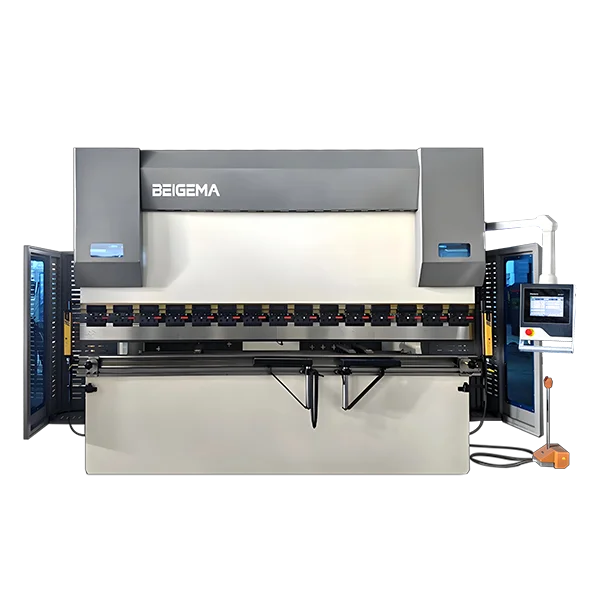
Include material grade, thickness, bend length, V opening, flange geometry, required tolerance and production volume. BEIGEMA can then check capacity, tooling and working length on the same requirement. If the force lands in the NC range, start with the WC67K NC press brake; for graphical CNC work, see the MB8 DA-66S press brake.