
A press brake is a machine that bends sheet metal by pressing a punch into a die. The right one depends less on a catalog headline and more on the part you need to make, how often you make it, and what the seller will confirm in writing. Start with material and part requirements, then choose the production method, then narrow the machine range, and only then set quotation boundaries. That order keeps a low-cost NC machine from being oversold and keeps a CNC package from carrying options you cannot use.
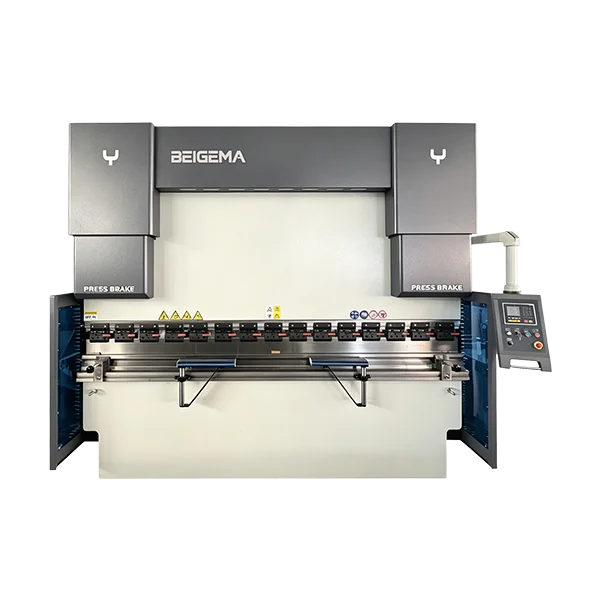
This guide follows that sequence. It keeps the familiar manual, NC, CNC, electric and tandem categories, but treats them as answers to a production question rather than a starting point. Where a value is unknown, it stays blank with an em dash. An unknown is unconfirmed, not zero.
Material and part requirements come first
Before comparing models, write down what the part actually is. The material grade, thickness, bend length, bend radius, hole-to-bend distance, and the smallest flange all affect whether a given machine can form the part at all. A machine rated for a certain force does not automatically mean every tool in it can take that load. Tool safe load is a separate confirmation.
Use the sheet metal gauge chart to translate gauge numbers into thickness and weight, then check the Press Brake Tonnage Chart: Model and Bed-Length Catalog for the force a bend needs. The press brake tonnage calculator helps with a first estimate. Treat those results as catalog guidance, not a qualified process limit. If the material is high-strength steel, stainless, or an unusual alloy, ask the seller to confirm the tooling and force for that grade rather than applying a guessed derating factor.
Part geometry matters as much as tonnage. A deep box needs a throat and stroke that clear the sides. A long, thin panel needs front support and a back gauge that can hold position without sag. A part with many bends needs a controller that stores and repeats a sequence.
Application limitations and what the buyer supplies
Every machine type has boundaries. Manual box and pan brakes and leaf brakes are not in the BEIGEMA catalog, so they are listed for comparison only. Mechanical press brakes are also not in this catalog. A folder or panel bender is not in this catalog either. Do not treat a competitor’s model as a BEIGEMA supply item.
The buyer supplies the drawing, the material specification, the batch size, the changeover frequency, the available floor space, the power supply, and the lifting and handling plan. The buyer also states which dimensions are critical and which are cosmetic. Without that, a seller can only quote a machine, not a process.
The seller confirms the model, the controller, the axes, the tooling interface, the back gauge configuration, the crowning method, the safety devices, the documentation language, and the commissioning scope. The seller also confirms which items are standard inclusions and which are configurable options.
The acceptance part demonstrates the match. Choose a representative part that uses the critical bends, the longest flange, and the tightest radius. Run it on the quoted machine with the quoted tooling. Inspect the angles, the dimensions, and the surface. Record the result against the drawing.
Sheet metal bending machine types compared
The table below summarizes the catalog descriptions for the main families. Force, length, throat, stroke and motor figures are published catalog ranges, not promises for every part. Confirm the exact row for your model in the signed quotation.
| Type / series | Drive and synchronization | Force (kN) | Bending length (mm) | Throat (mm) | Stroke (mm) | Main motor (kW) | Control and back gauge |
|---|---|---|---|---|---|---|---|
| Manual box and pan brake | Not a BEIGEMA line | — | — | — | — | — | — |
| Mechanical press brake | Not in this catalog | — | — | — | — | — | — |
| WC67K NC hydraulic | Two cylinders, torsion shaft | 400–6000 | 2200–7000 | 200–400 | 100–300 | 4–37 | E21, X/Y positioning |
| MB8 CNC hydraulic | Servo proportional valves, W-axis compensation | 630–12000 | 1300–10000 | 350–600 | 100–400 | 5.5–55; 2×37 on 1000T/1200T | DA-66S; 2–10 back stoppers |
| Pure electric | Servo motors, servo crowning | 350–1000 | 1350–3200 | 200–400 | 180–250 | 2*8.6–2*30 (average 1.1–2.7) | CNC, X 400/600 mm, R 200 mm |
| Tandem (two units) | Dual-machine linkage | 2*2500–2*5000 | not listed | 410–500 | 250–300 | 2*18.5–2*30 | CNC back gauge, X axis + optional R axis |
| Folder / panel bender | Not in this catalog | — | — | — | — | — | — |
See the hydraulic press brake machine category for the full range, and compare the WC67K NC hydraulic press brake with E21 controller against the MB8 CNC hydraulic press brake with DA-66S when the part mix is still being defined.
Manual, NC, CNC, electric and tandem: a decision order
Manual box and pan, leaf and hand benders suit simple, low-volume work where the operator sets every bend by hand. They are not in this catalog, so a buyer comparing them should treat them as a separate purchase path. Mechanical press brakes are also outside this catalog. The practical choice inside the BEIGEMA range starts at NC hydraulic and moves up.
NC hydraulic machines such as the WC67K use a torsion shaft to synchronize two cylinders and an E21 controller for X and Y positioning. That suits repeatable straight bends where the operator can manage the sequence.
The decision order is: material and part, then production method, then machine range, then quotation boundary. A shop that bends one thickness of mild steel in long runs may be well served by an NC machine. A shop that bends mixed materials with many bends per part should look at CNC.
Drive, workpiece and changeover matrix
Use this matrix to record what the part needs and what the machine offers. Leave a cell blank with an em dash when the value is not yet confirmed.
| Decision item | NC hydraulic | CNC hydraulic | Pure electric | Tandem |
|---|---|---|---|---|
| Drive and synchronization | Torsion shaft, two cylinders | Servo proportional valves | Servo motors | Dual-machine linkage |
| Typical workpiece | Straight bends, medium thickness | Complex multi-bend parts | Thin to medium sheet, high frequency | Long and wide plates |
| Changeover frequency | Low to moderate | Moderate to high | High | Low to moderate |
| Controller example | E21 | DA-66S | DA53T | DA53T or DA66T |
| Axis and function confirmation | Separate ram from back-gauge positioning | Separate ram, gauging and compensation | Confirm gauging travel and driven functions | Confirm frame linkage and gauging options |
| Tooling confirmation | Standard punch and die set | Double V die, fast clamp | Standard punch and die, fast clamp | Large mold, pin-type clamp |
| Crowning | Mechanical | Mechanical | Servo crowning | Mechanical |
This matrix is a record sheet, not a specification. The exact axes, tooling and crowning for a given order must appear in the quotation. See the pure electric press brake bending machine and the tandem press brake for long plate bending for the catalog descriptions behind those columns.
Tooling and back gauge confirmation items
Tooling and back gauge are where quotations most often drift. The table below lists what to confirm in writing before the order is placed.
| Confirmation item | What to ask | Record |
|---|---|---|
| Punch and die set | Which set is standard, and which is optional? | — |
| Tool safe load | What load can the tool accept, separate from machine force? | — |
| Die opening | Which opening suits the material and radius? | — |
| Fast clamp | Is it standard, and which shank sizes does it take? | — |
| Back gauge axes | Which axes are driven, and which are manual? | — |
| Back gauge travel | What X and R travel is quoted? | — |
| Stop fingers | How many, and what adjustment range? | — |
| Crowning | Mechanical or servo, and is it included? | — |
| Front support | What length and load does it support? | — |
Do not infer a tool’s safe load from the machine’s rated force. A machine may be rated for a force the tool cannot take. Ask for the tool rating separately. The How to Choose a Press Brake: RFQ and FAT Checklist guide covers the broader selection logic, and the Small Press Brake: Fit, Utilities and Delivery Checks page is useful when floor space is the first constraint.
NC and CNC hydraulic press brakes: WC67K with E21 versus MB8 with DA-66S
The WC67K is an NC hydraulic machine with a torsion shaft and an E21 controller. The E21 handles X and Y positioning and stores programs, which covers many straight-bend jobs. The MB8 is a CNC hydraulic machine with a Delem DA-66S controller, servo proportional valves, and a multi-axis back gauge. The product description discusses axis linkage, graphical programming and crowning, while the quotation must identify the configuration supplied. Those are catalog descriptions, not a guarantee for every part.
When is NC enough? When the part has few bends, the material and thickness are stable, the changeover frequency is low, and the operator can manage the sequence. When does CNC pay off?
For CNC, confirm which axes are actually driven. Identify the ram, positioning and compensation axes separately; the exact driven axes and included options must be confirmed in the signed quotation. Do not assume a standard axis set from a model name.
Pure electric and tandem press brakes
Pure electric machines use servo motors and servo crowning. The catalog describes them as low noise and oil-free, with a controller such as the DA53T. They suit high-frequency work on thin to medium sheet where clean operation matters. They are not a universal replacement for hydraulic machines on every part. Confirm the force, the length, and the tooling for the specific job.
Tandem machines link two units. The catalog describes dual-machine linkage where the two machines can operate independently or in sync. The linkage is a control and configuration decision. Do not simply add the tonnage of two units and assume the pair behaves like one larger machine.
Folding machines and panel benders versus a press brake
Folding machines and panel benders are not in this catalog. They are a different forming method, often suited to specific part families. A buyer comparing them with a press brake should treat them as a separate purchase path and confirm the tooling, the control, and the acceptance part for that method. Do not assume a folder can replace a press brake for every bend, and do not assume a press brake can replace a folder for every part.
Which press brake metal sheet shops should buy: capacity table and decision rules
Use the capacity table below to record the part and the candidate machine. The table is a record sheet. The numbers for a specific model come from the catalog row and the signed quotation.
| Record | Part requirement | Candidate machine | Confirmed by seller |
|---|---|---|---|
| Material and grade | — | — | — |
| Thickness | — | — | — |
| Bend length | — | — | — |
| Smallest flange | — | — | — |
| Bend radius | — | — | — |
| Bends per part | — | — | — |
| Batch size | — | — | — |
| Changeover frequency | — | — | — |
| Controller and axes | — | — | — |
| Tooling and safe load | — | — | — |
| Acceptance part | — | — | — |
The decision rules are simple. If the part fits an NC machine and the changeover frequency is low, NC is enough. If the part mix is wide and the angle consistency matters, look at CNC. If the work is high-frequency and clean operation matters, look at electric.
For a first conversation, bring the drawing and the record sheet to the BEIGEMA contact page and ask the seller to confirm the model, the axes, the tooling, and the acceptance part in writing.
Sheet Metal Bending Machine Types FAQs
What is the difference between a mechanical and a hydraulic press brake? A mechanical press brake uses a flywheel and clutch to drive the ram, while a hydraulic press brake uses cylinders and hydraulic pressure. Mechanical press brakes are not in this catalog. Hydraulic machines such as the WC67K and MB8 use two cylinders with synchronization, and the control method differs between NC and CNC.
When is an NC controller enough? An NC controller such as the E21 is enough when the part has few bends, the material and thickness are stable, the changeover frequency is low, and the operator can manage the sequence. If the part mix widens or the angle consistency across a batch becomes critical, a CNC controller is the better fit.
Which axes should I confirm on a CNC press brake? Confirm which axes are driven and which are manual. List the ram, back-gauge and compensation functions separately, and put the driven axes and included options in the signed quotation. Do not assume a standard axis set from a model name.
Does a tandem machine simply add the tonnage of two units? No. A tandem machine links two units, and the linkage is a control and configuration decision. The catalog describes dual-machine linkage where the two machines can operate independently or in sync. Confirm how the linkage is controlled and what the acceptance part will demonstrate rather than adding the tonnage.
What is the application boundary for a pure electric press brake? Pure electric machines use servo motors and servo crowning, and the catalog describes them as low noise and oil-free. They suit high-frequency work on thin to medium sheet where clean operation matters. They are not a universal replacement for hydraulic machines on every part. Confirm the force, the length, and the tooling for the specific job.
Related selection reference: Sheet Metal Gauge Chart: Thickness, Weight and the Machine You Need. The WC67K NC hydraulic press brake with E21 controller provides the supplier specification behind the shortlist.
Compare BEIGEMA press brake range against this job brief, then send your press brake requirements for a configuration review.
For factory specification sheets and controller configurations across this machinery series, compare our WC67K Series NC Hydraulic Press Brake Machine With TP10S Controller System.
Related pages
Related guides
- Press Brake Tonnage Chart: Model and Bed-Length Catalog
- Press Brake Tonnage Chart: V-Die Opening, Material and Force
- Press Brake Tooling: European, American and New-Standard Systems Compared
- Bend Allowance and Bend Deduction for Accurate Flat Patterns
- Hemming, Gooseneck and Special Press Brake Tooling
- Press Brake Operation from Setup to First Part Inspection
- Press Brake Safety and Safeguarding
- How to Choose a Press Brake: A 7-Step Buyer’s Guide
Machines this guide applies to
- MB8 Series CNC Hydraulic Press Brake Machine with DA-53Tx 4+1 Axis
- MB8 SERIES CNC HYDRAULIC PRESS BRAKE MACHINE WITH DA66S 6-8 AXIS
- MB8 SERIES CNC HYDRAULIC PRESS BRAKE MACHINE WITH DA69S 6-8 AXIS
- Pure Electric Press Brake Bending Machine
- Tandem Press Brake Machine for Long Plate Bending
- WC67K Series NC Hydraulic Press Brake Machine With E21 Controller System
- WC67K Series NC Hydraulic Press Brake Machine With E310P Controller System
- WC67K Series NC Hydraulic Press Brake Machine With TP10S Controller System