
This plate rolling machine capacity chart lists thickness, width and drive power model by model, pulled straight from the W11, W11S and W12 spec tables, so you can shortlist by size before any price discussion. The three series overlap at the thin end — all start at 4 mm — and spread apart at the top: 40 mm on the W11 3-roll, 50 mm on the W11S upper-roller, 60 mm on the W12 4-roll. Every figure below is copied from the tables, not estimated.
Which architecture those rows belong to — mechanical 3-roll, hydraulic upper-roller or 4-roll — is mapped in the sheet metal rolling machine types guide. See the full plate rolling machine range if your job needs cone rolling, a wider bed or an architecture not compared in this chart.
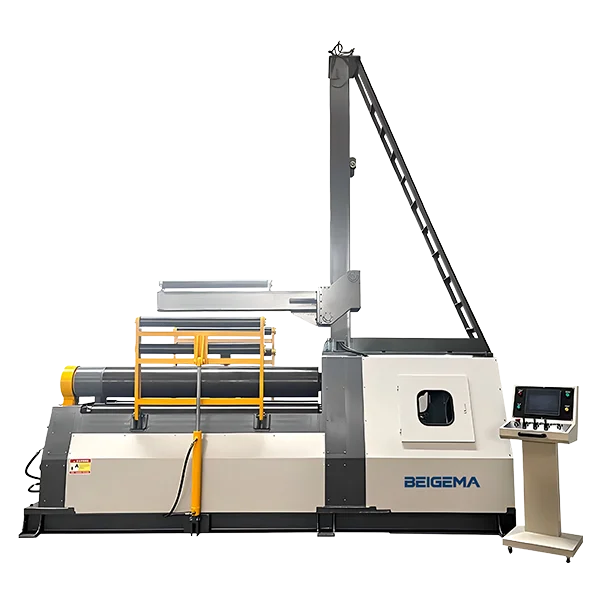
1. W11, W11S and W12: Three Architectures Behind One Capacity Chart
The three series aren’t different sizes of the same machine; they’re different roll arrangements. The W11 3-roll symmetrical plate rolling machine keeps its lower rolls fixed and drives the top roll down onto the plate — BEIGEMA’s basic reference configuration, sold for carbon steel, stainless steel and alloy plate.
The W11S upper-roller universal plate bending machine holds its two lower rolls at a fixed center distance and puts the working pressure into a forged 42CrMo top roll with a deflection-compensation drum. Its page lists tank shells, pipe segments and chimney sections from 4-50 mm plate as typical jobs.
The W12 4-roller plate bending machine grips the plate between its top and bottom rolls and lets the two side rolls do the pre-bending and rolling. An HMI with a PLC numerical control system runs the cycle, and a valve station with multiple solenoid valves treats pre-bending, rolling and discharging as separately controlled movements.
Need angle steel or channel instead of flat plate? The W24S fully hydraulic profile bending machine bends angle, flat bar and pipe into arcs and rings, and sits outside the plate figures below.
Across their full tables, W11 runs 1500-3000 mm wide and 4-40 mm thick; W11S runs 2000-4000 mm wide and 4-50 mm thick; W12 runs 2050-3100 mm and 4-60 mm thick. No single model covers that whole range, which is why the chart below breaks each series down by tier.
2. Capacity Chart: Thickness and Width From 1500 mm to 3100 mm
The table lists seven representative models spanning the lightest and heaviest ends of each series. Power is the main roll-drive motor; the W11S also carries separate hydraulic and movement motors on its own product page.
| Model | Series | Max. bending thickness (mm) | Pre-bending thickness (mm) | Max. width / working length (mm) | Power (kW) |
|---|---|---|---|---|---|
| W11-4×1500 | W11 | 4 | not listed | 1500 | 4 |
| W12-4×2000 | W12 | 4 | 3.5 | 2050 | 3 |
| W11S-4×2500 | W11S | 4 | 3.5 | 2500 | 4 |
| W11-30×3000 | W11 | 30 | not listed | 3000 | 30 |
| W11-40×2500 | W11 | 40 | not listed | 2500 | 37 |
| W11S-50×2500 | W11S | 50 | 40 | 2500 | 55 |
| W12-60×3000 | W12 | 60 | 48 | 3100 | 75 |
The W11S and W12 rows carry two thickness numbers because the middle of the plate and the plate end don’t form the same way: the max. bending column is rated for the middle of the plate at the stated width and yield limit, while the pre-bending column states what the same model forms at the end — a lower number on every row of both tables. The W11 table prints no pre-bending column at all.
3. Light-Gauge Models: 4 mm Plate on 1500-2500 mm Beds
All three series start at 4 mm, and bed width usually decides the model at this gauge. The W11-4×1500 is the narrowest machine in the chart at 1500 mm, running a 5 m/min coiling speed on 4 kW. Step up to the W11-4×2000 and roller diameter grows from 150/140 mm to 160/150 mm to hold the same thickness rating over a wider bed.
For cylindrical parts, the W11S covers 4 mm at 2500 mm wide (the W11S-4×2500 row) on 25 tons of top-roller pressure and a 4 kW drive, and its page sizes this class for tank shells and pipe segments rather than flat panel work.
The W12 starts at the same 4 mm thickness on a 2050 mm working length (the W12-4×2000 row) at 3 kW, the lowest power figure in this chart’s light-gauge tier.
4. Heavy-Gauge Models: 40-60 mm Plate and Why the Roll Count Changes
Push the same three series to their thickest ratings and the numbers spread out fast. The W11-40×2500 tops out the 3-roll line at 40 mm and 2500 mm: a 500 mm top roller, 400 mm bottom roller, 600 mm central distance, 37 kW. The W11S-50×2500 goes further, 50 mm at 2500 mm, but needs 430 tons of top-roller pressure and a 55 kW drive plus a 22 kW hydraulic motor.
The W12-60×3000 sits above both: 60 mm max. bending thickness, 48 mm pre-bending, a 3100 mm working length and 75 kW, the highest thickness and power in the whole chart. At this gauge the 3-roll vs 4-roll plate rolling machine comparison matters more than the model name: with the plate gripped between the main rolls and two side rolls doing the forming, the heaviest-rated model in the catalogue is a W12, not a wider W11.
5. Matching Bed Width to the Part: 1500 mm vs 2000-4000 mm
Width caps differ by series, and the gap is bigger than most buyers expect. W11 tops out at 3000 mm, W12’s widest working length is 3100 mm, and only the W11S table reaches 4000 mm — four rows, from W11S-20×4000 up to W11S-40×4000, list that bed width.
At 4 mm the roll grows with the bed on both tables we can check: top roller diameter steps 150 to 160 mm on the W11 (1500 to 2000 mm wide) and 160 to 210 mm on the W12 (2050 to 3100 mm). Main power follows on the W12, 3 to 5.5 kW across those steps, while the two W11 rows both print 4 kW. Whether the target diameter is reachable at all is a roll-diameter question first — screen it with the minimum rolling diameter guide, then confirm on the model row, as the how to choose a plate rolling machine checklist walks through.
6. Material and Yield Strength: Why the Same Thickness Isn’t Always the Same Job
The W11 and W12 tables both state a 245 MPa yield limit as their reference basis, and the W11 page lists carbon steel, stainless steel and alloy plate as its materials. A stainless grade with a higher yield strength than that 245 MPa basis needs a lower actual thickness to roll the same way, even on the identical model.
When you compare quotations, ask for the reference yield strength behind each capacity figure and how the proposed row is derated for your grade and width.
Plate Rolling Machine Capacity Chart FAQs
What’s the difference between max. bending thickness and pre-bending thickness?
Max. bending thickness is rated for the middle of the plate at the stated width and yield limit. Pre-bending thickness is what the same model forms at the plate end, where the forming conditions differ — that’s why the W11S and W12 tables print a second, lower figure on every row, and the W11 table prints none.
How do I compare two supplier quotes for the same W12 model?
Ask both suppliers to quote against the identical row in the spec table: same thickness, same width, same yield-strength basis. Compare control panel, roller material and pre-bending thickness separately, since those can differ even when max. thickness and width match, then confirm the full configuration in the signed technical quotation.
Can a one-pass pre-bending claim be verified before ordering?
Check the claim against the model’s own pre-bending thickness column for the plate width in question, and ask the supplier to state the reference yield strength the table is built on. A capability beyond the table’s listed pre-bending thickness for that width should be confirmed in writing, not assumed from a general one-pass description.
Which models cover a 3000 mm-wide plate?
W11 lists a 3000 mm width on its widest rows, W12’s widest working length is 3100 mm under the model code ending in 3000, and W11S goes further to a 4000 mm bed on its heaviest rows. Check the thickness column at that width before assuming the same power figure carries over from a narrower model.
Send your plate thickness, width and material grade through contact us; we recommend checking the reply against the exact model row in this chart before ordering.
Related pages
Related guides
- 3-Roll vs 4-Roll Plate Rolling Machine: Which to Choose?
- What Determines Plate Rolling Machine Price for Buyers
- Minimum Rolling Diameter and Bending Radius by Material
- Cone Rolling on a Plate Roll: How to Form Tapered Sections
- How to Choose a Plate Rolling Machine: Thickness, Width and Roll Diameter
- Plate Roll Maintenance Checklist: Daily, Weekly, Monthly and Yearly
- Plate Rolling Defects: Ovality, Springback, Misalignment and Surface Marks
- Plate Roll Pre-Bending: Why Cylinders Have Flat Ends and How to Fix Them


