
Plate rolling machine types differ by how the rolls are arranged and moved, not by the thickness figure on the nameplate: a sheet metal roller, plate roll or roll bending machine all name the same group. BEIGEMA’s catalogue covers the mechanical W11 symmetrical 3-roll (4-40 mm), the hydraulic W11S upper-roller universal 3-roll (4-50 mm) and W12 4-roll (4-60 mm), plus the W24S and WYQ24 machines that bend angle, channel, flat bar and pipe instead of flat plate. Hand-cranked slip rolls are bench tools outside this product line.
Browse the current plate rolling machine category for the full sheet metal rolling equipment list before comparing configurations below.
1. Manual Sheet Metal Rollers (Slip Rolls): the Boundary of the Range
A sheet metal slip roller — hand-cranked, sized by roll length rather than a thickness or tonnage rating — pinsches thin-gauge sheet into a curve one part at a time. These manual sheet metal rollers are not part of the BEIGEMA product line; powered plate work starts with the W11, W11S and W12 tables below.
2. 3-Roll Symmetrical Plate Rolling Machines (W11): Mechanical and Fixed-Geometry
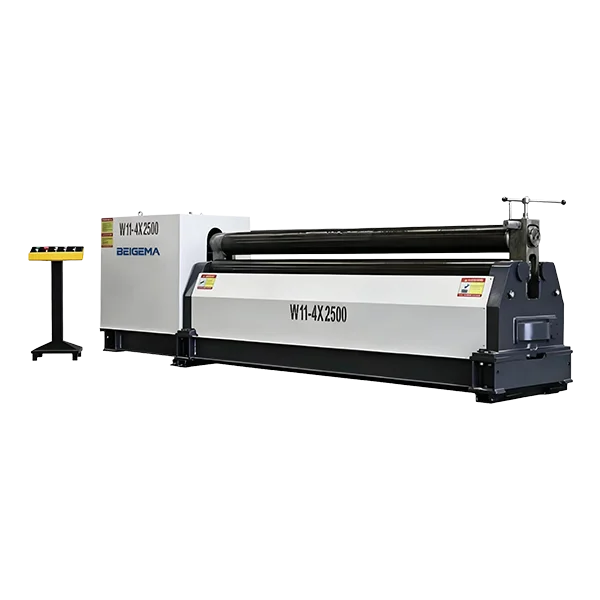
The W11 is a mechanical symmetrical 3-roll plate rolling machine: fixed lower rolls carry and drive the plate while the top roll drives down to set the bend, and a manual screw-and-slider mechanism opens the support seat for fast unloading. The page text says it completes pre-bending, rolling and rounding on carbon steel, stainless steel and alloy plate, but its parameter table prints no separate pre-bending thickness column, unlike the W11S and W12 below. BEIGEMA’s own W12 page links back to it as the economical W11 3-roll plate rolling machine.
The table runs 4-40 mm bending thickness and 1500-3000 mm width, rated at 245 MPa yield limit, with top roller diameter 150-500 mm, coiling speed 4-5 m/min and main power 4-37 kW.
Who should buy one: shops rolling carbon or stainless plate to 40 mm in a simpler, lower-cost mechanical frame. See the W11 3-roll plate rolling machine for the full model table.
3. Upper-Roller Variable-Geometry Plate Rolling Machines (W11S): Pre-Bending and Cone Work
The W11S is an upper-roller universal plate bending machine: the two lower rolls are synchronously driven at a fixed center distance, while the upper roll — forged from 42CrMo alloy steel with a deflection-compensation drum — supplies the main pressure. The page lists tank shells, pipe segments and chimney sections from 4-50 mm plate as its typical jobs, and every row pairs a bending thickness with a lower pre-bending thickness, so the flat end and the body are covered by one table.
Its table lists top-roller pressure 25-540 tons, bending thickness 4-50 mm, pre-bending thickness 3.5-40 mm, width 2000-4000 mm and drive power 4-55 kW. Cone work belongs to an optional taper device, which the W11S page itself lists as not standard; the cone rolling guide covers setup and limits.
For a cone or a specific cylinder, state plate grade, width, thickness and required finished diameter together; a thickness figure alone doesn’t confirm capacity. Details are on the W11S upper-roller universal plate bending machine page.
4. 4-Roll Plate Bending Machines (W12): One-Pass Pre-Bending and Hydraulic Unloading
The W12 4-roller plate bending machine adds a top roll, a bottom roll and two side rolls in 42CrMo alloy steel that the page describes as tempered and surface hardened. A hydraulic valve station with multiple solenoid valves independently controls pre-bending, rolling and discharging movements, and the page presents the plate as pre-bent and rolled in one pass with its integrated edge pre-bending function. Control is an HMI with a PLC numerical control system.
The table runs 4-60 mm bending thickness with 3.5-48 mm pre-bending thickness, working length 2050-3100 mm and 245 MPa yield limit; top roller diameter spans 160-670 mm and main power 3-75 kW, the heavy plate rolling end of these three series. For unloading, the bearing seat rotates outward 90° so the finished cylinder pushes out along the roller axis without hoisting; a mechanical and hydraulic double interlock blocks throw-out during winding.
Who should buy one: shops that need a pre-bent, flat-end cylinder in one setup, plate heavier than the W11 covers, or the interlock protection. See the W12 4-roller plate bending machine page and the 3-roll vs 4-roll plate rolling machine comparison for the full mechanism breakdown.
5. Profile and Section Bending Machines (W24S/WYQ24): Angle, Channel, Flat Bar and Pipe
A plate rolling machine bends flat sheet; a profile or section bending machine bends stock that already has a cross-section — the W24S page names angle steel, flat bar, pipe and other profiles formed into arcs and rings, with guide rolls that prevent twisting. The table runs W24S-6 to W24S-500, with channel size 8-50 and section sizes from 40×5 mm up to 500×76 mm on the largest frame; the same category holds the semi-hydraulic WYQ24. A box section bender belongs here too, sized to the section rather than a sheet thickness. The profile bending machine guide covers this class in detail.
6. Compare Plate Roller Capacity: Table and Buying Guidance
Evidence first: the table below pulls bending thickness, pre-bending thickness, width, roll diameter and power from each series’ own range; “not listed” means that series doesn’t print the column.
| Series | Mechanism | Bending thickness (mm) | Pre-bending thickness (mm) | Width (mm) | Top roller diameter (mm) | Main power (kW) |
|---|---|---|---|---|---|---|
| W11 3-roll | Mechanical, fixed lower rolls | 4–40 | not listed | 1500–3000 | 150–500 | 4–37 |
| W11S upper-roller | Hydraulic, variable geometry | 4–50 | 3.5–40 | 2000–4000 | 200–630 | 4–55 |
| W12 4-roll | Hydraulic, 4-roll | 4–60 | 3.5–48 | 2050–3100 | 160–670 | 3–75 |
The W11 tops out at 40 mm while the W11S and W12 reach further, to 50 mm and 60 mm; only the W11S and W12 print a separate pre-bending thickness column, so a one-pass flat end is a hydraulic-line feature in this catalogue. So which type do you buy?
- Batch plate to 40 mm in a simple mechanical frame: the W11 3-roll.
- Tank shells, pipe segments or chimney sections from 4-50 mm plate with pre-bending: the W11S upper-roller.
- Heavier plate to 60 mm, one-pass pre-bend plus hydraulic unloading: the W12 4-roll.
- Angle, channel, flat bar or pipe instead of flat plate: the W24S or WYQ24 profile bender.
Run the material, thickness and target diameter through the how to choose a plate rolling machine guide for the full checklist, and the model-row numbers behind this table through the plate rolling machine capacity chart.
Plate Rolling Machine Types FAQs
Can a plate rolling machine be set up for cone rolling in stainless steel?
On the W11S the taper device is optional and listed as not standard, so cone capacity is a configuration question, not a thickness-column fact. Give the plate grade, width, thickness and required finished diameter together, and state whether cone rolling is needed, so the job is confirmed against a specific row.
Should angle, channel or flat bar be bent on a profile bending machine or a plate rolling machine?
A plate rolling machine forms flat sheet and plate; angle steel, flat bar, channel and pipe go to a profile or section bending machine such as the W24S, whose guide rolls prevent twisting as the pre-formed cross-section is bent into arcs and rings. Batch size doesn’t change this — roll count on a plate machine doesn’t change what shape of stock it accepts.
How can a one-pass pre-bending claim for 20 mm plate be verified?
Check the pre-bending thickness column against that row’s bending thickness, not the model name alone. On the W12 table, 20 mm of pre-bending thickness is listed on the 25 mm-bending-thickness rows, not the 20 mm rows, so a 20 mm one-pass pre-bend claim should point to a 25 mm-class model. Ask the supplier to name the exact row.
How can a no-twist claim for long profile or guide-rail sections be validated?
A catalog table doesn’t confirm behavior on one specific long section. Request a trial bend using the buyer’s actual profile, length and material, then measure twist and straightness over the full length before accepting the claim.
Send the plate or profile type, thickness, width and target diameter through the BEIGEMA contact page, and we’ll point to the model row that fits.
Related pages
Related guides
- Plate Rolling Machine Capacity Chart: Thickness, Width and Power by Model
- 3-Roll vs 4-Roll Plate Rolling Machine: Which to Choose?
- What Determines Plate Rolling Machine Price for Buyers
- Minimum Rolling Diameter and Bending Radius by Material
- Cone Rolling on a Plate Roll: How to Form Tapered Sections
- How to Choose a Plate Rolling Machine: Thickness, Width and Roll Diameter
- Plate Roll Maintenance Checklist: Daily, Weekly, Monthly and Yearly
- Plate Rolling Defects: Ovality, Springback, Misalignment and Surface Marks

