
A small press brake is a compact bending machine for light-gauge and short-to-medium parts, not a scaled-down promise that every job fits. The term covers manual folding tools and powered press brakes, so first decide which side of that boundary your work sits on. The buyer sequence is simple: define the part envelope, match it to a published model row, confirm floor and power, then lock options and acceptance.
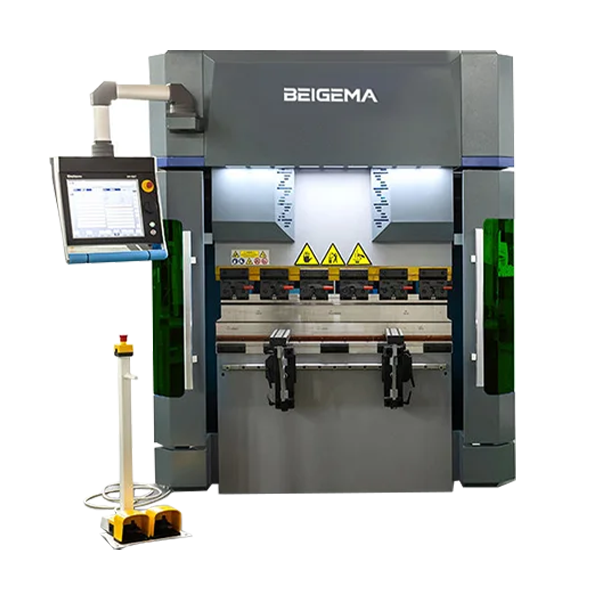
What a small bending brake is, and what it isn’t
A small bending brake bends sheet by pressing a punch into a die. Manual folders and benchtop benders move a beam by hand; powered press brakes move a ram with hydraulic or electric drive and usually add back gauges and controllers. The catalog rows below are powered machines. A manual folder can suit thin, short, low-volume work, but it is not a substitute for a powered press brake when you need repeatable back-gauge positioning, controlled ram speed, or consistent angle over a batch.
The mixed intent behind the phrase matters. Some buyers want a benchtop manual tool; others want the smallest industrial press brake they can power and fit. The first screen should answer that split: if your part needs a controlled stroke, a back gauge, and a controller, look at the powered rows.
Do not treat tonnage as a universal capacity rating. The published force is a catalog figure for the machine frame and drive, not a statement that any tool can safely bend any material at that force. Tool load limits, die opening, material strength, and part geometry all interact. Use the Press Brake Tonnage Chart: Model and Bed-Length Catalog and press brake tonnage calculator as starting references, then confirm the actual tool set and material with the seller.
Small press brake models from 35 to 63 tons: one table for three series
The table below collects the small rows from the pure electric, WC67K NC hydraulic, and MB8 CNC hydraulic series. It is a catalog comparison, not a claim that every row suits every workshop. Read the drive and control column first, then the bed length and throat depth. The pure electric rows use all-electric CNC; the WC67K rows use hydraulic drive with E21 NC; the MB8 rows use hydraulic drive with Delem DA-66S CNC.
| Model | Pressure (kN) | Bed length (mm) | Throat depth (mm) | Stroke (mm) | Drive and control | Main motor (kW) | Weight |
|---|---|---|---|---|---|---|---|
| Pure electric 35T 1350 | 350 | 1350 | 200 | 180 | All-electric, CNC | 2*8.6 | 4000 kg |
| Pure electric 50T 1650 | 500 | 1650 | 300 | 200 | All-electric, CNC | 2*16 | 4800 kg |
| Pure electric 63T 2050 | 630 | 2050 | 300 | 200 | All-electric, CNC | 2*21 | 6300 kg |
| Pure electric 63T 2500 | 630 | 2500 | 300 | 200 | All-electric, CNC | 2*21 | 6800 kg |
| WC67K 40/2200 | 400 | 2200 | 200 | 100 | Hydraulic, E21 NC | 4 | not listed |
| WC67K 40/2500 | 400 | 2500 | 200 | 100 | Hydraulic, E21 NC | 4 | not listed |
| WC67K 50/2500 | 500 | 2500 | 200 | 100 | Hydraulic, E21 NC | 5.5 | not listed |
| WC67K 63/2500 | 630 | 2500 | 250 | 100 | Hydraulic, E21 NC | 5.5 | not listed |
| WC67K 63/3200 | 630 | 3200 | 250 | 100 | Hydraulic, E21 NC | 5.5 | not listed |
| MB8 63T/1300 | 630 | 1300 | 350 | 100 | Hydraulic, Delem DA-66S CNC | 5.5 | 5.8 T |
| MB8 63T/2500 | 630 | 2500 | 350 | 170 | Hydraulic, Delem DA-66S CNC | 5.5 | 5.8 T |
Source links for the rows above: pure electric press brake, WC67K NC press brake with E21 controller, and MB8 CNC press brake with DA-66S. The broader press brake machine category shows the full range.
Two rows share the same tonnage and bed length but differ in drive and control. That is the practical decision point for many buyers.
Small electric press brake or small hydraulic press brake?
The electric row uses servo motors and a CNC controller. The catalog describes all-electric drive, CNC control, and a published motor figure that is split across two values. The hydraulic rows use a main motor and hydraulic valve system. The choice is not about which is modern; it is about duty cycle, available power, noise, and service access.
An electric machine may suit a shop that wants to avoid hydraulic oil and prefers servo response. A hydraulic machine may suit a shop with existing hydraulic service and a preference for a familiar drive. The catalog does not state that one is more accurate than the other across all parts. Confirm the controller, axes, and included tooling for the exact row you select. The press brake controller comparison helps separate NC and CNC features.
For a like-for-like look at the 63-ton, 2500 mm class, the table below compares the WC67K, MB8, and pure electric rows on published fields only. Where a field is not listed, it is not zero; it is unconfirmed in the catalog.
| Published field | WC67K 63/2500 (E21 NC) | MB8 63T/2500 (DA-66S CNC) | Pure electric 63T 2500 |
|---|---|---|---|
| Pressure (kN) | 630 | 630 | 630 |
| Bed / bending length (mm) | 2500 | 2500 | 2500 |
| Column distance (mm) | not listed | 1900 | 2000 |
| Throat depth (mm) | 250 | 350 | 300 |
| Ram / slider stroke (mm) | 100 | 170 | 200 |
| Max opening height (mm) | not listed | 380 | 470 |
| X-axis travel (mm) | not listed | 500 | 600 |
| R-axis travel (mm) | not listed | not listed | 200 |
| Back stoppers (pcs) | not listed | 2 | not listed |
| Strokes per minute | 10 | not listed | not listed |
| Bending / return speed (mm/s) | not listed | not listed | 0-30 / 200 |
| Main motor (kW) | 5.5 | 5.5 | 2*21 |
| Average power (kW) | not listed | not listed | 2.7 |
| Length × width × height (mm) | not listed | 3100×1450×2050 | 3260×1380×2505 |
| Weight | not listed | 5.8 T | 6800 kg |
Use the How to Choose a Press Brake: RFQ and FAT Checklist guide to frame the drive and control decision before you request a quote.
Floor space and weight of a compact press brake
Footprint is often the first hard constraint in a small shop. The published length, width, and height give a planning envelope, but they do not include clearance for the operator, material feed, or back-gauge travel. Add working space around the machine and confirm the actual shipping dimensions with the seller. Weight matters for floor loading and for lifting at delivery.
| Model | Length × width × height (mm) | Weight | Column distance (mm) | Opening (mm) | X-axis travel (mm) |
|---|---|---|---|---|---|
| Pure electric 35T 1350 | 2280×1220×2200 | 4000 kg | 900 | 430 | 400 |
| Pure electric 50T 1650 | 2280×1320×2230 | 4800 kg | 900 | 470 | 400 |
| Pure electric 63T 2050 | 2960×1380×2485 | 6300 kg | 1700 | 470 | 600 |
| Pure electric 63T 2500 | 3260×1380×2505 | 6800 kg | 2000 | 470 | 600 |
| MB8 63T/1300 | 3100×1450×2050 | 5.8 T | 1950 | 340 | 500 |
| MB8 63T/2500 | 3100×1450×2050 | 5.8 T | 1900 | 380 | 500 |
The pure electric 35T 1350 row is the smallest press brake BEIGEMA publishes, and its published footprint is the starting point for tight layouts. The MB8 63T rows share a published footprint even though their bed lengths differ, so do not assume that a longer bed always means a larger floor plan. Confirm the shipping configuration, because a machine may be split or skidded differently for transport.
Power supply is a separate check. The catalog lists main motor figures, but it does not state the required supply voltage, phase, or breaker size for every row. Those are configuration details to confirm with the seller. Do not size a supply from the motor figure alone.
Which thickness and length a small bending brake handles
Thickness and length are linked to tonnage, die opening, and material strength. The catalog rows give pressure and bed length, but they do not publish a qualified thickness for every material. A 35-ton row may bend a certain thickness in mild steel with a given die, but the same row will behave differently with stainless or high-strength steel. Do not apply an arbitrary derating factor from this article; ask the seller to confirm the material, thickness, and tool set against the selected row.
Length is bounded by the bed and by the part geometry. A machine with a longer bed can accept a longer blank, but the published column distance and throat depth also affect what can be positioned. For long parts, consider whether a single machine or a tandem press brake for long plate bending is the right configuration. Tandem machines are a separate category, not a standard option on the small rows.
Use the tonnage chart and calculator to screen a candidate part, then send the drawing for a real check. The calculator is a reference, not a substitute for the seller’s confirmation of tool load and machine capacity.
Options to confirm on a small metal bending brake
Configurable equipment is not the same as standard inclusion. The catalog lists standard components for each series, but the exact set for your machine must be confirmed in the signed technical quotation. Separate the two lists before you compare prices.
Standard inclusions named in the product extracts include the controller, back gauge, hydraulic valve, main motor, electrical components, foot switch, clamps, punch and die, and compensation type for the relevant series. Optional parts named for the electric series include a back gauge stop finger, laser safety, and sheet follower.
Ask the seller to confirm the controller model, number of axes, back-gauge travel, tooling set, crowning type, safety devices, and any interface or software license. If a value is not in the catalog, record it as unconfirmed rather than assuming a default. The controller comparison is a useful reference for controller families, but the final configuration belongs in the quotation.
Buyer inputs and seller confirmations
A useful inquiry starts with the part, not the machine. Supply the drawing, material grade, thickness, bend length, bend radius, and the required angle. State the largest and smallest parts, the batch size, and whether you need a back gauge or manual positioning. If you do not know a value, write it as unconfirmed; do not fill it with a guess.
The seller should confirm the model row, drive and control, published geometry, tooling, options, power supply, shipping dimensions, and acceptance method. The seller should also state what is excluded. A quotation that lists only the machine price without the tooling and options is incomplete for comparison.
Use the send the drawing link to start the technical review, and request a small-press-brake quote with your drawings when you are ready to compare configurations. The BEIGEMA press brake range gives the wider context, but keep the inquiry focused on the small rows.
Acceptance part and blank records
An acceptance part demonstrates that the machine and tooling can produce the agreed geometry. Choose a part that represents your real work, not a simple test strip. Record the material, thickness, bend length, angle, and any critical dimension. The seller should confirm the acceptance procedure and the inspection method in the quotation.
Use the blank record below to capture what is known and what is not. An em dash means unconfirmed, not zero. Fill it in as the seller confirms each item.
| Record field | Buyer entry | Seller confirmation |
|---|---|---|
| Part drawing number | — | — |
| Material grade | — | — |
| Thickness | — | — |
| Bend length | — | — |
| Required angle | — | — |
| Tool set | — | — |
| Controller and axes | — | — |
| Power supply | — | — |
| Shipping dimensions | — | — |
| Acceptance method | — | — |
| Floor layout and working clearances | — | — |
| Transport route and lifting plan | — | — |
| Maximum workpiece envelope | — | — |
| Changeover frequency and tooling plan | — | — |
Small Bending Brake FAQs
Does compact mean light? Not necessarily. The published weight of a compact row can still be several tonnes. Check the weight column and the lifting plan. Compact refers to the working envelope, not to a guarantee of low weight.
Can a 35-ton row cover a specific part? Only after the material, thickness, bend length, and tool set are checked against the row. The catalog gives pressure and bed length, but it does not qualify every part. Send the drawing and let the seller confirm.
What limits long work? Bed length, column distance, throat depth, and back-gauge travel all matter. A longer bed does not automatically mean a longer part can be positioned. For long plates, ask about a tandem configuration as a separate category.
What are the configuration and delivery boundaries? Standard inclusions, options, controller, tooling, power supply, and shipping configuration must be confirmed in the signed quotation. Delivery terms are commercial terms, not catalog specifications. Confirm them with the seller before you commit.
For a final check, compare the selected row against the Press Brake Tonnage Chart: Model and Bed-Length Catalog, review the controller comparison, and send the drawing through the contact page. The goal is a machine that fits the part and the floor, with every open item recorded before the order.
Related selection reference: press brake controller comparison. The WC67K NC press brake with E21 controller provides the supplier specification behind the shortlist.
Compare BEIGEMA metal pressing machines against this job brief, then send your small press brake requirements for a configuration review.
For factory specification sheets and controller configurations across this machinery series, compare our WC67K Series NC Hydraulic Press Brake Machine With TP10S Controller System, WC67K Series NC Hydraulic Press Brake Machine With E310P Controller System.
Related pages
Related guides
- Press Brake Types: Choose by Part and Production
- Press Brake Tonnage Chart: Model and Bed-Length Catalog
- Press Brake Tonnage Chart: V-Die Opening, Material and Force
- Press Brake Tooling: European, American and New-Standard Systems Compared
- Bend Allowance and Bend Deduction for Accurate Flat Patterns
- Hemming, Gooseneck and Special Press Brake Tooling
- Press Brake Operation from Setup to First Part Inspection
- Press Brake Safety and Safeguarding
Machines this guide applies to
- MB8 Series CNC Hydraulic Press Brake Machine with DA-53Tx 4+1 Axis
- MB8 SERIES CNC HYDRAULIC PRESS BRAKE MACHINE WITH DA66S 6-8 AXIS
- MB8 SERIES CNC HYDRAULIC PRESS BRAKE MACHINE WITH DA69S 6-8 AXIS
- Pure Electric Press Brake Bending Machine
- Tandem Press Brake Machine for Long Plate Bending
- WC67K Series NC Hydraulic Press Brake Machine With E21 Controller System
- WC67K Series NC Hydraulic Press Brake Machine With E310P Controller System
- WC67K Series NC Hydraulic Press Brake Machine With TP10S Controller System