
A plate rolling machine capacity chart is a starting filter, not a purchase decision. The chart tells you which catalog rows might fit your part; it does not prove that a machine can form your material, your diameter, or your pre-bend. Buyers should move in a fixed sequence: define the part, check the row, separate pre-bend from rolling, confirm the minimum diameter, and ask the seller to verify every blank or unlisted value. That sequence prevents a common error — choosing a machine because the nominal thickness matches, then discovering the width, yield strength, or pre-bend requirement does not.
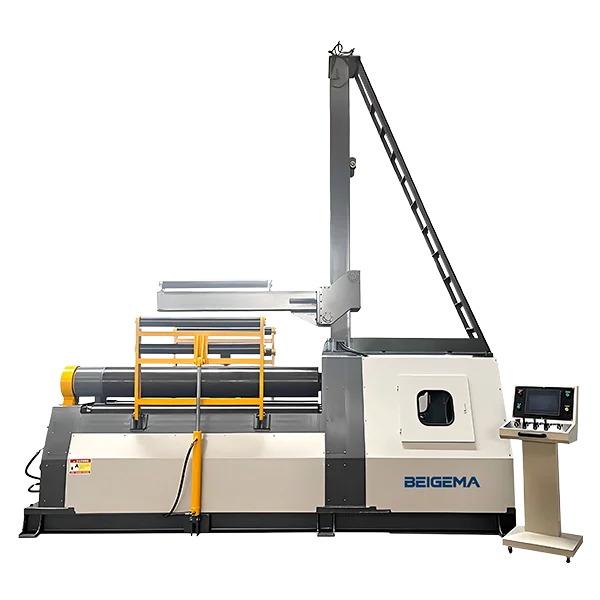
The chart below is a catalog summary. It is useful for orientation, but it is not a universal application promise. Where a cell says “not listed,” the value is unknown from the chart. Unknown means unconfirmed, not zero. The seller must confirm it in the quotation.
W11, W11S and W12: Three Architectures Behind One Capacity Chart
The three series share a capacity chart but not a forming architecture. The W11 3-roll symmetrical plate rolling machine uses a mechanical symmetrical layout with fixed lower rolls and a top roll drive. Its catalog description covers pre-bending, rolling and rounding for carbon steel, stainless steel and alloy plates. The W11S upper-roller universal plate bending machine adds dual-axis adjustment of the upper roller, which the catalog describes as enabling one-time forming without straight edges and supporting U-shaped, multi-segment and tapered work. The W12 4-roller plate bending machine uses a four-roll hydraulic layout with an integrated edge pre-bending function and a PLC control system.
Those differences matter at the selection stage. A three-roll symmetrical machine and a four-roll machine may both appear under the same nominal thickness, yet their pre-bend behavior, edge support and unloading method differ. The 3-roll vs 4-roll plate rolling machine comparison is the right place to study that trade-off before reading the chart row as an interchangeable specification.
| Model | Series | Max. bending thickness (mm) | Pre-bending thickness (mm) | Max. width / working length (mm) | Power (kW) |
|---|---|---|---|---|---|
| W11-4×1500 | W11 | 4 | not listed | 1500 | 4 |
| W12-4×2000 | W12 | 4 | 3.5 | 2050 | 3 |
| W11S-4×2500 | W11S | 4 | 3.5 | 2500 | 4 |
| W11-30×3000 | W11 | 30 | not listed | 3000 | 30 |
| W11-40×2500 | W11 | 40 | not listed | 2500 | 37 |
| W11S-50×2500 | W11S | 50 | 40 | 2500 | 55 |
| W12-60×3000 | W12 | 60 | 48 | 3100 | 75 |
Catalog links for the rows above: W11 3-roll symmetrical plate rolling machine, W11S upper-roller universal plate bending machine, and W12 4-roller plate bending machine. The broader Plate Rolling Machine Types: Feed, Prebend and Unload explains how the families differ in roll count and control.
Capacity Chart: Thickness and Width From 1500 mm to 3100 mm
The chart spans a wide working range. Light rows sit at a narrow bed and modest thickness; heavy rows move to a wider bed and a much larger drive. Working length runs along the roll axis: it limits the plate width that becomes the shell axial length. The developed length feeds around the rolls to form the circumference and is a separate dimension. Confirm usable working width and feed handling independently.
Read the chart in columns, not as a single number. The thickness column describes the maximum bending thickness under the catalog condition. The pre-bending column, where present, is a separate value and is often lower. The width column describes the maximum working length.
For a first filter, match the part width to the working length and the part thickness to the bending column. Then check whether the part needs pre-bending. If the chart shows no pre-bend value for that row, the pre-bend capability is unconfirmed and must be quoted.
Light-Gauge Models: 4 mm Plate on 1500-2500 mm Beds
The light rows are the entry point for thin sheet and small tanks. A four-millimeter part on a fifteen-hundred-millimeter bed is a different job from a four-millimeter part on a twenty-five-hundred-millimeter bed, even when the thickness column looks the same. The wider bed increases the span and changes the roll geometry, so the buyer should not treat the two rows as interchangeable.
At this gauge, the part diameter often controls the choice more than the thickness. A small-diameter cylinder needs a roll arrangement that can close the curvature without interference. The minimum rolling diameter guide explains why the smallest diameter is a separate confirmation, not a chart column. The buyer should supply the target inside diameter, the target outside diameter, and the straight-edge allowance, then ask the seller to confirm the minimum diameter for that row.
Light-gauge work also exposes the pre-bend question. A thin shell with a visible flat spot at the seam may need a pre-bend that the rolling column does not describe. If the chart lists no pre-bend value, write “to be confirmed” in the record and ask for a quotation note.
Heavy-Gauge Models: 40-60 mm Plate and Why the Roll Count Changes
The heavy rows move into a different class of machine. A forty-millimeter part on a twenty-five-hundred-millimeter bed and a sixty-millimeter part on a three-thousand-millimeter bed are not scaled-up light machines. The roll diameters, drive power and frame stiffness change, and the pre-bend value becomes a separate limit that the buyer must read from the row or request from the seller.
Roll count changes the forming sequence. A three-roll machine forms the curve with a top roll and two lower rolls; a four-roll machine adds side rolls that support the edge and can pre-bend in the same setup.
Heavy plate also makes the material question sharper. The same nominal thickness in a higher-yield steel is not the same job as the chart row’s catalog condition. The chart does not publish a derating table, and the buyer should not invent one.
Matching Bed Width to the Part: 1500 mm vs 2000-4000 mm
Bed width is a part-fit decision. Working width limits shell axial length, while diameter depends on the roll geometry and the application. Confirm working width, target diameter and handling support separately. The chart’s working length is the catalog maximum, not a guarantee that every part up to that length can be formed at every thickness.
The buyer should measure the part in three ways: the flat pattern length before rolling, the finished circumference, and the axial length of the shell. The plate width along the roll axis must fit the usable working length. Its developed circumferential length feeds through the machine; confirm feed space, end preparation and supports separately.
Width also interacts with handling. A long shell needs support at both ends during rolling and unloading. The catalog may list optional support devices, but the buyer should confirm whether side support, upper support or a feeding table is standard or optional for the specific row.
Material and Yield Strength: Why the Same Thickness Isn’t Always the Same Job
The chart’s thickness column is tied to a catalog condition, often a yield limit shown in the full product table. That condition is not a universal pass for every steel. A higher-yield material resists bending more, so the same thickness can require more force or a different roll setting. The chart does not publish a derating factor, and the buyer should not apply one without the seller’s confirmation.
Material also affects springback, edge condition and surface finish. Stainless steel and alloy plate may need different roll preparation or a different pre-bend allowance. The catalog describes the W11 series as suitable for carbon steel, stainless steel and alloy plates, but that is a series description, not a part-specific approval.
When the material is unknown, the record should say “to be confirmed,” not “standard.” That distinction keeps the quotation honest. A machine selected on an assumed material may pass the chart filter and fail the acceptance part.
What the Buyer Supplies and What the Seller Confirms
The buyer supplies the part definition: material grade, yield strength, thickness, width, target diameter, straight-edge allowance, surface requirement and any cone or taper requirement. The buyer also supplies the operating context: available floor space, power supply, lifting capacity and whether the machine will run one shift or continuous production. These facts let the seller map the part to a row instead of guessing.
The seller confirms the row against the part. That confirmation should cover the bending thickness, the pre-bend thickness, the working length, the minimum diameter, the yield condition and the included tooling.
The acceptance part demonstrates the match. A short trial piece at the target thickness, width and diameter shows whether the machine can form the part with the agreed pre-bend and seam quality. The acceptance part is not a substitute for the manual, and it does not prove every future part.
Selection Record: Same Nominal Thickness Does Not Mean Interchangeable
Use a record like the one below to keep the unknowns visible. The em dash means unconfirmed, not zero. Fill each row from the quotation, not from memory.
| Record field | Buyer entry | Seller confirmation |
|---|---|---|
| Part name / drawing number | — | — |
| Material grade | — | — |
| Yield strength at forming temperature | — | — |
| Nominal thickness | — | — |
| Finished width / axial length | — | — |
| Target inside diameter | — | — |
| Target outside diameter | — | — |
| Straight-edge allowance | — | — |
| Pre-bend required? | — | — |
| Pre-bend thickness confirmed | — | — |
| Rolling thickness confirmed | — | — |
| Minimum diameter confirmed | — | — |
| Cone or taper requirement | — | — |
| Standard inclusions | — | — |
| Configurable equipment | — | — |
| Acceptance part condition | — | — |
Two rows with the same nominal thickness can differ in pre-bend, minimum diameter, roll count and drive. The record forces those differences into the open before the order. If a field stays blank, the seller has not confirmed it, and the buyer should not treat the chart row as approved.
Rolling Sequence and Cone Positioning
The rolling sequence is a useful check on the chart row. Sheet feed brings the plate into the rolls. End preparation and pre-bend set the leading and trailing edges. Rolling forms the curve. Unloading removes the shell. A four-roll machine may combine pre-bend and rolling in one setup, while a three-roll symmetrical machine may need a separate pre-bend step. The chart does not describe the sequence, so the buyer should ask the seller to confirm it for the chosen row.
Cone positioning is a separate confirmation. The catalog lists a cone bending device as optional for some series, and the taper capacity is described as a fraction of the cylinder capacity. That fraction is a catalog description, not a universal rating.
Plate Rolling Machine Capacity Chart FAQs
Does a full-width rating apply to a narrow plate? Not automatically. The chart’s width column is a maximum working length, and the thickness column is tied to a catalog condition. A narrow plate may fit the bed, but the seller should confirm the thickness and pre-bend for that specific width and material. The row is a starting point, not a guarantee.
How do I find the minimum diameter? The chart does not publish it as a column. Supply the target inside and outside diameter, the thickness and the material, then ask the seller to confirm the minimum rolling diameter for the row. The minimum rolling diameter guide explains the variables.
Does yield strength change the row? Yes, it can. The chart’s thickness column is tied to a catalog yield condition, and a higher-yield material may need a different setting or a different row. The chart does not publish a derating table, so the seller must confirm the row against the actual yield strength.
Are pre-bend and rolling rated the same? No. Where the chart lists both, the pre-bend value is often lower than the rolling value. Where the chart lists no pre-bend value, the pre-bend capability is unconfirmed and must be quoted. Do not assume the two ratings are equal.
For a capacity review, send the part drawing, material data and target diameter through send your rolling specification for a capacity review. The how to choose a plate rolling machine guide and the plate rolling machine category page give the wider context. The W24S fully hydraulic profile bending machine is a separate family for profile work, not a substitute for plate rolling.
Related selection reference: Plate Rolling Machine Types: Feed, Prebend and Unload. The W11 3-roll symmetrical plate rolling machine provides the supplier specification behind the shortlist.
Compare BEIGEMA plate rolling machines against this job brief, then send your plate rolling machine capacity chart requirements for a configuration review.
Related pages
Related guides
- 3-Roll vs 4-Roll Plate Rolling Machine: Which to Choose?
- What Determines Plate Rolling Machine Price for Buyers
- Minimum Rolling Diameter and Bending Radius by Material
- Cone Rolling on a Plate Roll: How to Form Tapered Sections
- How to Choose a Plate Rolling Machine: Thickness, Width and Roll Diameter
- Plate Roll Maintenance Checklist: Daily, Weekly, Monthly and Yearly
- Plate Rolling Defects: Ovality, Springback, Misalignment and Surface Marks
- Plate Roll Pre-Bending: Why Cylinders Have Flat Ends and How to Fix Them