
Plate Rolling Machine Procurement: Three-Roll vs Four-Roll Guide
A plate rolling machine is bought against a part, not a brochure. The short answer: match the machine architecture to the workpiece path, the end preparation you can accept, and the cone or profile work you actually run. Then confirm every unknown with the seller before you sign.
Buyer decision sequence: define material and part envelope; decide whether straight ends are allowed; choose the roll architecture that fits the feed and unloading path; confirm cone or profile accessories as separate items; agree what the acceptance part must demonstrate; and record every unconfirmed value as an em dash until the seller answers in writing.
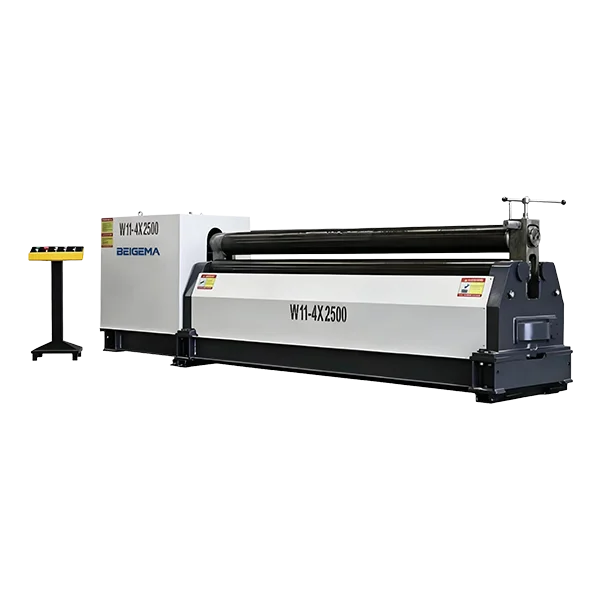
The BEIGEMA plate rolling machine category covers powered three-roll symmetrical, upper-roller universal, four-roll and profile bending families; manual slip rolls are outside the BEIGEMA range shown here. Each family changes how the sheet enters, how the edge is pre-bent, and how the finished shell leaves the rolls.
Manual Sheet Metal Rollers (Slip Rolls): the Boundary of the Range
Manual slip rolls are a separate light-duty category, outside the BEIGEMA product range shown here. The operator supplies the effort, so the practical boundary is set by sheet size, thickness and how often the shop rolls. A manual roller can be a sensible entry point for light cylindrical work, but it is not a substitute for a powered plate rolling machine when the part is long, thick or repeated.
For a powered alternative, ask the seller to review your material and width against the listed BEIGEMA models. Do not assume a manual roller shares the capacity of a powered machine with a similar roll diameter. Record the boundary as a confirmed figure or leave it blank.
3-Roll Symmetrical Plate Rolling Machines (W11): Mechanical and Fixed-Geometry
The W11 family is the fixed-geometry three-roll type. The lower rolls stay in place and the top roll drives down to set the bend. That simple structure is why it is common in small and medium shops. The W11 3-roll plate rolling machine page describes a mechanical symmetrical design with fixed lower rolls and a top roll that drives down.
Feed path: the sheet is presented to the rolls, the top roll is lowered to clamp, and the material is driven through. End preparation matters because the fixed geometry gives limited edge control.
Unloading on smaller W11 machines often uses a manual screw and slider to open the support seat, which lets the upper roll end release. That suits cylindrical parts with large diameter and long length, but it is a handling step the buyer must plan for.
Cone work on a fixed-geometry three-roll machine needs a cone bending device, and the positioning of that device must be confirmed against the cone angle and diameter. The cone rolling guide explains why the workpiece tends to migrate axially and why a stop or support is needed. Do not assume a standard W11 can roll a cone without the accessory.
Upper-Roller Variable-Geometry Plate Rolling Machines (W11S): Pre-Bending and Cone Work
The W11S changes the geometry. The upper roller moves vertically and horizontally, so its position relative to the lower rolls can be shifted. The W11S upper-roller universal plate bending machine page describes dual-axis adjustment and one-time forming without straight edges, plus U-shaped, multi-segment and tapered work.
Feed path: the sheet enters between the lower rolls and the upper roll, and the upper roll can be offset to bring the edge under pressure. That offset is what supports end pre-bending.
Cone positioning is the key difference. The W11S page lists a taper device as optional, not standard, installed at the outlet side with a rolling stopper to prevent axial movement. The catalog states a taper capacity relative to cylinder capacity.
Unloading on W11S can use a hydraulic drop end. Confirm whether the model you are buying includes it, because it changes how a closed shell leaves the machine.
4-Roll Plate Bending Machines (W12): One-Pass Pre-Bending and Hydraulic Unloading
The W12 is a four-roll hydraulic machine. The W12 4-roller plate bending machine page describes a diamond roll arrangement, with the lower roll rising to clamp the sheet against the upper roll, and side rolls feeding to pre-bend the edge. The catalog presents circular, chasing, cylindrical and arc rolling in one pass, with integrated edge pre-bending.
Feed path: the sheet is clamped between upper and lower rolls, the side rolls push the edge, and the sheet is rolled continuously. Because the side rolls handle the edge, the straight-end allowance is reduced compared with a fixed-geometry three-roll machine.
Unloading uses a hydraulic drop end: the bearing seat rotates outward so the upper roll end becomes a cantilever and the finished cylinder slides off. The page describes a mechanical and hydraulic double interlock and a balancing device.
Cone work on W12 uses a conical bending device, listed among the machine features. The positioning of that device and the cone size it supports must be confirmed with the seller. The 3-roll vs 4-roll plate rolling machine comparison is a useful cross-check on feed path and pre-bending, but it does not replace a model-specific confirmation.
Profile and Section Bending Machines (W24S/WYQ24): Angle, Channel, Flat Bar and Pipe
Profile bending is a different machine, not a plate roller with a different die. The W24S page describes three driven rolls with full hydraulic drive, guide rolls to prevent twisting, and interchangeable dies for angle, channel, I-beam, tube and flat bar. The profile bending machine guide explains the die and guide-roll logic.
A profile machine cannot replace a plate rolling machine for shell work, and a plate roller cannot replace a profile machine for angle or channel. The load path, the dies and the guide rolls are different.
Compare Plate Roller Capacity: Table and Buying Guidance
The table below is a catalog summary across the three-roll and four-roll families. It is a starting point for a shortlist, not a qualified capacity for your material. The Plate Rolling Machine Capacity Chart: Rating Boundaries and the how to choose a plate rolling machine guide give the row-level detail.
| Series | Mechanism | Bending thickness (mm) | Pre-bending thickness (mm) | Width (mm) | Top roller diameter (mm) | Main power (kW) |
|---|---|---|---|---|---|---|
| W11 3-roll | Mechanical, fixed lower rolls | 4–40 | not listed | 1500–3000 | 150–500 | 4–37 |
| W11S upper-roller | Hydraulic, variable geometry | 4–50 | 3.5–40 | 2000–4000 | 200–630 | 4–55 |
| W12 4-roll | Hydraulic, 4-roll | 4–60 | 3.5–48 | 2050–3100 | 160–670 | 3–75 |
Read the table by row, not by family headline. A W11 row and a W11S row with a similar bending thickness can differ in pre-bending thickness, roll diameter and power.
For a specific model, open the product page and read its own parameter table. The W11 3-roll plate rolling machine, W11S upper-roller universal plate bending machine and W12 4-roller plate bending machine pages each carry their own rows. Use the model code and its row when you filter, and do not retype ratings into a new claim.
Input, Process Limits and Options to Verify
The next table is a buyer record, not a catalog. Fill the right-hand column from the seller’s written answer. An em dash means unconfirmed, not zero.
| Family | Input the buyer supplies | Process limit to confirm | Option to verify | Confirmed value |
|---|---|---|---|---|
| W11 three-roll symmetrical | Material grade, sheet thickness, width, finished diameter, end allowance | Pre-bending thickness for the exact model; unloading method | Cone bending device; profile bending device; feeding table | — |
| W11S upper-roller universal | Material grade, sheet thickness, width, cone angle and diameter if any | Pre-bending thickness; taper capacity relative to cylinder work | Taper device with rolling stopper; hydraulic drop end | — |
| W12 four-roll | Material grade, sheet thickness, width, finished diameter, weld seam position | Pre-bending thickness; side-roll reach; drop-end clearance | Conical bending device; side support; upper support | — |
| W24S profile | Profile type, section size, bend radius, quantity | Section size per die; guide-roll setup | Interchangeable dies; PLC control | — |
Keep the record with the quotation. When the seller confirms a value, write it in the last column and date it. When the seller cannot confirm, leave the em dash and ask what information is missing.
What the Buyer Supplies and What the Seller Confirms
The buyer supplies the part definition: material grade, sheet thickness, width, finished diameter or profile, end allowance, weld seam position, cone angle if any, and the handling method at both ends of the machine. The buyer also states the available floor space and power supply, because a drop end and a cone device change the footprint.
The seller confirms the model row, the standard inclusions, the optional items, the unloading method, the control system, and the acceptance procedure. The seller should state which items are configurable equipment and which are standard.
For cone work, the seller confirms the device, the stopper position and the cone size the arrangement supports. For profile work, the seller confirms the die set and the guide-roll arrangement for the section.
What the Acceptance Part Demonstrates
The acceptance part should be the hardest representative part in the buyer’s range, not a convenient sample. It demonstrates the feed path, the end preparation, the rolling sequence and the unloading step. It also shows whether the cone device or profile die is set correctly for that part.
Agree the acceptance part before shipment. Record its material, thickness, width, finished diameter and end allowance. Record the inspection method and the deliverable. If the acceptance part is a cone, record the cone angle and the axial position of the stopper.
The acceptance part does not prove every part in the range. It proves the agreed part on the agreed machine. Keep the record with the machine file.
Plate Rolling Machine Types FAQs
Are the three-roll types the same mechanism? No. W11 is a fixed-geometry symmetrical three-roll machine with fixed lower rolls and a top roll that drives down. W11S is an upper-roller universal machine with dual-axis adjustment. They share a three-roll count but not the same mechanism, feed path or pre-bending behavior.
Can one clamping complete the part? On W12 the catalog describes one-pass pre-bending and rolling with a single clamping operation. On W11 the fixed geometry usually needs a separate pre-bending step, and the catalog does not list a pre-bending thickness. Confirm the sequence for your part rather than assuming one clamping is enough.
What does a cone configuration require? A cone bending device, a rolling stopper at the outlet side, and confirmation of the cone angle and diameter the arrangement supports. The W11S page lists the taper device as optional, not standard, and states a taper capacity relative to cylinder capacity. Confirm the device and the stopper position for your cone.
Can a profile machine replace a plate rolling machine? No. A profile machine bends angle, channel, flat bar and pipe with dies and guide rolls. A plate rolling machine forms sheet into shells. The load path and tooling are different, so plan for the machine that matches the part.
Related Procurement Links
Use the Shearing Machine Capacity Chart: Verify the Cutting Job when the same project also needs cutting, and keep the cutting and rolling records separate. For rolling, start from the plate rolling machine category, then open the model page for the row. The cone rolling guide and the 3-roll vs 4-roll comparison help frame the feed-path question. When the part is defined, share your plate and finished-cylinder dimensions with the seller so the confirmation is against your part, not a family headline.
Related selection reference: Shearing Machine Capacity Chart: Verify the Cutting Job. The W11 3-roll plate rolling machine provides the supplier specification behind the shortlist.
Compare BEIGEMA sheet metal machinery against this job brief, then send your plate rolling machine requirements for a configuration review.
Related pages
Related guides
- Plate Rolling Machine Capacity Chart: Rating Boundaries
- 3-Roll vs 4-Roll Plate Rolling Machine: Which to Choose?
- What Determines Plate Rolling Machine Price for Buyers
- Minimum Rolling Diameter and Bending Radius by Material
- Cone Rolling on a Plate Roll: How to Form Tapered Sections
- How to Choose a Plate Rolling Machine: Thickness, Width and Roll Diameter
- Plate Roll Maintenance Checklist: Daily, Weekly, Monthly and Yearly
- Plate Rolling Defects: Ovality, Springback, Misalignment and Surface Marks